
Job Opportunities
Pacific Battleship Center is the non-profit 501(c)(3) organization that operates the National Museum of the Surface Navy and the Battleship IOWA Museum as a platform for programs focused on education, veterans, and community. The mission of the Pacific Battleship Center is to inspire civic engagement through Education, Veterans, and Community efforts – our three core pillars. As a historic ship museum, we’re revolutionizing the way people experience history through multi-faceted programming including on-site and virtual programs. Located along the Los Angeles Waterfront in San Pedro, CA, the museum has built a diverse supporter base that is proud to support programs of the organization and honor the men and women of our sea services.
Learn more about our organization.
Working Environment
Pacific Battleship Center is a dynamic, high-spirited, tight-knit working environment of paid staff and dedicated volunteers with an unwavering committment to being the best. The team is passionate, transparent, hard-working, supportive, diverse and fun-loving which can feel very different from corporate environments. Your fellow teammates will be honest with feedback, yet incredibly supportive to help you learn and accomplish your goals. The organization is on a trajectory to rapidly expand over the next four years, which will open up additional positions and growth opportunities. Best of all, we work on a real battleship!
The job you’re interested in not available?
Click here to apply to become a volunteer.
Hint: we usually announce open jobs to the crew first!
Why volunteers are essential to Battleship IOWA
Why Volunteers Are Essential to Battleship IOWA
Battleship IOWA was built to be operated by a crew.
During active service, thousands of sailors worked throughout the ship to keep its machinery operating, its weapons ready, its spaces maintained, and its people fed, supplied, trained, and connected. Every system depended on someone knowing what to do and taking responsibility for doing it.
The ship no longer has a Navy crew of thousands, but it still depends on people.
Today, volunteers are central to the operation of Battleship IOWA and the broader mission of Pacific Battleship Center. They preserve historic spaces, welcome visitors, teach students, support veterans, restore equipment, stage events, maintain the vessel, and contribute across the organization.
In 2025, Pacific Battleship Center reported that volunteers had collectively surpassed 750,000 hours of service over more than twelve years.
The number is impressive. What matters even more is what those hours have made possible.
Battleship IOWA is not simply a historic ship being cared for by volunteers. Volunteers help turn it into a museum, classroom, veterans resource, community gathering place, and living connection to America’s maritime story.
Why Does Battleship IOWA Depend So Heavily on Volunteers?
An 887-foot battleship presents an unusual challenge for any nonprofit museum.
The vessel itself requires continuous care. Steel has to be protected from corrosion. Decks need attention. Historic equipment must be maintained. Hundreds of compartments have to be inspected, cleaned, restored, and prepared for visitors.
At the same time, Pacific Battleship Center operates tours, educational programs, veterans activities, public events, community initiatives, and the continuing development of the National Museum of the Surface Navy.
That combination requires far more labor and expertise than a small professional staff could provide alone.
Pacific Battleship Center has described volunteers as fundamental to its operation, with volunteer participation extending across virtually every department.
That makes volunteering aboard IOWA more than a source of additional labor. It is part of the institution’s operating model and part of the way it fulfills its mission.
The ship needs a crew.
Today’s crew simply looks very different from the one that took IOWA to sea.
What Do Volunteers Actually Do Aboard Battleship IOWA?
The short answer is “almost everything.”
Some volunteers work directly with visitors, helping them navigate the ship and understand what they are seeing. Others lead tours, support educational programs, work with young people, assist veterans, help stage events, perform administrative functions, contribute photography or communications, and handle many of the day-to-day jobs required to operate a large museum.
Then there is the ship itself.
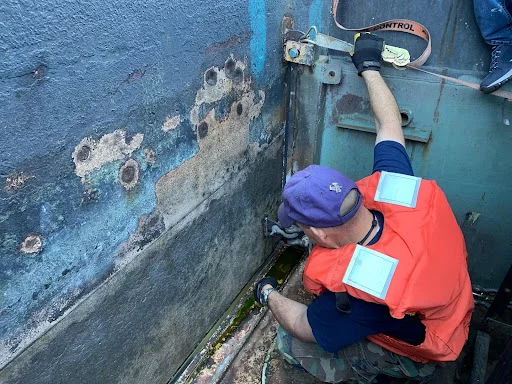
Preserving Battleship IOWA involves painting, surface preparation, carpentry, corrosion control, equipment restoration, cleaning, inspection, and countless smaller jobs that rarely attract attention individually but become essential at the scale of an 887-foot vessel.
Pacific Battleship Center’s 750,000-hour milestone highlighted volunteers performing physically demanding work such as needle gunning, painting, and removing deteriorated deck boards, alongside detailed technical projects such as restoring vintage radio equipment.
Other jobs may be as simple as replacing a light bulb or polishing a brass fitting.
On a ship with thousands of fixtures, hundreds of compartments, and acres of surface area, even simple jobs add up quickly.
Taken together, that work is what helps keep the ship open, safe, understandable, and alive as a museum.
How Do Volunteers Help Preserve a Historic Battleship?
Preservation is where the scale of volunteer service becomes especially visible.
Battleship IOWA has an extraordinary amount of exposed steel. Protective coatings are one of the primary defenses against corrosion, but painting a battleship is not simply a matter of applying a new coat.
Rust has to be removed. Failing coatings must be stripped or stabilized. Surfaces need to be cleaned and prepared properly before new protective materials can be applied.
Deck restoration creates another kind of challenge.
During work on the 01-level deck, staff and volunteers helped remove deteriorated decking by hand, preserve surviving pieces of teak, address corrosion beneath the old surface, and prepare the steel for resealing before a new deck system was installed.
That work also uncovered physical traces of earlier chapters in the ship’s history, including evidence of former World War II-era gun positions and battle damage.
Pacific Battleship Center’s 2024 reporting credited the broader crew, including volunteers, with supporting a project that replaced 4,725 square feet of vulnerable wood decking with composite material intended to reduce water intrusion and corrosion.
Projects like these demonstrate why preservation depends on much more than highly specialized restoration work.
A professional conservator or contractor may perform a particular technical task, but the project also requires preparation, cleaning, documentation, movement of materials, inspection, follow-up, and ongoing maintenance.
Volunteers expand the amount of preservation work the organization can realistically accomplish.
Do Volunteers Need Naval or Technical Experience?
No.
Some volunteers arrive with decades of experience in the Navy, maritime trades, engineering, education, construction, communications, technology, or other fields. That expertise can be particularly useful in technical restoration, historical interpretation, and specialized projects.
Others arrive knowing very little about battleships.
Battleship IOWA’s volunteer program is designed to allow people to learn. Volunteers can be trained for particular roles and gradually develop knowledge of the ship, its history, its visitors, and the work required to maintain it.
That creates a useful exchange.
The organization benefits from people who already possess valuable expertise, but it also helps create expertise in people who simply begin with curiosity and a willingness to contribute.
A volunteer with little naval knowledge may eventually become an experienced tour guide. Someone with no preservation background may learn surface preparation or restoration techniques. Another person may discover an ability to work with students or museum visitors.
Volunteering aboard IOWA can therefore become a form of hands-on education as well as service.
More important than arriving as an expert is being willing to learn and become part of the crew.
Why Are Volunteers Important to the Visitor Experience?
Most visitors will never know how many volunteer hours were required to make their visit possible.
That is because much of the work happens before anyone buys a ticket or walks onto the ship.
Volunteers help maintain the decks and compartments visitors move through. They support restoration and cleaning. They help prepare exhibits, events, and spaces that may have been inaccessible for years before reopening to the public.
They also shape the visitor experience directly.
A knowledgeable volunteer can explain not only what a piece of equipment is, but how it fits into the larger story of the ship. They can answer the question a visitor did not know to ask, point out a detail that might otherwise go unnoticed, or connect a compartment with the experience of the sailors who once worked there.
That human interaction is difficult to reproduce through signs and displays alone.
A historic battleship contains an enormous amount of information, but much of it is not immediately obvious. Pipes, controls, machinery, passageways, and equipment can appear confusing without someone who knows what they mean.
Volunteers help translate the ship.
They turn a very large historic object into a more understandable human experience.
How Do Volunteers Support Education and Veterans Programs?
Volunteers contribute to missions that extend well beyond preservation and tours.
Battleship IOWA is also a learning environment where students can explore history, engineering, science, leadership, teamwork, maritime careers, and the lives of sailors.
Those experiences often begin with direct observation.
A student sees a turbine and asks how it works. A gun system leads to questions about physics. A sailor’s bunk opens a conversation about shipboard life. Corrosion on a steel surface becomes an introduction to chemistry and preservation.
A knowledgeable volunteer can help turn those observations into learning.
For volunteers with technical, naval, maritime, or educational experience, the ship offers a particularly valuable opportunity to pass knowledge from one generation to another.
Veterans are also both part of Battleship IOWA’s audience and part of its volunteer crew.
Some come aboard for programs, ceremonies, organizations, or community events. Others become volunteers themselves and bring military experience, leadership, technical skills, and familiarity with service culture to the museum.
For some veterans, volunteering can provide something especially familiar: a crew, a responsibility, and a shared mission.
Navy veteran Hershell Hardimon, who volunteered aboard IOWA before later joining the organization professionally, described being drawn not only to the historic ship but to the energy, camaraderie, and commitment of the people working aboard it.
That helps explain why volunteering can mean different things to different people.
For one person, it may begin with history.
For another, it may be about service.
For someone else, it may be about finding a crew again.
What Does 750,000 Volunteer Hours Really Mean?
Large numbers can become abstract.
In 2025, Battleship IOWA’s volunteers surpassed 750,000 collective hours of service contributed over more than twelve years. Those hours represent hundreds of thousands of individual decisions to show up, take responsibility for a task, and give time to the ship.
Their meaning becomes clearer when measured by what they produced.
Those hours helped protect steel before corrosion advanced. They helped reopen historic spaces. They supported tours, school programs, veterans activities, and public events. They restored equipment, maintained spaces, and handled countless details that determine whether a museum of this scale can operate successfully.
Volunteer labor also allows other resources to go farther.
A donation may purchase materials. A grant may pay for specialized expertise. A contractor may perform work that requires professional certification or equipment.
But many projects also demand large amounts of preparation and support before and after that specialized work occurs.
Volunteers create capacity.
That is why 750,000 hours should not be understood simply as a measure of donated time. It is a measure of how much more the organization has been able to accomplish because people chose to contribute it.
Why Does Battleship IOWA Call Its Volunteers a Crew?
The language is deliberate.
Battleship IOWA’s volunteer program emphasizes the idea of joining the ship’s crew rather than simply completing isolated volunteer assignments.
That reflects the history of the ship itself.
USS Iowa operated because thousands of sailors with different specialties understood that their work contributed to something larger. A machinist, cook, electrician, gunner, corpsman, communicator, and officer performed very different jobs, but all were part of the same ship.
The modern museum obviously has a different mission, yet that idea of interdependence still applies.
A preservation volunteer may never lead a tour, but the condition of the ship affects what visitors experience. A tour guide may never restore historic equipment, but their interpretation gives meaning to what restoration crews preserve. An education volunteer works with students inside spaces maintained by someone else.
Those jobs connect.
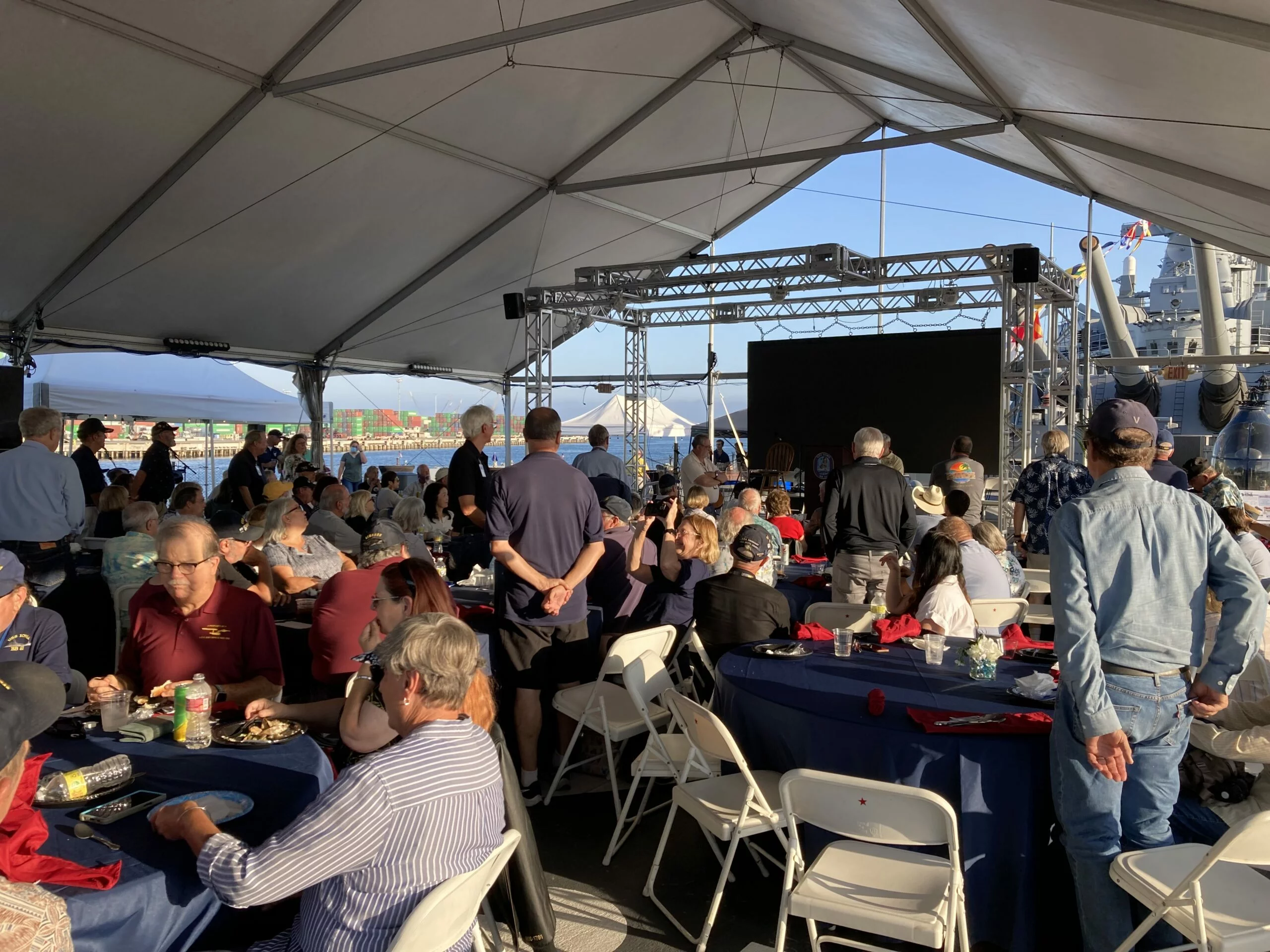
The volunteer program also creates a social community around that shared work, with activities that have included potlucks, lectures, movies, behind-the-scenes access, field trips, and recognition of service milestones.
For people who remain aboard for years, that community can become as important as the task that first brought them to the ship.
A battleship may attract someone initially.
The crew can give them a reason to stay.
Why Does Long-Term Volunteer Service Matter?
Volunteer retention provides Battleship IOWA with something beyond additional hours.
It creates institutional knowledge.
A person who has spent years aboard learns the ship in ways that are difficult to capture in a manual. Longtime volunteers remember earlier restoration projects, understand how spaces have changed, recognize recurring maintenance issues, and accumulate stories and historical knowledge that can help newer members of the crew.
Battleship IOWA recognizes major service milestones as part of its volunteer culture.
That recognition matters because reaching hundreds or thousands of hours represents more than occasional participation. It reflects sustained responsibility to a mission and a community.
Long-term volunteers can also become informal mentors.
They teach new volunteers how work is done, explain why certain practices developed, and pass along knowledge that helps maintain continuity even as staff and volunteer roles change.
For an organization responsible for preserving a ship whose systems and history are already extraordinarily complex, that continuity has real value.
Can Companies and Organizations Volunteer Aboard Battleship IOWA?
Volunteer service aboard IOWA is not limited to individuals.
Pacific Battleship Center has also hosted corporate, civic, military, and other volunteer groups for project-based service.
Group projects can be particularly useful because a concentrated team can complete labor-intensive work in a short period. One example involved Tourism Cares volunteers working aboard Battleship IOWA as part of a larger Los Angeles Waterfront service effort. Their work included painting and cleaning areas intended to reopen to visitors, including spaces around the mess, post office, and barber shop.
For participating organizations, work like this can provide a more tangible form of community engagement than a conventional off-site meeting or team-building exercise.
Participants can look at a compartment, deck, or restored area and see what their effort accomplished.
For Battleship IOWA, group service adds another source of human capacity to a preservation challenge that is too large for any one staff or volunteer team to address alone.
What Do Volunteers Gain From Serving Aboard Battleship IOWA?
Volunteerism works best when the relationship has value in both directions.
Battleship IOWA gains time, skills, knowledge, experience, and commitment.
Volunteers can gain community, education, friendships, practical experience, access to parts of the ship not normally open to visitors, and the satisfaction of contributing to something larger than themselves.
Those benefits mean different things to different people.
A history enthusiast may want to learn IOWA in greater depth. A retired tradesperson may want to put decades of knowledge to use. A veteran may value camaraderie and shared purpose. A student or younger volunteer may gain skills and experience that influence a future career.
Someone new to Los Angeles may simply be looking for a community.
The ship gives those different motivations a common focus.
People arrive for different reasons, but they work toward the same goal: preserving Battleship IOWA and making its history useful to others.
Why Does Volunteerism Matter to Battleship IOWA’s Future?
Battleship IOWA’s mission is expanding.
The ship remains a major historic attraction, but Pacific Battleship Center’s work now extends through the National Museum of the Surface Navy and Maritime Pathways, connecting people with maritime history, education, careers, service, leadership, volunteering, and community impact.
That future requires more than preserving the physical vessel.
New exhibits need people. Educational programs need people. Community events need people. Veterans programs need people. Preservation projects need people.
Volunteers expand the organization’s ability to do all of those things.
They also create something that cannot simply be purchased: people with a personal stake in the mission.
A volunteer who has spent years aboard the ship understands its challenges differently from someone who visits once. Over time, volunteers can become advocates who introduce friends, families, employers, community groups, and potential supporters to the organization.
Their influence therefore extends beyond the hours they record.
They help build the community that will determine whether the ship and its mission remain sustainable over the long term.
Why Is Volunteer Service Part of Battleship IOWA’s History?
Visitors understandably focus on USS Iowa’s naval service.
They see the 16-inch guns, bridge, machinery, crew quarters, and other evidence of the ship’s history from World War II through the Cold War.
But another chapter of IOWA’s history is being written around them.
The ship did not automatically become a museum after decommissioning. People had to save it, bring it to Los Angeles, prepare it for visitors, preserve its structure, restore spaces, build programs, and continue caring for it year after year.
Volunteers have been part of that work from the beginning.
Every compartment reopened to the public, every restored system, every school program, every guided tour, and every preserved section of deck becomes part of IOWA’s post-Navy history.
The modern crew is therefore doing more than maintaining the past.
It is creating the next chapter of the ship’s story.
What Does Volunteer Service Ultimately Preserve?
The obvious answer is Battleship IOWA itself.
Volunteers remove corrosion, paint steel, restore equipment, maintain spaces, welcome visitors, and perform thousands of jobs that help protect an 887-foot historic vessel.
But what they preserve extends beyond steel.
They preserve the opportunity for a child to step onto a battleship and ask how it works.
They preserve a place where a veteran can reconnect with a culture of service.
They preserve the setting that helps a sailor’s story make sense.
They preserve a museum where history can still be experienced at full scale.
They help sustain a community in which people from very different backgrounds can work together toward the same purpose.
Battleship IOWA was built around the idea that every member of a crew had a role in keeping the ship functioning.
More than eight decades later, that principle still applies.
The mission has changed.
The need for a crew has not.
How Can Someone Become Part of the Battleship IOWA Crew?
Battleship IOWA continues to welcome people interested in joining its volunteer community.
Opportunities can include working with visitors, supporting education programs, helping with preservation and operations, assisting with events, and contributing to other areas of the organization. Group opportunities are also available for companies, civic organizations, military units, and other teams.
Naval experience is not required.
For someone considering volunteering, the more useful question may be whether they want to learn, contribute, and help keep a historic battleship alive.
Every hour donated aboard Battleship IOWA becomes part of something larger: preserving a national historic resource, helping visitors understand America’s maritime story, supporting veterans and students, and making it possible for future generations to step aboard and experience the ship for themselves.
VISIT & EXPLORE
Experience the Life of a Sailor.
Included with Admission

How Battleship IOWA serves veterans beyond remembrance
How Battleship IOWA Serves Veterans Beyond Remembrance
Battleship IOWA was built for sailors, and more than 80 years after USS Iowa entered service, that relationship has not ended.
Today, the ship serves not only as a place to remember military service, but also as a place where veterans can reconnect with one another, find new opportunities, share their experience, volunteer, build careers, and remain part of a community shaped by service.
That makes Battleship IOWA different from a traditional military museum.
Museums honor veterans by preserving artifacts, telling stories, commemorating sacrifice, and marking important anniversaries. Battleship IOWA does all of those things. But Pacific Battleship Center has also developed Military & Veterans Programs built around a broader idea: military service may end, but the leadership, technical skill, resilience, judgment, and sense of responsibility developed through service do not simply disappear.
The challenge is often finding where those qualities can matter next.
Battleship IOWA provides one place where they can.
How Battleship IOWA Serves Veterans Beyond Remembrance
Battleship IOWA was built for sailors, and more than 80 years after USS Iowa entered service, that relationship has not ended.
Today, the ship serves not only as a place to remember military service, but also as a place where veterans can reconnect with one another, find new opportunities, share their experience, volunteer, build careers, and remain part of a community shaped by service.
That makes Battleship IOWA different from a traditional military museum.
Museums honor veterans by preserving artifacts, telling stories, commemorating sacrifice, and marking important anniversaries. Battleship IOWA does all of those things. But Pacific Battleship Center has also developed Military & Veterans Programs built around a broader idea: military service may end, but the leadership, technical skill, resilience, judgment, and sense of responsibility developed through service do not simply disappear.
The challenge is often finding where those qualities can matter next.
Battleship IOWA provides one place where they can.
Why Can the Transition From Military to Civilian Life Be So Significant?
Leaving the military involves more than changing jobs.
For many service members, military life provides a community, a mission, clearly defined responsibilities, a common language, and relationships with people who understand the demands of service. Transitioning to civilian life can change many of those things at once.
A veteran may be looking for a new career while also learning how civilian workplaces operate, rebuilding professional networks, translating military experience into language employers understand, or replacing the sense of connection that once came naturally from being part of a unit.
Battleship IOWA’s Military & Veterans Programs recognize transition as a broader process rather than a single problem to solve. Career connections, civilian reintegration, quality of life, social connection, and renewed purpose are all part of that picture.
That distinction matters.
Veterans do not necessarily need someone to tell them what they lack. Many need opportunities to identify where their experience, abilities, and desire to contribute can be useful next.
Why Do Connection and Purpose Matter After Military Service?
One of the things some veterans miss after leaving the military is the sense of being part of something larger than themselves and knowing that other people depended on them.
That sense of purpose can be difficult to replace.
Battleship IOWA’s veterans programming is built in part around creating opportunities for connection, camaraderie, mission, and contribution. What that looks like can vary considerably from one person to another.
A veteran with technical experience might help preserve the ship. A retired sailor may become a docent and turn decades of knowledge into something visitors can learn from. Another veteran might mentor a younger person, develop professional relationships, participate in a veterans organization, or help someone else navigate the transition to civilian life.
The activity matters less than the opportunity to contribute.
That changes the way veterans are seen. Instead of approaching veterans only as people who may need assistance, it recognizes that they also bring leadership, experience, technical skills, adaptability, judgment, and perspective that can strengthen organizations and communities.
Battleship IOWA can provide an environment where those qualities remain useful.
How Does Battleship IOWA Create Community for Veterans?
A ship is a natural place to build community among people who have served.
Military culture is shaped by teams, units, shared missions, routines, traditions, and relationships. Battleship IOWA provides a physical environment where many of those reference points remain immediately recognizable.
The museum hosts and supports military and veterans organizations and social groups including the Surface Navy Association, Marine Corps League Big Stick Detachment 1496, American Legion Battleship IOWA Post 61, American Legion Riders Chapter 61, and the Battleship IOWA Division of the Sea Cadets.
The ship also serves as a setting for ceremonies, reunions, gatherings, resource fairs, and other events that give veterans opportunities to meet one another and remain connected with a larger community of service.
The setting itself adds something important.
Veterans from different branches and generations may have had very different military experiences, but they are meeting inside a ship whose history was built around crew culture. The surroundings provide a shared point of reference and can make conversation easier because people do not always have to begin by explaining what military service means.
Community can begin with something as simple as being in a place where part of that experience is already understood.
How Has Battleship IOWA Provided Direct Support to Veterans?
Battleship IOWA’s veterans mission has included more than social connection and commemoration.
Beginning in the early 2020s, the ship became home to a Los Angeles County Veterans Peer Access Network operation. VPAN follows a veterans-helping-veterans model, connecting veterans and their families with resources while helping them navigate systems related to transition, housing, employment, healthcare, education, legal services, and other needs.
The ship also became home to a Veterans Resource Center created in a refurbished section of former Chief Petty Officers’ berthing, providing offices and meeting space for veterans, families, staff, and partner organizations.
Pacific Battleship Center’s 2023 impact reporting demonstrates the scale that work reached during that period. Veterans West helped 2,505 members of the veteran community navigate services that included mental health and recovery support, housing coordination, workforce development and employment, healthcare, education, legal assistance, and social connection. The organization also reported 111 veteran community gatherings and 44 honors and memorial events during the year.
Those figures represent a particular period in the program’s development, but they illustrate a larger idea.
A historic battleship can preserve the story of military service while also remaining useful to the people whose service that history represents.
Why Is Peer Support Valuable for Veterans?
Sometimes the most effective person to help a veteran navigate a difficult system is another veteran.
Shared service does not mean two people have identical experiences, but it can eliminate some of the distance created when someone must first explain military culture, terminology, expectations, or the complexities of leaving service.
That principle was central to the Veterans Peer Access Network work aboard Battleship IOWA. Veterans helped other veterans understand available resources, make connections, and navigate systems that could otherwise feel fragmented or difficult to approach.
Peer support also changes the starting point of the relationship.
Instead of defining someone by a particular problem, the conversation can begin with shared experience and recognition of the strengths the individual already possesses.
That fits a broader principle behind Battleship IOWA’s veterans mission. Military service can involve hardship, sacrifice, and loss, but veterans should not be understood only through those experiences. They also bring technical ability, leadership, teamwork, resilience, and practical judgment.
An effective veterans program makes room for both realities.
How Can Battleship IOWA Help Veterans Build Civilian Careers?
Military experience often develops skills that civilian employers value, but those skills do not always translate neatly onto a résumé.
A service member may have spent years managing complex machinery, leading teams, coordinating logistics, maintaining electrical systems, operating communications equipment, solving technical problems, or working under intense time pressure. A civilian employer may need exactly those capabilities without immediately understanding the military title attached to them.
Battleship IOWA identifies career connections and transition support as part of its Military & Veterans mission. Earlier Veterans West programming also included workforce development, employment assistance, and participation in the Department of Defense SkillBridge program. In 2023, the organization provided internships for transitioning service members preparing to enter the civilian workforce.
The connection can be particularly strong within the maritime sector.
Ports, shipping, logistics, engineering, transportation, public safety, skilled trades, government, and maritime businesses depend on many of the same capabilities veterans may have developed during service. Pacific Battleship Center’s broader Maritime Pathways model is designed to connect people with careers, service, volunteering, leadership, and community impact.
For many veterans, the issue is not whether their experience has value.
It is identifying where that value fits next.
Why Can Volunteering Be Especially Meaningful for Veterans?
Not every veteran who comes to Battleship IOWA is looking for formal assistance.
Some are looking for a place to contribute.
Volunteers are fundamental to Pacific Battleship Center’s operation, working across preservation, visitor engagement, education, events, administration, and other areas. Veterans who join the volunteer crew can bring technical knowledge, leadership experience, maritime understanding, and familiarity with military culture.
In return, the ship can provide something many veterans recognize immediately: a crew, a mission, responsibility, and the expectation that their contribution matters.
That exchange works in both directions.
The museum gains experience and knowledge that can be difficult to replace. The veteran gains an environment in which those skills remain useful.
Stories collected by Battleship IOWA have described veterans initially drawn to the historic ship but ultimately staying because of the people—the camaraderie, shared purpose, and experience of working alongside others toward a common mission.
That is what makes volunteering different from many conventional veterans programs.
The first question is not necessarily, “What does this person need?”
It can also be, “What can this person contribute?”
Why Is Preserving Veterans’ Stories Part of the Mission?
Military history can easily become a story about ships, weapons, battles, technologies, and dates.
Battleship IOWA has an opportunity to put people back into that history.
More than 50,000 sailors served aboard USS Iowa from World War II through the Cold War. The museum’s “Those Who Served” collection preserves individual stories, photographs, ranks, assignments, memories, and other information shared by veterans and their families.
That work matters because firsthand experience disappears if it is not recorded.
A technical manual can explain how equipment functioned. A veteran can describe what it sounded like, how people worked around it, what happened when something failed, and how a crew solved problems.
An official history can document a deployment. A sailor can describe the routines, friendships, fatigue, humor, responsibility, and everyday realities of being aboard.
Those human details are what turn a historic vessel from an object into a place where people once lived and worked.
Preserving those stories also gives veterans another role.
They become teachers.
What Can Younger Generations Learn From Veterans?
One of Battleship IOWA’s strongest opportunities lies where its Veterans and Education missions intersect.
Students can learn how a battleship operated through tours, exhibits, and STEM programs. Veterans can help them understand something more difficult to reproduce in a classroom: what it means to be part of a crew.
Military experience provides real examples of leadership, responsibility, technical competence, decision-making, adaptability, teamwork, and service. Those lessons can be meaningful even for students who will never enter the military.
Battleship IOWA’s Military & Veterans programs identify sharing lessons learned with future generations as part of their purpose.
That creates value in both directions.
Young people gain access to firsthand experience and perspectives that cannot be found in a textbook. Veterans have an opportunity to put their knowledge to constructive use and help another generation understand the people behind the ship.
The veteran is no longer simply the subject of the history lesson.
The veteran becomes part of how the lesson is taught.
How Does Battleship IOWA Balance Continuing Service With Remembrance?
Connection and continuing purpose do not replace remembrance.
They give it context.
Battleship IOWA remains a setting for memorial services, military honors, reunions, retirement ceremonies, and other forms of recognition. Because generations of sailors actually lived and worked aboard the ship, those ceremonies take place within an environment that carries its own history.
The most solemn example is April 19, 1989, when an explosion in USS Iowa’s Turret II killed 47 sailors.
The IOWA 47 remain inseparable from the history of the ship. Remembering them is part of Battleship IOWA’s responsibility to their families, their shipmates, and future generations.
A memorial aboard IOWA has a different quality from one held in a neutral setting because the ship is not simply representing military service symbolically.
Sailors lived here. They stood watch here. They worked in these compartments, built friendships, performed difficult jobs, and depended on one another here.
Some lost their lives here.
The physical ship gives remembrance a setting that cannot be reproduced elsewhere.
Why Is Battleship IOWA More Than a Military Museum for Veterans?
Battleship IOWA can serve several purposes at the same time.
It can be a memorial and a meeting place. It can provide connections to resources while creating professional networks. It can be somewhere to volunteer, teach, mentor, preserve history, meet other veterans, or simply spend time in an environment where military culture is understood.
Those roles do not assume that every veteran has the same experience or the same needs.
Some may be navigating a difficult transition. Others may be looking for employment or professional connections. Some miss the camaraderie of military life. Others want to volunteer, teach, preserve history, or share what they learned.
The strength of the ship as a community platform is that those motivations can coexist.
Pacific Battleship Center’s broader Maritime Pathways approach connects people with opportunities involving careers, service, volunteering, leadership, and community impact, while its Military & Veterans Programs emphasize connection, belonging, transition, and purpose.
That is a much broader mission than displaying military history.
The ship becomes useful again.
Why Does Connecting Veterans and Civilians Matter?
Many Americans today have limited firsthand exposure to military service or to the people who have served.
That distance can allow assumptions and stereotypes to replace understanding.
Battleship IOWA creates opportunities for veterans and civilians to encounter one another naturally. A visitor may meet a veteran serving as a docent. A student may learn from someone who operated similar equipment. A civilian volunteer may spend hours working alongside a former sailor preserving part of the ship.
Those encounters make military service personal rather than abstract.
They also make room for a more complete understanding of veterans themselves.
There is no single veteran experience. Some people served in combat and others did not. Some had difficult transitions into civilian life; others moved quickly into new careers. Some carry painful memories. Others remember their service primarily through friendship, responsibility, pride, or accomplishment. Many carry combinations of all of those things.
A useful veterans program recognizes that complexity rather than reducing service to a single narrative.
What Does It Really Mean to Honor Veterans?
Honoring veterans is often associated with ceremonies, monuments, holidays, and expressions of gratitude.
Those things matter, but they are only part of the picture.
Honoring veterans can also mean preserving their stories accurately, listening to their experience, connecting them with resources when support is needed, recognizing the skills they bring, and creating opportunities for them to continue contributing.
It may mean helping a transitioning service member build a civilian career. It may mean giving a retired sailor a place to volunteer. It may mean preserving the story of someone who served or bringing a veteran and a student together for a conversation.
That broader idea is particularly appropriate aboard Battleship IOWA.
The ship was built around service, but it was also built around the concept of a crew. No single sailor could operate it. Thousands of people with different skills and responsibilities depended on one another to accomplish a common mission.
The machinery may be silent today, but the principles that made the ship work have not disappeared.
Teamwork, competence, trust, leadership, responsibility, and service still matter.
They simply need new places to be applied.
Battleship IOWA can be one of them.
How Can Veterans Connect With Battleship IOWA Today?
Veterans, active-duty service members, and military families can connect with Battleship IOWA’s Military & Veterans team to learn about current programs, social groups, ceremonies, resources, volunteering, and other opportunities.
Veterans and their families can also contribute personal histories to the USS Iowa “Those Who Served” registry, become part of the volunteer crew, participate in affiliated veterans organizations, attend events, or simply spend time aboard a Navy ship where the experience of military service is recognized.
Community members, donors, foundations, and corporate partners can support that mission as well.
That support offers a broader way to honor veterans—not only by recognizing what they have already done, but by investing in what they can continue to contribute.
Why Does Battleship IOWA’s Veterans Mission Extend Beyond Remembrance?
USS Iowa’s original mission required sailors to serve their country at sea.
Battleship IOWA’s mission today is different, but it remains centered on people.
The ship preserves veterans’ history and honors those who served. At the same time, it creates opportunities for veterans to reconnect, contribute, teach, find resources, build careers, volunteer, and remain part of a community.
One veteran may come aboard looking for help and meet someone who understands. Another may arrive looking for a place to contribute and find a new crew. A transitioning service member may make a professional connection. A retired sailor may preserve a story that would otherwise be lost. A student may learn about leadership from someone who practiced it under very different circumstances.
That is why Battleship IOWA’s relationship with veterans extends beyond remembrance.
The ship once gave generations of sailors a mission.
Today, it can help ensure that their knowledge, experience, service, and ability to contribute continue forward.
VISIT & EXPLORE
Experience the Life of a Sailor.
Included with Admission

How has innovation shaped Battleship IOWA?
Why Is Battleship IOWA One of the Most Significant Battleships in American History?
How Has Innovation Shaped Battleship IOWA—and What Can It Teach Us About Solving Problems?
Battleship IOWA was built because the United States Navy faced a problem.
By the late 1930s, naval warfare was changing rapidly. Aircraft carriers were becoming increasingly important, fleets were operating across enormous distances, and the Navy needed battleships capable of combining the firepower and protection expected of a capital ship with enough speed to operate alongside fast carrier forces.
The result was the Iowa class, the final class of battleships built by the United States.
USS Iowa entered service in 1943 with nine 16-inch guns, an engineering plant capable of producing 212,000 shaft horsepower, and a combination of speed, range, weapons, protection, communications and mechanical systems that made the ship one of the most complex machines of its era.
But IOWA did not remain frozen in 1943. Radar and other systems changed during World War II. Four decades later, Tomahawk cruise missiles, Harpoon anti-ship missiles and updated combat systems were added during the ship’s Cold War modernization.
Today, innovation aboard Battleship IOWA continues for a very different reason.
Engineers, preservation specialists, volunteers, museum designers, educators and technology professionals now solve problems the ship’s original designers could never have anticipated: how to preserve an 887-foot steel vessel for future generations, how to reactivate historic systems without returning the ship to operational service, how to incorporate modern materials without erasing historic character, and how to use technology to help contemporary audiences understand a ship built more than 80 years ago.
The mission has changed dramatically since 1943.
The need to solve problems has not.
Why Was the Iowa Class Innovative When It Was Built?
Battleship design has always been an exercise in compromise.
Armor improves protection but adds weight. Larger weapons increase firepower but require more space, stronger structures and additional ammunition. Greater speed demands more power, which means larger engineering systems, more fuel and additional supporting equipment.
Improving one characteristic can easily make another problem more difficult.
The Iowa class represented an effort to balance those competing demands for a new naval environment. IOWA’s nine 16-inch guns could fire shells weighing as much as 2,700 pounds more than 20 miles, while the ship’s propulsion plant gave her the speed needed to operate with fast naval forces.
Producing that performance required far more than powerful engines.
Eight boilers generated steam for four turbines, which transferred power through four shafts to the propellers. Together, the system could produce approximately 212,000 shaft horsepower and propel the ship at speeds approaching 35 knots under some conditions.
But propulsion was only one part of the engineering challenge. Electrical generation, navigation, communications, fire control, ventilation, pumps, plumbing, ammunition handling, damage control and systems supporting thousands of sailors all had to occupy the same hull and work together.
That is why an Iowa-class battleship is best understood not simply as a large weapon, but as an enormous exercise in systems engineering.
Its innovation was not found in any single machine. It came from making thousands of individual solutions function as one ship.
Why Is Speed Such a Difficult Engineering Problem on a Battleship?
Making something move quickly becomes much more difficult as it becomes larger and heavier.
Battleship IOWA had to push an enormous hull through the water while carrying armor, weapons, ammunition, machinery, fuel, supplies and a crew numbering in the thousands during portions of her service.
Generating enough horsepower was only part of the solution. Naval architects also had to shape the hull, manage weight, distribute machinery and maintain stability and structural strength.
Those tradeoffs are central to understanding engineering.
More armor might improve protection, but it also makes the ship heavier. More propulsion power can increase speed, but the additional machinery, fuel and piping add still more weight. Larger weapons require stronger structures and greater ammunition capacity.
Engineers rarely get to maximize every desirable characteristic.
They optimize.
That is what makes the figure “35 knots” more interesting than it first appears. The number describes the result. The boilers, turbines, shafts, hull form, weight distribution and thousands of design decisions required to achieve it are the real innovation story.
Battleship IOWA allows visitors to see that story at full scale.
How Did USS Iowa Adapt as Technology Changed?
Historic technology is often presented as though it existed in a single finished form.
USS Iowa did not.
Warships change because the world around them changes. During a major 1945 overhaul, for example, IOWA received new search and fire-control radar as electronic detection and targeting became increasingly important.
The transformation was even more dramatic when the ship returned to service in the 1980s.
When USS Iowa was recommissioned in 1984, the Navy did not simply restore a World War II battleship to its original configuration. The ship was modernized with Tomahawk cruise missiles, Harpoon anti-ship missiles and updated combat systems while retaining her nine 16-inch guns.
The resulting ship brought together technologies separated by roughly four decades.
Its hull and main battery came from a design developed before America’s entry into World War II. Its missile systems belonged to an era of long-range precision weapons and increasingly computerized naval warfare.
That juxtaposition provides an important lesson about innovation: sometimes the answer is not to discard an existing platform and start over.
The better question is whether an existing system still provides useful capabilities—and whether it can be adapted to meet a different mission.
What Is the Difference Between Invention and Innovation?
Invention and innovation are related, but they are not the same thing.
An invention creates something new. Innovation more often involves applying knowledge, materials, technology or processes in a different way to solve a problem more effectively.
USS Iowa illustrates that distinction repeatedly.
Steam turbines were not invented for the ship. Radar was not invented aboard IOWA. Neither were cruise missiles. What mattered was how those technologies were integrated into a larger system to meet changing operational requirements.
The same distinction can be seen aboard the museum today.
Battleship IOWA’s preservation team did not invent composite marine decking. Instead, the team evaluated a modern material as one possible answer to a very specific preservation problem: how to protect historic steel beneath deteriorating deck surfaces while maintaining the appearance of a battleship deck and addressing the cost, availability and sustainability concerns associated with traditional teak.
The innovation was not the material itself.
It was understanding the problem well enough to determine where a different material could provide a better solution.
How Can Modern Technology Help Preserve a Historic Battleship?
Preserving Battleship IOWA creates an interesting paradox.
The museum is responsible for protecting a historic artifact, but fulfilling that responsibility sometimes requires materials and methods that did not exist when the ship was built.
Deck preservation is a good example.
Traditional teak performs well in marine environments, but replacing large areas of deteriorated decking with new teak presents significant challenges involving cost and sourcing. Douglas fir, which was used on portions of IOWA during later periods of service, does not provide the same durability.
After researching alternatives, the operations team selected a resin-composite marine decking system using Herculan for selected areas. Before installation, staff and volunteers removed deteriorated material, preserved usable historic planks, treated corrosion beneath the old deck and resealed the steel.
The objective was not to make an old battleship more modern.
It was to use an appropriate modern solution to protect more of the historic ship.
That distinction matters because good innovation begins with the mission, not with the technology.
Why Is Historic Preservation an Engineering Design Problem?
Preservation is full of constraints, and constraints are often where engineering becomes most interesting.
Consider an exterior deck aboard Battleship IOWA. Any solution has to keep moisture away from structural steel while surviving sunlight, rain, salt air, foot traffic and temperature changes. It should respect the visual character of the historic vessel, remain maintainable by a nonprofit organization and make economic sense over decades rather than simply at the moment of installation.
No single factor can determine the answer.
The process therefore looks much like engineering design elsewhere: define the problem, identify the constraints, investigate alternatives, test an approach, observe the results and improve the solution.
Battleship IOWA initially used synthetic marine decking on the wings of the 04-level navigation bridge, allowing the preservation team to evaluate the material and installation process before using the approach on a larger area.
The same problem-solving approach appears in hull preservation. Dry-docking an 887-foot battleship presents enormous financial and logistical challenges, so the museum uses cofferdams to create temporary dry work areas against portions of the hull. That allows crews to address vulnerable steel while the ship remains at its berth.
Neither approach exists because innovation itself was the goal.
The problem came first.
Can Historic Battleship Technology Be Brought Back to Life?
Some of the most interesting innovation aboard Battleship IOWA involves technology that is not new at all.
A volunteer team made up of engineers and retirees from technology and electronics industries has worked to reactivate historic electronic systems that had been cold and silent for decades.
That work changes the way visitors can understand the ship.
A static piece of equipment can show what a system looked like. A functioning system can begin to demonstrate what it actually did.
Switches, displays, communications equipment, indicators, motors and other shipboard systems often make much more sense when they are experienced as parts of a functioning network rather than as isolated artifacts.
Bringing those systems back to life requires an unusual combination of expertise. Original Navy technology and documentation may have to be interpreted alongside veteran knowledge, modern electronics experience, fabrication skills, troubleshooting and contemporary museum requirements.
In that sense, the project joins old and new problem-solving methods.
The original machine provides the challenge. Today’s engineers and technicians have to determine how much of its function can responsibly be restored.
Why Does Restoring Old Technology Require New Solutions?
Repairing historic machinery is not the same as fixing a modern appliance.
Replacement parts may no longer exist. Documentation may be incomplete. Original manufacturers may have disappeared. People who once operated the equipment may no longer be available.
There is also a fundamental difference between maintaining a warship and preserving a museum artifact.
An active Navy crew repaired equipment so the ship could accomplish an operational mission. A museum may want a system to function because operation helps visitors understand it—but without placing irreplaceable historic material at unnecessary risk.
That creates difficult decisions.
Which original components can operate safely? Which should remain untouched? Can a modern component substitute discreetly for something no longer available? How much operation is appropriate for fragile machinery? How can visitors experience a system without shortening its life?
Those questions make restoration a form of applied innovation.
The past provides the technology.
The present has to determine how to keep its story working.
How Is Innovation Changing the Museum Experience?
Innovation aboard Battleship IOWA now extends beyond machinery and preservation.
In 2026, Pacific Battleship Center opened the first elements of Life of a Sailor, an immersive National Museum of the Surface Navy experience intended to connect visitors with the people, experiences, technology and culture of America’s Surface Navy.
The experience includes a 60-foot video sculpture showing the evolution of Navy ships, an immersive boot-camp component, a large-scale ship cutaway, interactive experiences and interpretation integrated into the historic battleship itself.
Pacific Battleship Center invested $3.5 million in the experience, developed with American Scenic Design and Pure Imagination Studios, as an early major step in the transformation of the ship into a national museum destination.
The choice to use immersion is important because Battleship IOWA already has an advantage most museums do not.
Visitors are standing inside the artifact.
Digital media, projection, physical environments, firsthand accounts, historic equipment and the ship itself can therefore work together. The purpose is not simply to add screens or new technology to an old battleship. It is to help visitors understand something the steel alone cannot fully explain: the experience of the sailors who operated the Surface Navy.
Technology is most valuable when it strengthens that human story rather than competing with it.
Can Innovation Help Connect Students With Future Careers?
Battleship IOWA also makes innovation visible as a career rather than simply a chapter in technological history.
Students can examine the principles behind a 1940s steam plant, encounter systems added decades later and then see how the same ship is being adapted again for preservation and education.
That sequence makes technological change visible as a continuing process.
A student can begin by asking how a system works. The next question may be why it was designed that way. Eventually, the question can become: Who solves similar problems today?
In March 2026, Pacific Battleship Center announced a $500,000 gift from the Timken Foundation to develop an engineering-focused career pathway within the National Museum of the Surface Navy experience. The initiative is intended to expand engineering-related learning for students as well as general visitors.
That progression can lead toward careers in engineering, shipbuilding, electronics, skilled trades, information technology, logistics, maritime operations and other fields.
Innovation stops looking like something done only by famous inventors.
It becomes something people do every day when they understand a problem well enough to improve the solution.
Does Innovation Always Mean Replacing Old Technology?
Battleship IOWA demonstrates almost the opposite.
During the 1980s modernization, the Navy retained the ship’s 16-inch guns while adding missiles and updated combat systems. Technologies from different eras became part of the same platform.
Today, the museum again combines old and new.
Original machinery exists beside restored electronics. Synthetic deck material protects historic steel. Digital interpretation helps explain analog equipment. Contemporary engineers and technicians use modern knowledge to preserve systems designed before many of them were born.
Innovation in this environment is therefore not synonymous with replacement.
It is often about integration.
The challenge is deciding what should remain, what can change and how a new solution can strengthen the value of something that already exists.
What Does Battleship IOWA Teach About Experimentation and Failure?
Innovation rarely follows a perfectly straight path.
Engineering depends on testing assumptions, observing results, correcting problems and learning from what happens. Preservation works much the same way.
Battleship IOWA’s use of synthetic decking illustrates the process. Rather than immediately applying a new approach across the ship, the museum first used the system on a limited area. That experience could then inform work on the much larger 01-level restoration.
Removing deteriorated material also revealed conditions that could not be fully understood until the deck was opened. Corrosion had to be addressed, usable historic material preserved and steel resealed before a new surface could be installed. Crews also encountered previously hidden evidence of former 40 mm gun positions and wartime damage.
The lesson is simple but important.
Plans matter, but real-world conditions often reveal something the plan could not predict.
Strong problem-solving responds to what is actually found.
Why Are People More Important Than Technology in Innovation?
The machinery aboard Battleship IOWA makes it easy to think of innovation as a story about hardware.
It is really a story about people.
Machines do not identify problems, weigh tradeoffs, make observations, exchange knowledge or decide which solution best serves a mission.
People do.
That was true when naval architects balanced speed, firepower, protection and range in the original Iowa-class design. It remained true when sailors and engineers adapted the ship during World War II and when the Navy modernized it for Cold War service.
It remains true aboard the museum today.
Preservation teams research material alternatives. Volunteers study dormant systems before attempting to reactivate them. Exhibit designers decide when digital technology improves interpretation and when the historic ship should speak for itself.
The common thread is not any particular technology.
It is people applying knowledge to changing circumstances.
What Can Modern Organizations Learn From Battleship IOWA?
Battleship IOWA’s history offers several lessons about innovation that extend well beyond naval engineering.
Constraints can drive better solutions. Weight, space, cost, material availability, safety, maintenance and historical authenticity do not simply make a project more difficult. They force people to make choices and establish priorities.
Innovation is also often incremental. USS Iowa did not move from a World War II battleship to a Cold War missile platform because of one breakthrough. It evolved through changes to equipment, systems, processes and training.
Old and new are not necessarily opposites. Existing technology can sometimes be adapted instead of discarded. Modern materials can protect historic structures. New interpretation can make an old artifact more understandable without replacing it.
Most importantly, innovation should begin with the problem.
Starting with a fashionable technology and searching for somewhere to use it is not the same thing as solving a problem well. The better questions are: What needs to be accomplished? What constraints stand in the way? Which solution best serves the mission?
Battleship IOWA has been answering versions of those questions for more than eight decades.
What Is the Most Important Innovation Lesson Battleship IOWA Can Teach?
Walk through Battleship IOWA and innovation appears everywhere: in the propulsion plant, the 16-inch guns, radar, missile systems, restored electronics, preservation materials and immersive museum technology.
But those are the results of innovation, not its source.
The source is the repeated human decision to solve a problem differently because circumstances have changed.
Naval architects did that when they balanced speed, firepower, protection and range in the Iowa class. Sailors and engineers did it as wartime technology evolved. The Navy did it when the ship returned for Cold War service. Preservation teams do it today when they determine how to protect an historic battleship using modern materials and limited resources. Museum designers do it when they use immersive technology to help visitors understand the people behind the machinery.
That may be the most enduring lesson contained within an 887-foot battleship.
Innovation is not simply about inventing something new.
It is about understanding the problem in front of you well enough to build the next solution.
Battleship IOWA has been doing that since before she first went to sea. Today, as the ship becomes the home of the National Museum of the Surface Navy, innovation continues to connect what came before with what comes next.
VISIT & EXPLORE
Experience the Life of a Sailor.
Included with Admission

Why is Battleship IOWA one of the most significant battleships in American history?
Why Is Battleship IOWA One of the Most Significant Battleships in American History?
Battleship IOWA’s history spans more than half a century of extraordinary change in the United States Navy.
She entered service during World War II as the lead ship of the final class of American battleships. She carried President Franklin D. Roosevelt across the Atlantic during one of the most consequential diplomatic journeys of the war, fought across the Pacific, returned to combat during Korea, spent years in reserve, and then emerged again during the Cold War carrying modern missiles alongside the massive guns of an earlier era.
Her history also includes tragedy. On April 19, 1989, an explosion inside Turret II killed 47 sailors, creating one of the darkest chapters in the ship’s story.
When USS Iowa was decommissioned for the final time in 1990, her active naval career ended. Her history did not.
Today, Battleship IOWA remains on the Los Angeles Waterfront as a museum, memorial, educational platform, and anchor of the National Museum of the Surface Navy. The ship preserves something difficult to capture in a conventional museum: the ability to walk through more than five decades of American naval history inside the vessel that experienced it.
That is what makes IOWA’s history larger than the story of one warship.
It is a story about changing warfare, presidential leadership, industrial power, technological adaptation, national tragedy, and the tens of thousands of sailors who gave the ship life.
What Is USS Iowa BB-61?
USS Iowa, hull number BB-61, was the lead ship of the Iowa class, the last class of battleships built by the United States.
Her keel was laid at the New York Naval Shipyard on June 27, 1940, as war spread across Europe and Asia. She was commissioned into the United States Navy on February 22, 1943.
The Iowa class represented an evolution in American battleship design. These ships combined heavy armor and nine 16-inch main guns with unusually high speed, allowing them to operate alongside the fast aircraft carrier forces that were becoming central to naval warfare in the Pacific.
That combination helped make USS Iowa useful across very different eras.
She began her career as a World War II battleship built around armor, guns, and speed. Four decades later, she returned to service carrying Tomahawk cruise missiles, Harpoon anti-ship missiles, and modernized combat systems while retaining those same nine 16-inch guns.
Few surviving warships show the transition from World War II naval technology to the late Cold War as visibly as USS Iowa.
Why Is USS Iowa Known as the “Battleship of Presidents”?
Battleship IOWA is often called the “Battleship of Presidents” because of her unusual connections to American presidential history.
The most famous began almost immediately after the ship entered service.
In November 1943, USS Iowa carried President Franklin D. Roosevelt across the Atlantic during the first part of his journey to meet Allied leaders Winston Churchill and Joseph Stalin at the Tehran Conference. Roosevelt was traveling at a critical moment in World War II, when Allied leaders were coordinating strategy that would help shape the final years of the conflict.
Because Roosevelt used a wheelchair, modifications were made aboard the ship for the voyage. Among them was the installation of a bathtub for the president, an unusual feature aboard an American battleship.
The voyage linked Iowa to presidential history before she had begun her primary combat service in the Pacific.
That association continued. Battleship IOWA records connections with five U.S. presidents, and President Ronald Reagan later came aboard during the ship’s Cold War service.
The result is a battleship whose history repeatedly intersects with the office of the commander in chief and with some of the defining political moments of the twentieth century.
What Did USS Iowa Do During World War II?
After completing the presidential transport mission, USS Iowa headed for the Pacific.
There she joined a Navy in the middle of a major transition.
Battleships had once been expected to meet enemy battleships in decisive gun battles. By 1944, aircraft carriers had become the centerpiece of American naval power in the Pacific. Fast battleships such as Iowa increasingly operated as part of carrier task forces, using their speed, antiaircraft weapons, and heavy guns to protect carriers and support broader fleet operations.
USS Iowa participated in major Pacific campaigns during 1944 and 1945, supporting operations associated with the Marshall Islands, the Marianas, the Philippines, Iwo Jima, Okinawa, and strikes against the Japanese home islands.
Her 16-inch guns could also bombard targets ashore, delivering shells at ranges far beyond conventional field artillery.
By the end of World War II, Iowa had earned nine battle stars.
Yet her wartime importance was not simply a matter of firepower. Her service illustrates how battleships themselves were adapting to a new naval environment in which aviation, radar, logistics, and coordinated fleet operations increasingly determined success.
Iowa had been designed as a battleship.
She proved valuable because she could function as part of a much larger naval system.
Why Did USS Iowa Return for the Korean War?
Like many American warships, USS Iowa did not remain continuously active after World War II.
The enormous Navy built to defeat the Axis powers was reduced dramatically after 1945, and Iowa was decommissioned as the United States adjusted to peacetime requirements.
That peacetime did not last.
When war began on the Korean Peninsula in 1950, the United States again needed naval forces capable of supporting operations ashore. USS Iowa was recommissioned in August 1951 and deployed to Korean waters in 1952.
The conflict gave the battleship a mission well suited to one of its traditional strengths: heavy naval gunfire.
Iowa’s 16-inch and 5-inch guns could strike coastal targets, transportation infrastructure, supply positions, and other military objectives from offshore. During one mission, the ship operated near Chongjin in northeastern Korea, far north along the Korean coast and relatively close to the Soviet border.
Korea demonstrated why battleships could remain useful even after aircraft carriers had surpassed them as the Navy’s dominant capital ships.
Their role had changed.
Rather than seeking enemy battleships at sea, they could provide sustained gunfire against targets ashore while projecting a highly visible form of naval power.
After the Korean War, Iowa also served as flagship of the Second Fleet and participated in NATO exercises and overseas deployments before once again entering reserve status.
That cycle of service, reserve, and recommissioning became a defining characteristic of her career.
Why Was USS Iowa Brought Back During the Cold War?
By the late 1970s and early 1980s, USS Iowa had been inactive for decades.
Then the strategic environment changed again.
During President Ronald Reagan’s administration, the United States pursued a major naval expansion centered on the goal of a 600-ship Navy. The four Iowa-class battleships offered an unusual opportunity: large, fast, heavily armed vessels that already existed and had enough space to accommodate modern weapons and electronics.
USS Iowa was recommissioned in April 1984.
The ship that returned to service combined technologies from two very different eras.
Her nine 16-inch guns remained. But she also carried Tomahawk cruise missiles capable of striking distant targets, Harpoon anti-ship missiles, and updated combat systems integrated into a hull designed in the early years of World War II.
That made Iowa one of the clearest physical examples of technological adaptation in the Navy.
Instead of discarding the old platform, the Navy found a way to combine existing capabilities with new weapons and systems.
During the 1980s, USS Iowa operated in the Atlantic, Mediterranean, and other regions as part of America’s Cold War naval presence. President Reagan also came aboard during the 1986 International Naval Review in New York Harbor.
By then, the battleship had become a living bridge between two very different generations of naval warfare.
What Happened Aboard USS Iowa on April 19, 1989?
The most tragic day in USS Iowa’s history occurred on April 19, 1989.
At 9:55 a.m., during a gunnery exercise, an explosion occurred in the center gun of Turret II.
Forty-seven sailors were killed.
The loss devastated the crew and the families and communities connected to them. It also became one of the most intensely examined episodes in the ship’s history.
For Battleship IOWA today, April 19 is not simply another date on a timeline.
The sailors who died are remembered as the IOWA 47, and their memory remains closely tied to the museum’s identity, its relationship with veterans, and its interpretation of the ship’s Cold War service.
Survivors of the 1989 crew have also become part of the ship’s continuing story. Some have returned years later to share their experiences and help ensure that the history of the tragedy includes the voices of those who lived through it.
That matters because the history of USS Iowa cannot be told only through military power, technology, and achievement.
It also includes loss, service, trauma, memory, and responsibility to those who did not come home.
When Did USS Iowa Leave Active Service for the Last Time?
USS Iowa was decommissioned for the final time on October 26, 1990.
By then, the Cold War itself was nearing its end.
The battleship era was ending as well.
Missiles, submarines, aircraft carriers, precision weapons, and increasingly sophisticated sensor networks had transformed naval warfare. Large battleships no longer occupied the role they once had in American fleet planning.
Iowa’s final decommissioning therefore marked more than the retirement of one ship.
It was part of the closing chapter of an entire category of American warship.
But retirement created a new question.
What should happen to a vessel with this much history?
How Was Battleship IOWA Saved and Brought to Los Angeles?
Historic warships do not automatically become museums.
Preserving a ship the size of USS Iowa requires an organization willing to secure the vessel, identify a permanent home, build public and political support, raise substantial funding, and accept responsibility for maintaining an 887-foot steel ship indefinitely.
Supporters spent years working to preserve Iowa.
Pacific Battleship Center was established in 2008 as part of the effort. The Navy ultimately awarded USS Iowa to the organization for use as a museum, and on July 4, 2012, Battleship IOWA opened to the public in Los Angeles.
The location gave the ship another connection to maritime history.
San Pedro and the Los Angeles Waterfront have deep ties to the Navy, commercial shipping, and maritime activity. IOWA entered a new life in a working port environment rather than becoming an isolated monument.
The move transformed the ship from a retired warship into a place where the public could encounter the history she represents directly.
How Many Sailors Served Aboard USS Iowa?
Battleship IOWA estimates that more than 50,000 sailors served aboard USS Iowa from World War II through the Cold War.
That number is essential to understanding why the ship matters.
Battleships are often remembered through specifications: speed, horsepower, armor, displacement, guns, and battle stars.
None of those capabilities existed independently of people.
Sailors fired the guns, maintained boilers and turbines, navigated the ship, prepared meals, treated injuries, repaired electrical equipment, handled ammunition, operated radios, stood watches, cleaned compartments, and performed thousands of other tasks required to keep a battleship functioning.
Their experiences also differed by era.
A sailor aboard Iowa in 1944 served in a different Navy from one aboard in Korea in 1952 or during the Cold War in 1988. The technologies changed. The missions changed. The strategic environment changed.
The steel remained.
Generations of sailors gave it life.
That human continuity is one of the most important parts of the ship’s history.
Why Is Battleship IOWA Historically Important Today?
Battleship IOWA is significant in part because her history spans three very different periods of American naval service: World War II, the Korean War, and the Cold War.
Few surviving artifacts allow people to encounter all three within the same physical object.
Walk through the ship and those layers remain visible.
World War II-era guns and armor exist alongside Cold War missile systems. Spaces associated with sailors of the 1940s coexist with modifications made decades later. The Roosevelt voyage, Pacific combat, Korean gunfire missions, Cold War deterrence, and the 1989 tragedy are all part of the history of the same vessel.
That makes IOWA particularly useful for understanding how the Navy and the United States changed during the second half of the twentieth century.
The ship is not frozen in one moment.
She is a record of adaptation.
Her history demonstrates how a nation changes its technology, strategy, and institutions in response to a changing world.
Why Preserve the Entire Battleship Instead of Just Its Artifacts?
Many objects associated with USS Iowa could be preserved individually.
A uniform could be placed in a display case. A shell could be exhibited. Photographs, documents, equipment, and personal possessions could all help tell parts of the story.
What would be lost is context.
A 16-inch gun means something different when visitors can stand next to the turret that carried it.
A sailor’s bunk has greater meaning when it remains inside the compartment where sailors slept.
A boiler becomes easier to understand when visitors descend through the ship to reach the engineering spaces.
The bridge makes more sense when someone can stand there and look forward over an 887-foot bow.
Preserving the entire ship protects the relationships between those things.
It preserves scale.
It preserves space.
It allows history to remain three-dimensional.
That is something no collection of separate artifacts can fully reproduce.
How Has Battleship IOWA’s Mission Changed Since Becoming a Museum?
USS Iowa was built to fight wars.
Battleship IOWA now serves a very different purpose.
Today, the ship interprets the Life of a Sailor, preserves naval history, educates students, supports veterans, engages volunteers, connects visitors with maritime careers and service, hosts civic and community activities, and serves as the anchor of the National Museum of the Surface Navy.
That transition is itself one of the most interesting chapters in Iowa’s history.
The ship has moved from an instrument of national defense to a platform for education, remembrance, service, and public engagement.
Those roles are different from the ship’s original mission, but they are connected to it.
The museum’s relevance depends on the history embodied in the vessel and, especially, on the people who served aboard her.
The ship no longer carries sailors into war.
It now carries their stories forward.
What Is the National Museum of the Surface Navy?
Battleship IOWA is the anchor of the developing National Museum of the Surface Navy.
That role broadens the story beyond BB-61 itself.
Iowa provides a powerful starting point for interpreting the ships and sailors who operate on the surface of the world’s oceans. Her own career touches many of the themes such a museum can explore: technological change, maritime security, deterrence, global deployment, teamwork, naval careers, service, sacrifice, and the continuing importance of access to the seas.
In 2021, Iowa was named the future National Museum of the Surface Navy.
That designation added another chapter to the ship’s evolution.
A vessel built to fight during World War II, recommissioned for Korea, and modernized for the Cold War is now becoming a platform for explaining the larger history and continuing role of America’s Surface Navy.
What Can Battleship IOWA Teach Us About American History?
Battleship IOWA allows visitors to examine American history from an unusual perspective.
Through the ship, World War II becomes more than a sequence of battles. It becomes a story about industrial mobilization, technology, global logistics, diplomacy, and the enormous national effort required to fight a worldwide conflict.
The Korean War reveals the early tensions of the Cold War and the continued use of naval power in conflicts very different from World War II.
Iowa’s return in the 1980s shows how the United States responded to renewed superpower competition by combining existing military assets with new technologies.
The Turret II tragedy provides a reminder of the human risks associated with military service even outside conventional combat.
And the effort to preserve the ship after decommissioning raises another historical question: what does a society decide is worth remembering, and what is required to preserve that memory?
That is why Battleship IOWA remains relevant.
The ship is not simply evidence of what happened.
It is a place from which to ask why those events mattered.
What Is the Legacy of Battleship IOWA?
It would be easy to define USS Iowa’s legacy through numbers.
She served across three major eras of conflict. She has connections with five presidents. She earned 11 battle stars. More than 50,000 sailors served aboard her. She carried nine 16-inch guns across an 887-foot hull.
Those numbers establish scale.
They do not fully explain why the ship matters.
Iowa’s larger legacy lies in the people and events behind them.
She carried a president toward a meeting that helped shape Allied strategy in World War II. She supported carrier forces and combat operations across the Pacific. She returned to provide gunfire during the Korean War. She was modernized and recommissioned during the Cold War. Forty-seven sailors lost their lives aboard her in 1989. Thousands more served aboard and carried their experiences home.
Then another generation worked to save the ship itself.
Today, visitors can walk through the same vessel and encounter those histories in the places where they occurred.
That continuity is what makes Battleship IOWA historically significant.
She is not simply a surviving battleship.
She is a surviving connection between generations.
How Can Visitors Experience Battleship IOWA’s History Today?
The best way to understand Battleship IOWA’s history is to experience the ship itself.
Visitors can move through spaces associated with the sailors who served aboard, see the weapons and machinery that defined different periods of the ship’s career, explore exhibits connected to the Life of a Sailor, and observe how the vessel evolved from World War II through Korea and the Cold War.
Guided and specialized tours offer opportunities to go deeper into particular parts of the story, including weapons systems, engineering spaces, presidential history, and areas beyond the standard visitor route.
Each compartment adds another piece to a history that cannot be reduced to a single battle, president, technology, or era.
Battleship IOWA’s story is the accumulated history of a ship and the people who brought her to life across generations.
More than 80 years after USS Iowa entered service, that history can still be experienced by stepping aboard.
VISIT & EXPLORE
Experience the Life of a Sailor.
Included with Admission

What Can Students Learn From a Battleship?
What Can Students Learn from a Battleship?
What Can Students Learn From a Battleship?
A battleship may not look like a classroom, but few learning environments bring as many subjects together in one place.
Inside Battleship IOWA are boilers, turbines, gun systems, navigation equipment, electrical networks, crew quarters, communications spaces, miles of piping and cable, and hundreds of compartments contained within an 887-foot steel ship. For students, that makes IOWA much more than a historic artifact. She becomes a place where history, engineering, physics, mathematics, geography, technology, leadership and teamwork can all be explored through the same real-world object.
The educational value begins with questions.
How does something this large float? How do you produce enough power to move tens of thousands of tons through the water? How did sailors navigate before GPS? How could thousands of people live and work inside one ship? Why does steel corrode near salt water? What happens when one part of a complicated system stops working?
Aboard Battleship IOWA, the answers are not confined to a textbook. Much of the evidence is physically present around the student.
Why Is Battleship IOWA Such a Strong STEM Learning Environment?
Almost everything aboard an Iowa-class battleship exists because someone had to solve a problem.
Naval architects had to design a steel hull large enough to carry enormous weight while remaining stable and fast. Engineers had to create propulsion systems capable of moving the ship across oceans, electrical networks that could distribute power throughout an 887-foot vessel, and mechanical systems that could operate reliably far from shore.
The crew faced another set of challenges. Sailors needed to communicate, navigate, generate fresh water, ventilate compartments, move ammunition, maintain machinery and respond when equipment failed.
Those challenges make Battleship IOWA a natural STEM learning environment because science, technology, engineering and mathematics do not appear as separate subjects. They work together.
The propulsion plant is a good example. Eight boilers and four steam turbines produced 212,000 shaft horsepower, allowing a ship weighing tens of thousands of tons to reach speeds approaching 35 knots. That single system can introduce questions involving heat, pressure, energy conversion, mechanical power and efficiency.
Elsewhere aboard the ship, navigation connects mathematics with geography. Radar and communications can introduce electromagnetic waves. The hull creates a real-world example of buoyancy, density and displacement. Preservation work can lead into chemistry, materials science and corrosion.
The advantage is not simply that these subjects can be taught aboard a ship. It is that the ship gives students a reason to ask why the concepts matter.
How Can Battleship IOWA Help Students Understand Physics and Engineering?
One of the simplest questions a student can ask aboard IOWA is also one of the best: How does a steel ship this large stay afloat?
Battleship IOWA has enormous mass, but its hull displaces enough water to create the buoyant force required to support its weight. A question prompted by simply looking at the ship can therefore become a lesson involving density, volume, force, displacement and Archimedes’ principle.
The same pattern appears throughout IOWA.
The propulsion system demonstrates energy conversion. Gun systems can introduce force, motion and trajectory. Navigation involves speed, distance and direction. Radar and communications provide entry points into wave behavior and the electromagnetic spectrum.
Engineering takes those concepts a step further by showing how individual systems must work together.
A turbine cannot operate without steam. Steam requires boilers, fuel, water, controls, maintenance and trained operators. A weapon depends on ammunition handling, electrical power, communications, targeting information and the sailors operating the system.
That is one of the most important engineering lessons the ship can offer. Engineering is not simply about inventing an individual machine. It is about designing systems that can work together reliably under real-world constraints.
An Iowa-class battleship makes that idea visible on an extraordinary scale.
Can a Historic Battleship Teach the Engineering Design Process?
Engineering aboard Battleship IOWA did not end when the ship left the shipyard.
USS Iowa changed repeatedly during decades of service as technologies, missions and strategic requirements evolved. Equipment was installed, removed and modernized. Systems designed for one era had to coexist with technologies introduced decades later.
Today, preservation presents a new set of engineering challenges.
The ship exists in a harsh marine environment where steel, wood, coatings and other materials are continually exposed to moisture and salt air. Preservation therefore requires the same kind of structured problem solving used in other engineering fields: identify the problem, understand the constraints, evaluate alternatives and implement an appropriate solution.
Deck preservation provides one example. When deteriorated exterior decking allowed water to reach the steel beneath it, the preservation team had to consider the historic appearance of the ship along with durability, cost, material availability and sustainability. The eventual use of high-quality synthetic marine decking in selected areas reflected a design process in which no single consideration could determine the answer.
That is an important lesson for students because real engineering problems rarely have one perfect solution.
Engineers work within limitations involving materials, cost, safety, longevity, labor, environmental conditions and intended use. The goal is to develop the best solution within those competing requirements.
Students can see that process taking place on a historic object that must continue to survive in the real world.
What Can Students Learn About American History Aboard Battleship IOWA?
Battleship IOWA connects more than five decades of American history through one physical object.
USS Iowa entered service during World War II. Early in her career, she carried President Franklin D. Roosevelt across the Atlantic during the first stage of his journey to meet Allied leaders Winston Churchill and Joseph Stalin before the Tehran Conference. She later served in the Pacific, returned to combat during the Korean War and was recommissioned during the Cold War in the 1980s.
In a classroom, those periods are often taught as separate chapters. The ship connects them.
Students can stand aboard a vessel constructed during America’s World War II industrial mobilization and see technologies added during later eras. They can ask how naval warfare changed, why the ship was repeatedly modernized and how changes aboard IOWA reflected changes in America’s role in the world.
That makes the ship useful for much more than military history. IOWA can provide entry points into presidential history, diplomacy, industrial production, international relations, technological change and geography.
In that sense, the ship functions almost like a primary source large enough to walk through.
What Can Students Learn From the Sailors Who Operated the Ship?
Battleships are often described through specifications: horsepower, speed, armor, displacement and gun caliber. Those figures help explain the ship’s capabilities, but they do not explain what it took to make the ship work every day.
People do.
Thousands of sailors had to eat, sleep, communicate, navigate, stand watch, repair equipment, maintain machinery, handle ammunition, provide medical care and perform hundreds of specialized jobs. Crew spaces make that human system easier to understand.
A bunk shows how little personal space a sailor might have had. A mess area raises questions about feeding thousands of people. A machinery compartment reveals a demanding working environment. A narrow passageway makes the physical realities of moving through the ship immediately apparent.
Those details can lead students into broader discussions of service, responsibility, teamwork and leadership.
No individual could operate Battleship IOWA alone. Engineers depended on electricians. Weapons crews depended on communications and fire-control personnel. Everyone relied on supply, food service, medical teams, maintenance crews and sailors standing watches throughout the ship.
That interdependence provides a useful lesson well beyond naval history. Complicated organizations work because people with different responsibilities understand their own roles and how those roles affect everyone else.
The ship also offers a practical way to discuss leadership. Although a naval vessel has a formal chain of command, responsibility exists throughout the organization. Sailors at every level had to know their jobs, communicate clearly, maintain equipment, follow procedures and respond appropriately when circumstances changed.
That makes IOWA a setting for questions students encounter in their own lives: What makes a good team? How is trust earned? Why does communication matter? What does accountability look like when other people depend on you?
How Can a Battleship Teach Geography, Navigation and the Importance of the Ocean?
A battleship operates in a world defined by oceans, coastlines, ports, islands, weather, distance and direction, making geography a natural part of learning aboard IOWA.
USS Iowa traveled across enormous areas during her career. Following those movements on a map helps students understand the scale of oceans and regions in a way that a conventional map alone may not.
Navigation adds mathematics to that geography.
Long before modern GPS, sailors still had to determine where the ship was, where it was going, how fast it was traveling and how changing weather or sea conditions might affect the voyage. Those practical requirements create opportunities to explore latitude and longitude, coordinates, speed, distance, direction and map reading.
The ship’s location on the Los Angeles Waterfront adds another layer.
Students can look from a historic Navy ship toward a working port and connect naval and maritime history with the world around them today. Clothing, electronics, vehicles, food, fuel, raw materials and countless other products move through ports and across oceans as part of the modern global economy.
A lesson that begins with USS Iowa can therefore expand into global trade, supply chains, maritime transportation, economics and international relationships.
The ocean stops being simply a setting for events in the past. It becomes part of understanding how the modern world works.
Can Battleship IOWA Introduce Students to STEM and Maritime Careers?
For some students, one of the most valuable questions prompted by the ship may be: Who does this kind of work today?
The modern maritime world depends on engineers, skilled tradespeople, logistics specialists, shipbuilders, port operators, cybersecurity professionals, communications specialists, environmental scientists, navigators, emergency-response personnel and supply-chain managers, among many others.
Students may encounter these careers for the first time through something they see aboard IOWA.
A student interested in the propulsion plant may begin asking about marine engineering. Someone fascinated by navigation may discover maritime operations. Watching cargo move through the nearby port may lead another student toward transportation, logistics or supply-chain management.
Pacific Battleship Center’s broader Maritime Pathways approach is designed around that progression: using exploration to help students make connections that may eventually lead to careers, service, leadership, volunteering or other forms of community participation.
That gives the ship’s education mission a forward-looking dimension.
Battleship IOWA can help students understand the past while also showing them possibilities they may not have considered for their own futures.
Why Does Hands-On Learning Matter?
Students do not all learn in the same way, and historic ships offer something a conventional classroom cannot easily reproduce: the subject and the learning environment are the same thing.
Students can stand beside machinery rather than simply look at a diagram of it. They can climb between decks and experience how the ship’s layout affects movement. A watertight door can lead to a discussion about damage control. A steep ladder raises questions about design and space. Layers of pipe and cable reveal how many systems had to occupy the same finite environment.
Simple observations become useful questions.
Why are ladders so steep? Why are doors designed differently from those in a building? Why is machinery packed so tightly together? Why are certain systems duplicated? Why does the ship contain so many pipes? Why does weight matter so much?
The learning process begins with noticing something, asking why and investigating the answer.
That is one of the strengths of inquiry-based learning, and it happens naturally aboard a ship as complex as IOWA.
Can Students Learn From Battleship IOWA Without Visiting the Ship?
The educational value of Battleship IOWA is not limited to students who can travel to the Los Angeles Waterfront.
Virtual education programs and online resources allow teachers and students to use the ship as a case study for subjects including STEM, history, navigation, weather, buoyancy, communications and energy.
The essential educational asset is not simply the ability to walk aboard the ship. It is the collection of real-world questions the ship makes possible.
A teacher hundreds of miles away can still begin with: How does a steel ship this large float? How did sailors navigate across an ocean? How did steam become motion? Why does steel corrode?
The physical artifact may remain in Los Angeles, but the science, engineering, history and problem solving can travel much farther.
What Educational Experiences Does Battleship IOWA Offer Students and Schools?
Battleship IOWA can support learning across subjects rather than functioning only as a history field trip.
History teachers can use the ship to explore World War II, Korea, the Cold War, presidential history and technological change. Science teachers can focus on buoyancy, energy, waves, weather and materials. Engineering and technology classes can examine systems, design constraints and problem solving. Geography students can explore navigation and global maritime routes. Leadership programs can examine teamwork, responsibility and communication.
For some students and youth groups, that experience can extend beyond a daytime visit. Camp Battleship allows participants to spend the night aboard while combining ship exploration, maritime activities, teamwork, meals and sleeping in Navy-style racks.
An overnight changes the relationship with the ship. A bunk becomes something a student actually sleeps in. Passageways become routes they learn to navigate. The physical realities of shipboard life become easier to appreciate because students spend more time inside the environment.
Battleship IOWA also supports learning through school field trips, STEM and STEAM programs, virtual programs and educational resources designed around the ship and the maritime world.
The strongest educational experiences are not simply tours. They use the ship as the starting point for questions students and teachers want to explore.
What Is the Most Important Thing Students Can Learn From a Battleship?
A traditional classroom often begins with a subject. Battleship IOWA begins with a real object.
That difference matters because the real world does not divide itself neatly into school subjects.
A boiler can lead from physics into engineering. A navigation chart combines mathematics and geography. A sailor’s bunk opens a discussion about social history. Corrosion on a steel surface can become chemistry. A container ship passing nearby can lead into economics, logistics and global trade.
The subjects overlap because the problems overlap.
Battleship IOWA is an extraordinary technological achievement, but technology did not design, build, operate or preserve itself. People did.
Engineers designed the systems. Shipyard workers built the vessel. Sailors learned how to operate it. Crews navigated, maintained machinery, communicated, prepared food, treated injuries and solved problems under demanding conditions. Decades later, another group of people preserved the ship and developed new ways for future generations to learn from it.
That continuity may be Battleship IOWA’s greatest educational value.
Science explains why the ship floats. Engineering explains how its systems work. History explains why it was built and where it served. Geography explains the world in which it operated. Leadership helps explain how thousands of people worked together. The maritime economy shows why many of the same skills remain relevant today.
A battleship can teach students about the past.
Its greater value may be showing them how knowledge is used to solve real problems—and helping them begin to imagine what they might do with what they learn.
VISIT & EXPLORE
Experience the Life of a Sailor.
Included with Admission

What Can A Museum Collection Tell Us That A Battleship Alone Cannot?
What Can a Collection Tell Us That A Battleship Alone Cannot?
Exploring the broader connections of the artifacts at the National Museum of the Surface Navy
What Can a Museum Collection Tell Us That a Battleship Alone Cannot?
Battleship IOWA is, in one sense, an unusually simple museum collection to understand.
Its largest artifact is 887 feet long.
The ship herself preserves the spaces where sailors lived, the machinery they operated, the weapons they maintained, the passageways they moved through, and physical evidence of more than five decades of naval service. Battleship IOWA’s curatorial team has described the vessel as “Artifact #1”- the central object around which the museum’s larger collection is built.
But the ship cannot tell her entire story by herself.
Battleship IOWA, home of the National Museum of the Surface Navy, also cares for thousands of additional artifacts, including photographs, documents, personal materials, digital images, art, equipment, and objects connected both to USS Iowa and to the broader history of America’s Surface Navy.
Those materials provide something the battleship alone cannot: detail.
A photograph can identify a sailor. A uniform can help trace a career. A handwritten document may preserve an experience that never entered an official record. A personal object can reveal something about daily life at sea. A piece of equipment can help explain not only what the ship contained, but how people actually used it.
Battleship IOWA provides the setting.
The collection helps populate that setting with people, experiences, and evidence.
Together, they allow the museum to preserve something larger than a battleship: the human history of the Surface Navy.
Why Does Battleship IOWA Need a Collection When the Ship Is the Main Artifact?
A historic battleship preserves physical context extraordinarily well.
Visitors can stand on the bridge, move through crew spaces, enter engineering compartments, and see weapons and machinery in the places where they were used. Few conventional museums can preserve the relationship between an artifact and its environment on that scale.
But a ship has limitations as a historical source.
It cannot identify every sailor who worked in a compartment. It cannot explain what someone thought during a deployment. It cannot tell visitors what a sailor stored in a locker, how families experienced long separations, or how someone remembered an event decades later.
It also cannot explain every change made to the vessel over more than fifty years of service without additional evidence.
That is where collections become essential.
Objects, photographs, documents, recordings, oral histories, and personal accounts can establish names, dates, functions, relationships, and experiences. They can also preserve histories connected to ships and sailors beyond Battleship IOWA, allowing the National Museum of the Surface Navy to tell a story that reaches across the Surface Navy’s past, present, and future.
The battleship gives history scale.
The collection gives it detail.
What Counts as an Artifact at Battleship IOWA?
An artifact does not have to be rare, valuable, or visually dramatic.
It needs to help document the past.
Battleship IOWA’s collection includes thousands of physical and digital items. An artifact might be a uniform, photograph, piece of shipboard equipment, technical document, work of art, personal possession, or object associated with another ship or period in naval history.
The ship herself is also an artifact.
That changes the way collections work aboard IOWA.
In a conventional museum, curators may remove an object from storage and place it in a gallery. On Battleship IOWA, many historically significant objects remain embedded in Artifact #1. A control panel can still be located where sailors operated it. Machinery remains inside the compartment for which it was designed. A bulkhead may carry evidence of modifications separated by decades.
The distinction between museum building and museum object therefore becomes unusually complicated.
The building is part of the collection.
And sometimes the history being studied is still physically attached to it.
Why Is the Story Behind an Artifact So Important?
Consider an old Navy photograph with no information attached to it.
It may show several sailors aboard ship, but without names, a date, location, ship identification, or an explanation of what was happening, much of its historical meaning can be difficult to recover.
Now imagine that same photograph accompanied by the names of the sailors, their ranks, the dates, their divisions, and a short account from someone who was there.
The photograph has not changed.
Its historical value has.
That is one of the fundamental responsibilities of a museum collection: preserving context along with the object.
Battleship IOWA’s growing Those Who Served collection demonstrates why that matters. The collection preserves photographs and personal histories associated with sailors who served aboard USS Iowa from World War II through the Cold War. Entries can include rates or ranks, divisions, periods of service, photographs, and personal memories provided by veterans and families.
The result is more than a list of names.
It is a growing record of the people who made the battleship function.
An object can survive for generations.
The knowledge attached to it can disappear much faster.
Why Are Sailors’ Personal Stories Part of the Collection?
More than 50,000 sailors served aboard Battleship IOWA over the course of her active career, and no two experienced the ship in exactly the same way.
A sailor working deep inside engineering inhabited a different IOWA from someone standing watch on the bridge. A sailor aboard in 1944 encountered different technology, missions, and conditions from someone serving after the ship’s modernization in the 1980s.
Official Navy records can document deployments, orders, battles, organizational structure, and equipment.
Personal histories preserve something different.
They can describe what a machinery space sounded like, how sailors actually used a piece of equipment, or how daily routines worked when the ship was underway. They can preserve friendships, traditions, frustrations, humor, fear, pride, and countless other details that rarely appear in formal reports.
Those details matter because a museum devoted only to machinery can explain what a Navy ship was.
A museum that also preserves the voices of sailors can begin to explain what serving aboard one meant.
That people-centered approach is especially important to the National Museum of the Surface Navy, whose broader story is not simply about ships and technology, but about the people who designed, built, operated, and maintained them.
Why Are Family Collections Important to Naval History?
Some of the most valuable historical material does not begin in a museum.
It begins in a drawer, footlocker, photo album, garage, closet, or family archive.
Letters may preserve observations that exist nowhere else. Photographs may identify sailors whose stories have disappeared from the official record. Cruise books, menus, patches, recordings, documents, and personal objects can show how service was experienced by individuals rather than institutions.
They do not document a major battle or strategic decision.
They preserve the stories of families trying to remain connected.
That is part of naval history too.
The history of the Navy does not happen only aboard ships. It also happens in homes, in letters and recordings sent across oceans, in objects sailors bring back, and in stories passed from one generation to the next.
When families preserve those materials—and preserve the information attached to them—private memory can become part of the historical record.
How Does a Museum Know What an Artifact Really Is?
An artifact entering a museum can create as many questions as answers.
Who owned it? Was it actually aboard Battleship IOWA? When was it used? What was its purpose? Has it been modified? Is the date attached to it correct? Are there photographs showing it in use? Can a veteran identify it? Does the story associated with it match other records?
Answering those questions is collections research.
Cataloging gives the museum a way to connect an object with the information known about it. Those records can later support preservation, research, exhibits, interpretation, and education.
The process also protects against one of the biggest risks in museum collections: the slow loss of knowledge.
An object whose history seems obvious today may become mysterious twenty years from now if the person who donated it is no longer available and the information was never documented.
Good collections work tries to preserve the answer while someone still knows it.
That is also why provenance matters.
Provenance is the documented history connecting an artifact to its origin, ownership, use, or historical context. It is what allows a museum to move from saying, “This is a Navy object,” to saying that a particular sailor used it, aboard a particular ship, during a particular period.
That difference can turn an illustrative object into historical evidence.
What Happens When an Artifact Is Donated?
Donating an artifact to a museum involves more than handing over an old object.
The museum first has to understand what is being offered and determine whether it fits the institution’s collecting mission. Information about the object’s history, ownership, condition, and connection to a person, ship, or event can be as important as the artifact itself.
Accepting an object also creates a long-term responsibility.
The museum may need to catalog and photograph it, create permanent records, provide appropriate storage, monitor its condition, conduct research, and preserve it for future generations.
Some artifacts may eventually appear in exhibits.
Others may never be displayed but remain valuable for research, documentation, education, or future interpretation.
That is why museums cannot simply accept every object offered to them.
Collecting responsibly means determining both what an item contributes to the historical record and whether the institution can care for it properly.
For someone considering donating material, the most valuable contribution may be information.
An ordinary-looking object with a well-documented history can be far more useful than a dramatic object whose origin cannot be established.
Why Doesn’t Every Artifact Go on Display?
Museum collections are usually much larger than the number of objects visitors see at one time.
There are practical reasons for that.
Some artifacts are too fragile for prolonged display. Others may duplicate material already on view. Some become especially useful only when a particular story is being interpreted. Photographs and documents may require environmental conditions that are difficult to maintain in exhibition spaces.
Objects may also be held for research or exhibits that do not yet exist.
Collections are therefore not simply inventories used to fill display cases.
They are long-term historical resources.
That is particularly important as Battleship IOWA continues to develop as the home of the National Museum of the Surface Navy. Experiences such as Life of a Sailor depend on personal stories, historic images, shipboard context, and interpretation focused on the people of the Surface Navy.
A deep collection gives future exhibits authentic material to draw from.
It also gives the museum flexibility to tell stories that may not yet have been identified.
How Is Collections Care Different Aboard a Historic Ship?
Caring for a collection aboard Battleship IOWA presents a challenge most museums do not face.
The collection exists inside another artifact.
Traditional museums are generally designed around preservation. Temperature, humidity, light, storage, visitor circulation, and building systems can all be planned with collections care in mind.
A World War II battleship was designed for sailors, weapons, machinery, ammunition, supplies, and combat operations at sea.
It was not designed as climate-controlled museum storage.
That means collections care has to coexist with preserving and operating the ship itself.
The surrounding environment adds another complication. Battleship IOWA remains beside salt water on the Los Angeles Waterfront, where moisture and corrosion are continuing concerns.
Collections professionals therefore have to care for objects inside a historic structure that also requires constant preservation.
That makes the ship both the collection’s greatest strength and one of its most difficult preservation challenges.
Can Battleship IOWA Still Reveal New Historical Evidence?
Yes.
Battleship IOWA is not simply a container for known history. It contains layers of physical evidence created as the ship changed over decades of service.
Weapons were installed and removed. Compartments were repurposed. Electronics changed. Structures were modified. Later systems were sometimes installed over traces of earlier ones.
Evidence of those changes can remain hidden until preservation work exposes it.
A weld pattern, old opening, removed fitting, bolt arrangement, or covered structure may reveal how a part of the ship looked or functioned in an earlier period.
The crew sometimes refers to discoveries like these as “battleship archaeology.”
Once found, that evidence has to be studied and documented before restoration work covers or alters it again.
In that sense, the museum can discover new collection information inside Artifact #1 itself.
The ship is still producing historical evidence.
Why Do Digital Collections Matter?
Not every important artifact needs to be physically owned by a museum.
Digital collections allow historical information to be preserved even when the original object remains with a veteran, family, archive, or another institution.
Photographs can be digitized. Documents can be scanned. Audio can be preserved. Personal accounts can be recorded. Information about sailors can be added to searchable databases.
Battleship IOWA already treats digital images as part of its collections responsibility, and Those Who Served shows how digital collecting can expand the historical record by allowing veterans and families to contribute information.
Digital collections also dramatically expand access.
Only a small number of people can enter museum storage. Far more can view a digitized photograph, search a sailor’s history, or read a personal account online.
The digital copy does not necessarily replace the original.
It expands what the original can do.
That is particularly valuable for a national museum whose audience extends far beyond people able to travel to Los Angeles.
Why Are Photographs Especially Valuable?
A photograph can perform several historical jobs at once.
It can document what a compartment looked like at a particular moment. It may reveal equipment that was later removed, show where something was located, or record signs, uniforms, tools, furniture, modifications, and procedures that formal plans do not capture.
Most importantly, photographs preserve people.
For a museum focused on the Life of a Sailor, that matters enormously.
A machinery space without people can become an engineering exhibit. A photograph of sailors working inside that same machinery space helps establish it as a workplace.
A bunk is an object.
A photograph showing sailors living around rows of bunks begins to communicate something about shipboard life.
Photographs can also help recover information years later. Veterans or family members may recognize someone, correct a caption, identify a location, or remember the story behind what the camera recorded.
In that way, collections can become collaborative.
The museum preserves the evidence.
The community can help recover its meaning.
Can Ordinary Objects Be Historically Important?
Often they are among the most revealing objects in a collection.
Major weapons and machinery explain what a battleship could do.
Everyday objects help explain how people lived while doing it.
A menu can show what sailors ate. A handwritten note can reveal how they communicated. A photograph can show how they relaxed. A shipboard publication can reveal how information moved through the crew. A personal object can connect an enormous military institution to a single human life.
The Those Who Served collection includes an example from a sailor who worked in Battleship IOWA’s print shop and Public Affairs Office from 1987 to 1990, producing The Iowan along with FamilyGrams, holiday menus, and port-visit guides.
Those items are small compared with a 16-inch gun.
But they can reveal details about communication, family connections, morale, deployment, and everyday crew culture that the gun cannot.
Historical significance is not determined by size.
Sometimes the smallest object tells the most human story.
How Do Collections Help Preserve Accurate History?
Historical memory becomes more fragile as time passes.
Stories change when they are retold. Details disappear. Simplified versions of complicated events become accepted because the people who could correct them are no longer available.
Collections help preserve evidence against that drift.
A dated photograph can challenge an incorrect timeline. A document can establish what happened at a particular moment. A veteran’s account can preserve an operational detail absent from official histories.
No single source always tells the entire story.
But several sources considered together can reveal where memories agree, where they differ, and what can be supported by surviving evidence.
That is one reason collections work becomes more important with time.
As the distance from World War II, Korea, the Cold War, and other periods of naval service increases, the opportunity to ask eyewitnesses directly becomes smaller.
Collections cannot preserve every answer.
They preserve enough evidence for future generations to continue asking informed questions.
How Will Collections Support the National Museum of the Surface Navy?
Battleship IOWA’s expanding museum role creates a larger responsibility for collections.
The National Museum of the Surface Navy is intended to connect Americans not only with one battleship but with the broader story of the people and ships of the Surface Navy.
Its growing interpretation includes personal stories, ship technology, career exploration, historic environments, and the lived experience of sailors.
Collections provide the source material that makes those stories possible.
Future exhibits may require photographs from different eras. Educational programs may draw on personal accounts. Researchers may need technical documentation. Digital experiences may use historic images, voices, or documents.
Stories about particular occupations, communities, technologies, ships, or events depend on evidence being collected before it disappears.
That means the value of a collection is not limited to what a museum can do with it today.
It also creates possibilities for stories the museum does not yet know it will need to tell.
Why Is Collections Work Often Invisible to Visitors?
A successful exhibit can make an artifact look effortless.
Visitors see an object, photograph, or story accompanied by a clear explanation.
They do not see the work that came before it.
They may not see the correspondence surrounding a donation, the database record documenting the object, the photography used to record it, the research required to identify it, the storage materials protecting it, or the questions curators had to resolve before presenting it publicly.
That invisible work is part of what makes a museum trustworthy.
Collections professionals and volunteers are not simply caretakers of objects.
They are caretakers of evidence.
Their work determines whether the information attached to an artifact will still be available when the next researcher, student, veteran, family member, or exhibit designer asks a question about it.
The farther society moves from the people who experienced these periods of naval history firsthand, the more important that responsibility becomes.
Why Should Veterans and Families Preserve Their History Now?
Historical information is easiest to preserve while someone still remembers it.
A family may own photographs without knowing everyone pictured in them. A veteran may recognize every face immediately.
A patch may mean little to a grandchild. The person who wore it may remember exactly where it came from.
A handwritten abbreviation may appear indecipherable decades later but be obvious to someone who worked in that division.
That is why documenting a family collection can be as important as preserving the objects themselves.
Record names, dates, ships, ranks, rates, divisions, locations, and stories while someone can still provide them. Digitize fragile photographs and recordings. Ask what an object was used for and why it mattered.
For veterans and families connected to USS Iowa, Those Who Served provides one way to contribute that information to a growing public record.
The best time to preserve a story is before it becomes a mystery.
What Does Battleship IOWA’s Collection Ultimately Preserve?
Battleship IOWA’s collection preserves objects, but objects are not really the final purpose.
A photograph matters because someone is in it.
A uniform matters because someone wore it.
A piece of equipment matters because someone relied on it.
A letter matters because someone wrote it to someone they missed.
A shipboard publication matters because a crew read it.
An oral history matters because someone experienced something future generations cannot experience for themselves.
Even Battleship IOWA – the largest artifact in the collection – ultimately matters because of people.
Specifications such as length, displacement, horsepower, armor, and gun caliber explain what Battleship IOWA was physically capable of doing.
They do not explain the thousands of individual lives required to make those capabilities possible.
That is the larger purpose of the collection at Battleship IOWA and the National Museum of the Surface Navy.
The ship preserves the place.
The collection preserves the evidence that gives that place meaning.
Together, they allow people who were never there to understand something about those who were.
How Can the Public Help Preserve Battleship IOWA’s Collection?
The public plays an important role in building and protecting the historical record.
Veterans and families connected with Battleship IOWA can contribute information to Those Who Served, helping preserve individual service histories for future generations. People considering donating artifacts or other historic material can contact the museum so staff can determine whether an item fits the collection and what information should accompany it.
Visitors, donors, volunteers, sponsors, and philanthropic partners also help support the work required to care for Battleship IOWA’s spaces, artifacts, records, and collections.
But the most useful first step for someone who owns historic material may be much simpler.
Find out what you have.
Ask who used it.
Write down the story.
Because an artifact can survive for generations while the knowledge that gives it meaning disappears in one.
Battleship IOWA’s collections exist to prevent that loss—and to ensure that the history of America’s Surface Navy is not merely stored, but understood.
VISIT & EXPLORE
Experience the Life of a Sailor.
Included with Admission

What Is It Really Like To Walk Through An Iowa-Class Battleship?
What’s It Like To Walk on an Iowa-Class Battleship?
You’ll never understand unless you experience it in person
What Is It Like to Experience an Iowa-Class Battleship?
You stand on the dock. As far as you can look to the left or right, you see nothing but ship. She extends down to the water and up almost as high as your neck can crane. IOWA is immense in a way your brain can’t fully comprehend. When you get aboard, she’s a giant in other ways.
Inside, there’s a special smell. Her crew likes to call it “battleship perfume.” It’s a fragrant bouquet of diesel fuel, hydraulic oil, bleach, and sailor sweat. It will linger in clothes for a few days, but it washes out eventually. It’s like this ship: she sticks with you.
From the pier, Battleship IOWA is impressive because of her size. Once aboard, that scale becomes harder to comprehend. Passageways lead into living spaces, machinery compartments, command areas and workstations. Ladders rise to decks above while others descend deep into the hull. Pipes and cables run overhead, watertight doors divide the ship into compartments, and spaces that seem close together on the outside can require an unexpected route to reach.
The ship stops feeling like a single enormous object and begins to feel like what it really is: a working community built inside a steel hull.
That is what makes visiting Battleship IOWA different from visiting a conventional museum. The museum is the artifact. You do not stand outside a display case looking at an Iowa-class battleship. You walk through one.
How Big Does Battleship IOWA Feel From the Inside?
Battleship IOWA stretches 887 feet from bow to stern, roughly the length of three football fields. Those dimensions are impressive on paper, but they tell only part of the story.
The first surprise aboard is that the ship’s scale is not simply horizontal. IOWA rises deck after deck above the waterline and extends deep into the hull below. The current self-guided experience takes visitors across seven decks and through more than 75 exhibits and displays, yet even that represents only part of the ship.
Moving through those spaces reveals why battleships are sometimes described as floating cities. An Iowa-class battleship has to be a weapons platform, power plant, communications center, transportation system, workplace and home at the same time.
Thousands of sailors need places to sleep, eat, and work. Food has to be prepared. Electrical power has to be generated and distributed. Water has to be managed. Machinery requires constant maintenance. Supplies and ammunition have to move throughout the ship. Orders and information have to reach sailors working hundreds of feet apart.
Every one of those requirements creates another compartment, system or job.
That interconnectedness is one of the defining characteristics of the ship. A passageway may lead to a berthing area, workshop, office, mess space, or operating station. Almost every function depends on another part of the vessel working correctly.
The farther you explore, the less IOWA feels like a single ship and the more she feels like an entire community compressed into steel.
How Do Sailors Move Around And How Do They Know Where They Are?
Moving through a ship is very different from moving through a building on land.
Visitors encounter steep ladders, raised thresholds, hatches, narrow passageways and abrupt transitions between decks. These features are not designed around modern expectations for a public building. They are part of a ship that has to conserve space, maintain watertight integrity, withstand damage and allow sailors to reach their stations efficiently.
For today’s visitor, climbing a steep shipboard ladder may be part of the adventure. For sailors, it is part of everyday life. They make those same movements carrying tools and equipment, reporting to battle stations and passing shipmates heading in the opposite direction.
They also have to know exactly where they are.
Deep inside the ship, signposts are different. Sailors learn a precise language of location: forward and aft, port and starboard, deck numbers, frames and compartment designations. The Navy’s compartment-numbering system – nicknamed bullseyes – identifies where a space is located and what type of space it is.
That matters because an emergency aboard a battleship leaves little time for confusion. A sailor responding to damage, a fire or another casualty needs to understand immediately where a problem has occurred.
Visitors get a small taste of that internal geography. Follow a passageway, pass through a hatch, climb a ladder, and you may emerge in a place that feels surprisingly far from where you started.
For the men who serve aboard IOWA, navigating that three-dimensional environment is simply part of knowing the ship.
What Is Daily Life Like for Battleship IOWA’s Sailors?
Battleships are usually described through numbers: speed, displacement, armor, horsepower and the size of their guns. Walking through IOWA shifts the focus from those specifications to the people who make the ship work.
A bunk, locker or mess table can sometimes tell that story better than a large piece of machinery.
Thousands of sailors serve aboard IOWA during different periods of her career, and the ship has to accommodate them. Berthing spaces show how little personal room a sailor can expect. Privacy is limited, and daily life revolves around watches, meals, maintenance, training and the operational demands of the ship.
Work and living spaces exist almost side by side. A sailor might climb through several levels to reach a station, spend hours performing a highly specialized task, eat with his shipmates, sleep in close quarters and then begin the cycle again.
That human perspective is central to Battleship IOWA’s emphasis on the “Life of a Sailor.”
It also explains why some of the smallest spaces aboard can be among the most memorable. The 16-inch guns and towering superstructure communicate the power of the ship. A bunk or narrow passageway communicates what it means to live there.
Once you have stood in those spaces, the thousands of sailors who serve aboard IOWA become more than a statistic. The ship begins to look like their workplace and their home.
What Is It Like to Stand in Battleship IOWA’s Command Spaces?
As visitors move higher through the ship, the experience changes again.
From the bridge and command areas, the harbor opens around you and the length of IOWA becomes easier to appreciate. Looking forward over the bow provides a very different perspective than looking up at the ship from the pier.
These spaces also show the complexity involved in operating an 887-foot ship.
Someone has to navigate. Someone has to steer. Sailors monitor the sea, communicate information and relay orders while others work far below in engineering, machinery and other spaces.
A ship of IOWA’s size cannot respond simply because one person turns a wheel or issues an order. Operating the battleship requires a network of sailors and systems working together.
Standing in the spaces where those decisions are made transforms an abstract phrase such as “command and control” into something physical. The bridge is part of a system that extends from the highest levels of the ship to compartments deep inside the hull.
What Do Battleship IOWA’s 16-Inch Guns Reveal About the Ship?
IOWA’s nine 16-inch guns are among her most recognizable features. From shore, they dominate her silhouette. Standing beside them makes their scale more difficult to ignore.
But the barrels visible above deck are only the most obvious parts of a much larger weapons system.
Behind and below the turrets are machinery, ammunition-handling systems, magazines, fire-control functions and workspaces needed to make the guns operate. Battleship IOWA’s specialized Gun Tour provides access to spaces associated with these systems, including a 5-inch gun house, ammunition-handling areas, battery plot and the interior of a 16-inch gun turret.
Seen in that context, a battleship gun becomes something more than a barrel pointing toward the horizon. She is the end of a complex chain involving machinery, electrical power, targeting information, communications, ammunition and sailors performing carefully coordinated jobs.
The same lesson appears throughout IOWA: much of what makes the ship work is hidden beneath the surfaces most people recognize.
What Is Inside Battleship IOWA’s Engineering Spaces?
If the guns represent IOWA’s visible combat power, engineering provides the power that makes nearly everything else possible.
Battleship IOWA is built with eight boilers and four steam turbines capable of producing 212,000 shaft horsepower, allowing the enormous armored ship to reach speeds approaching 35 knots.
Those numbers become more meaningful when placed beside the machinery and spaces required to produce them.
The Engineering Tour takes visitors into normally restricted areas that include boiler rooms, engine rooms, the Anchor Windlass Room, After-Steering room, and oil and water testing lab. These compartments reveal IOWA as an industrial machine as much as a ship.
Steam has to be generated and controlled, turbines have to turn, and shafts have to transfer power to the propellers. Electrical power has to reach systems throughout the vessel, while fuel, oil, water, ventilation and communications all have to function across hundreds of feet of ship.
Thousands of sailors depend on those systems. Many others spend their working lives maintaining them.
Engineering therefore tells two stories at once: the extraordinary power required to move an Iowa-class battleship and the human effort required to keep that power available.
What Does an Operating Battleship Feel Like?
A museum visit cannot completely recreate IOWA underway. Her boilers are no longer producing full power. Thousands of sailors are not moving through the passageways, and the ship is not rolling through the Pacific.
The spaces, however, provide clues.
Machinery is packed tightly together. Passageways are narrow. Hatches are heavy. Ladders connect working spaces spread across multiple decks. Add the sounds of ventilation, machinery, voices, alarms and communications, along with thousands of sailors performing their assigned tasks, and the environment is loud, crowded, disciplined and complex.
An Iowa-class battleship can function only because sailors with hundreds of specialties work as one integrated crew.
Navigation depends on engineering. Weapons depend on electrical systems, fire control and ammunition handling. Machinery depends on maintenance. The crew relies on cooks, corpsmen, supply personnel, machinists, electricians, gunners, communications specialists, officers and many others.
The ship is a system, and the crew is part of that system.
Walking through IOWA makes that relationship between people and machinery visible in a way specifications alone cannot.
Why Does Preserving the Ship Itself Matter?
There are only four Iowa-class battleships, representing the final class of battleships built by the United States. Battleship IOWA is the lead ship of the class and serves during World War II, the Korean War and the Cold War before her final decommissioning in 1990.
Preserving IOWA therefore protects something that cannot be fully recreated through photographs, documents, models or individual artifacts removed from their original surroundings.
It preserves scale. It preserves space. It preserves context.
A sailor’s bunk means something different when you see where it fits inside the ship. A 16-inch gun means something different when you understand the systems hidden beneath the turret. A boiler takes on new significance when you descend through the ship to reach it. The bridge looks different when you stand there and look down the length of an 887-foot vessel.
The physical ship gives historical stories a setting.
That may be the most important difference between Battleship IOWA and a conventional museum. History is not simply displayed aboard the ship. Visitors physically move through the environment where part of that history occurs.
What Can Visitors Explore Aboard Battleship IOWA Today?
Battleship IOWA’s self-guided experience allows visitors to explore seven decks and more than 75 exhibits and displays. Along the way, they encounter crew areas, command spaces, historic shipboard environments, major weapons and exhibits devoted to the Surface Navy and the Life of a Sailor.
For a first visit, the self-guided route provides a broad introduction to the ship and the people who serve aboard her.
Visitors interested in understanding how an Iowa-class battleship produces and manages its enormous power can go deeper through the Engineering Tour, which enters normally restricted machinery and operating spaces.
Those interested in how IOWA’s weapons actually work can take the Gun Tour, which goes behind the visible guns into ammunition-handling, fire-control and turret spaces.
Other crew-led experiences provide additional access and stories beyond the standard visitor route.
Each experience approaches the ship differently, but together they reinforce the same point: you cannot fully understand an Iowa-class battleship from the pier.
You understand it one deck, one compartment, one system and one sailor’s story at a time.
What Is It Really Like to Walk Through an Iowa-Class Battleship?
You can read that Battleship IOWA is 887 feet long. You can study photographs of her nine 16-inch guns and learn about her armor, engines, speed and combat history.
Those facts explain what the ship is capable of doing.
Walking through IOWA answers a different question. It shows what the battleship is like as a place.
You experience the steepness of the ladders, the density of the machinery, the confined living spaces and the complexity of the passageways. You begin to understand the relationship between the enormous ship visible from the pier and the hundreds of spaces and systems hidden inside it.
Most importantly, the steel begins to connect to people.
The sailors who serve aboard IOWA live and work in these spaces, operate the machinery, maintain the systems and depend on one another to make an extraordinarily complex ship function.
That is when Battleship IOWA becomes more than an enormous historic ship.
It becomes a human environment—one built, operated, maintained and lived in by generations of sailors.
And that is something you can only fully appreciate by stepping aboard.
VISIT & EXPLORE
Experience the Life of a Sailor.
Included with Admission

Volunteering: Find Your Place Aboard Battleship IOWA
Volunteer
Find your place as a crewmember aboard Battleship IOWA.
More Than Volunteering: Find Your Place Aboard Battleship IOWA
People sometimes ask me who keeps Battleship IOWA running. The answer is pretty simple—the crew does. What surprises people is how much of that crew is made up of volunteers. Walk aboard on any given day and you may meet a volunteer welcoming a family, telling a sailor’s story, helping a child understand how the ship worked, repairing equipment, painting steel, working on an electrical system, preparing for an event, helping with safety, restoring a historic space, or doing one of the hundreds of other things required to take care of an 887-foot battleship. Today, roughly two-thirds of our operating crew are volunteers, continuing a tradition that dates back to the people who helped save IOWA in the first place. This organization was built by people who were willing to show up. It still is.
It Started With Volunteers
Before Battleship IOWA became one of Los Angeles’ major attractions, before LA Fleet Week, before the National Museum of the Surface Navy and everything else that has grown around this ship, there was a group of people trying to save a battleship. They didn’t have much. The early crew working on IOWA in Richmond faced cold, wet conditions, limited power, little money, and a ship that had been sitting in the reserve fleet for years. What they did have was determination. Volunteer Manager Sue Schmidt has described those early days as inheriting an “alien city” that needed to be populated. People came aboard with different backgrounds, different skills, and different reasons for being there. They worked long days together, solved problems as they appeared, laughed a lot, and built relationships that have lasted for years. That spirit never really left the ship. We sometimes call today’s volunteers IOWA’s fourth crew. The first crews took her to war. The fourth crew was given a different mission: take care of her, share her stories, and find new ways for this battleship to serve.
You Don’t Have to Know Anything About Battleships
Importantly, you don’t have to know anything about battleships to volunteer. You do not need to be a Navy veteran. You do not need to know the difference between port and starboard. You don’t need to know what a bulkhead is, how a steam plant works, or why sailors call a floor a deck. We’ll teach you. Our volunteers come from all walks of life. Veterans serve alongside people who have never spent a day in the military. Retired tradespeople work alongside students. Engineers, teachers, accountants, technology professionals, history buffs, and people who want to do something useful all find their way aboard. Our current volunteer program includes opportunities in areas such as tours, safety and security, engineering and preservation, education, events, technology, administration, and many other functions. We also look for people with skills ranging from carpentry, welding, electrical and HVAC work to accounting, IT, electronics, video production, and graphic arts. Sometimes, someone arrives with a skill we didn’t even know we needed. Those can be some of the best volunteers.
Your Experience Matters Here
One of the things I like most about our volunteer crew is seeing people bring a lifetime of experience aboard and put it back to work. We have engineers and electronics professionals who have spent careers solving complicated technical problems. Instead of letting that knowledge sit idle in retirement, they are using it. One of our volunteer engineering and technology teams has restored original communications systems aboard IOWA, including radios, portions of the ship’s 1-MC public address system, its 1980s telephone system, and other equipment that helps bring the ship back to life for visitors. Think about that for a second—someone may spend forty years learning electronics, engineering, machining, plumbing, construction, or another trade. They retire. Then they walk aboard Battleship IOWA and discover an 887-foot machine filled with problems waiting to be solved. That’s a pretty good retirement project.
But the same thing happens outside engineering. A teacher can help a child discover history. A veteran can help someone understand what service really means. Someone who spent a career in business can help behind the scenes. A person who loves talking with people can become one of the faces visitors remember from their trip. The idea is not to force everybody into the same volunteer job. It is to ask a much better question: what are you good at, and where can that help?
Sometimes People Find More Than a Job to Do
I’ve watched people come aboard looking for something to occupy their time and find something much more important. They find people. They find a reason to get up in the morning. They find a place where their experience still matters. They find shipmates. One person I think about often is Bob Despain. Bob was a World War II veteran and survivor of the Battle off Samar and the sinking of USS Hoel. He had already lived an extraordinary life long before he came aboard Battleship IOWA. But IOWA gave him something different. It gave him purpose, connection, and community. Bob and his partner became part of our family. They were active members of the crew, surrounded by people who cared about them, and that community stayed around them through the final chapter of their lives. That experience changed the way I think about what this organization can be. We preserve a battleship. But sometimes, while we’re doing that, something else happens. The ship starts taking care of people too.
Veterans Find a Different Kind of Crew
That is particularly important for some of our veterans. Leaving military service means leaving more than a job. For many people, it also means leaving a team, a rhythm, a shared mission, and an environment where everyone understands the importance of depending on the person standing next to you. A civilian workplace doesn’t always replace that. A battleship can feel different. In our 2024 reporting, 43% of active volunteers were veterans, and the organization specifically identified improved job skills, camaraderie, and a sense of belonging among the benefits of their involvement. I don’t think that’s an accident. There is something familiar about being part of a crew. There is work to be done. People depend on one another. Everybody brings something different to the mission. And at the end of the day, you know whether you contributed. You don’t have to have served aboard IOWA—or even served in the military—to understand that feeling.
There Is Real Work to Do
I also don’t want to make volunteering aboard IOWA sound like a social club disguised as work. There is plenty of real work. A battleship sitting in salt air does not stop deteriorating just because it has become a museum. Steel rusts. Wood deteriorates. Paint fails. Systems need maintenance. Visitors need assistance. Programs need people. Events need support. Students need instructors. Stories need to be researched and preserved. New exhibits have to be built. Spaces that have been closed for decades have to be cleaned, repaired, and brought back into use. The National Museum of the Surface Navy doesn’t appear by itself. Neither does LA Fleet Week. Neither do our youth programs, veteran activities, or community programs. Someone has to do the work. In 2024, 695 volunteers contributed approximately 58,000 hours of service to Pacific Battleship Center. The estimated value of those hours exceeded $2 million. Those aren’t ceremonial hours. That is real organizational capacity. Without volunteers, much of what people experience aboard Battleship IOWA wouldn’t happen.
You May Learn Something Too
Volunteering isn’t only about bringing skills aboard. People develop them here too. New engineering volunteers can work alongside people with decades of trade experience. New volunteers are introduced to their departments, paired with experienced crew members, and trained for their roles. Current recruitment materials for our engineering crew, for example, describe one-on-one mentorship, orientation, and hands-on departmental training. That creates something increasingly rare—knowledge gets passed from one person to another. A retired electrician can teach someone younger. A Navy veteran can explain why something aboard the ship was done a certain way. A docent can learn a story from someone who actually lived it. Someone with no maritime background can discover that they’re pretty good at something they had never tried before. That’s how communities should work. People don’t just show up with something to give. They leave with something too.
We Have Some Unusual Traditions
When you spend enough time aboard a battleship, you tend to develop traditions. One of my favorites happens when a volunteer reaches a milestone of 1,000 hours of service. They get to ring the ship’s bell—not a little desk bell, a ship’s bell. Their accomplishment is announced to their shipmates; they step forward on the foredeck and let the bell’s sound ring out across the ship. Then they do it again when they reach another thousand hours, and another. Some of our volunteers have logged many thousands of hours aboard IOWA. Volunteers reaching their first 1,000 hours also earn a special embroidered jacket that can’t be purchased—it has to be earned. I love that tradition because volunteering should be recognized. Time is valuable. When someone gives us a thousand hours of their life, that matters. We should make some noise about it. Literally.
The Community Goes Beyond the Work
Another reason people stay is that the relationships don’t end when the workday does. Our volunteers have gathered for potlucks, lectures, movies, field trips, behind-the-scenes explorations of the ship, crew appreciation events, and other activities. You’ll hear people use the word shipmate around here. It isn’t accidental. You spend enough Saturdays restoring a compartment with someone, enough afternoons talking with visitors together, enough long event days solving problems, or enough lunches sitting around swapping stories, and eventually you’re not just volunteering at the same place. You know one another, and that matters. Our own leadership framework recognizes these communities as more than informal social groups. They help retain people, transfer knowledge, develop leaders, and expand what the organization can do. That is exactly what I’ve watched happen aboard IOWA.
There Is a Place for Different Generations
Another number from our 2024 report really stands out to me: sixty-one percent of our active volunteers were over the age of 55. That says something important. We spend a lot of time as a society talking about preparing the next generation—and we should. But we also have generations of people walking around with decades of knowledge, experience, and relationships. We shouldn’t waste that. A person doesn’t stop having value when they retire. Quite the opposite. Sometimes retirement finally gives them enough time to put everything they’ve learned toward something they care about. At the same time, we need younger people aboard too—students, young professionals, people exploring careers, people who want mentors, people who want to learn how something works rather than watch another video about it. Put those generations together and something powerful happens. Experience moves forward.
Why Volunteer Here?
There are thousands of places worthy of someone’s volunteer time. So why Battleship IOWA? The answer depends on the person. Maybe you love history. Maybe you served. Maybe someone in your family served. Maybe you love machinery. Maybe you are fascinated by ships. Maybe you want to work with kids. Maybe you’re looking for experience that can help with a future career. Maybe you’re retired and miss being part of a team. Maybe you’ve just moved to Los Angeles and want to meet people. Maybe you don’t know exactly what you’re looking for. That’s okay too. You might come here because of the battleship. You may stay because of the people.
One Ship. One Crew.
We use a phrase around here: One Ship. One Crew. One Mission. It isn’t about whether there is a paycheck attached to your role. It isn’t about whether you served in the Navy. It isn’t about how much you knew when you walked through the gate for the first time. It means that everybody has something they can contribute. This organization has always depended on people who decided that simply caring wasn’t enough. They wanted to participate. They wanted to build something. They wanted to help. That is how Battleship IOWA was saved. It’s how this museum grew. And it’s how we’re building what comes next.
If you’ve ever driven across the Vincent Thomas Bridge, looked down at that battleship, and wondered what it would be like to be part of the crew, I have a suggestion: come find out. You don’t need to know exactly where you fit. Please tell us what you enjoy. Tell us what you know. Tell us what you’d like to learn. Bring your experience, your curiosity, your sense of humor, and a willingness to contribute. We’ll figure out the rest together. Because there is always work to do on a battleship. And there is usually room for one more shipmate. Come aboard. Find your place. Join the crew.
VISIT & EXPLORE
Experience the Life of a Sailor.
Included with Admission

Public Safety Training
Supporting our first responders with unique training opportunities.
Public Safety Training: A Battleship Still Serving Its Community
Most people who visit Battleship IOWA see a museum. However, first responders often see something entirely different: ladders, hatches, confined spaces, multiple decks, long passageways, machinery spaces, blind corners, steel bulkheads, unusual access points, significant heights, and places where moving an injured person would be anything but simple. In other words, they see an incredible place to train—and that is why Battleship IOWA serves public safety agencies so well. At the Pacific Battleship Center, I am proud that we make Battleship IOWA available to public safety agencies and organizations, providing essential training to the people who protect our communities. It is yet another way this ship continues to serve.
First responders spend an enormous amount of time training. They have to. When somebody calls 911, we expect the people arriving to know what to do, even when the situation they encounter is unusual, dangerous, or unlike anything they have seen before. There are excellent public safety training facilities throughout Southern California, but there is real value in putting a team into an environment that wasn’t designed as a training facility. Battleship IOWA certainly wasn’t, which is part of what makes it so useful. The ship was designed to fight and survive at sea. That makes it complicated. A modern building generally has predictable stairs, hallways, doors, and access points. A battleship has decks connected by steep ladders. It has vertical hatches, narrow passageways, tanks, machinery spaces, and compartments buried deep inside a massive steel structure. Some spaces are difficult to access. Some require teams to move vertically. Communications can become more difficult once people are several decks down. If there is a victim, they still have to figure out how to safely get that person back out. Those challenges force people to think, and that is exactly what good training should do.
Train for the Situation You Didn’t Expect
We have hosted Urban Search and Rescue teams, police and fire departments, federal agencies, and other public safety organizations aboard the ship. The exercises vary because the needs vary. Sometimes the goal may be technical rescue. Sometimes it is working in confined or difficult spaces. Sometimes an agency wants to test equipment in an environment that presents challenges they can’t easily reproduce elsewhere. In 2021, for example, the Los Angeles Office of Field Operations Special Response Team from U.S. Customs and Border Protection used Battleship IOWA for scenario-based training involving an unmanned ground vehicle. Working with Air and Marine Operations, the team tested the ability to insert the robot onto the ship by helicopter. That example shows what makes IOWA useful: we don’t need to invent an elaborate training prop. The ship is the training prop. Give a professional team a real problem in a complex environment and let them work through it. They test their equipment, their procedures, their communication, and, more importantly, themselves. If something doesn’t work perfectly during training, that isn’t failure. That’s one of the reasons you train—to find the weakness before somebody’s life depends on it.
Then There Is GRIMP
One of the best examples of what can happen aboard Battleship IOWA has been CMC GRIMP North America. If you’ve never seen a technical rescue competition, it is impressive. These aren’t people running an obstacle course for entertainment. They are experienced rescue professionals putting highly specialized skills to work against a clock in scenarios deliberately designed to challenge them. CMC brought GRIMP North America to Battleship IOWA for an international rescue-skills challenge focused on education, collaboration, and competition. The ship was a perfect fit for that purpose. During the 2022 competition, 12 teams from eight countries came aboard IOWA and faced six different 90-minute rescue scenarios. Think about what our ship offers someone designing those scenarios: you can put a victim several decks down through a hatch, create a rescue that requires a team to move somebody vertically through the ship, send rescuers into confined spaces, work from the superstructure, and require teams to move patients across areas where a normal straight-line evacuation simply isn’t possible. One GRIMP scenario used the bow of the ship for a vertical rescue through an access hatch to a non-ambulatory victim several decks below, combined with a high-line evolution from the bow toward the access road. During the 2022 event, teams worked through skills including patient packaging and transport, confined-space rescue, tower climbing, ascending and descending, raising and lowering, vertical knot passing, and high-line construction. That’s serious work. But what interests me most about GRIMP isn’t who wins; it’s what happens between the teams.
Competition Makes Everyone Better
Rescue teams can come from different departments, different states, or, in the case of GRIMP, different countries. They may use different equipment, approach a problem differently, and have techniques another team has never seen. Put those people together and something happens: they start watching each other, asking questions, comparing equipment, talking about why they approached the rescue one way rather than another, and, most importantly, they learn. CMC has been very clear that this is a central purpose of GRIMP. The competition is designed to foster learning and collaboration within the rescue community so teams sharpen their skills and response capabilities and ultimately make rescues safer and more successful. That’s exactly the type of activity we want aboard Battleship IOWA. Yes, there is competition. People want to win. But everybody goes home having seen something they didn’t know before. Eventually some technique, idea, or lesson learned during training may find its way into an actual rescue. That’s where the impact becomes real.
The Ship Understands Preparedness
There is also something fitting about this work happening aboard a Navy ship. A sailor serving aboard Battleship IOWA couldn’t simply call the fire department if something went wrong hundreds of miles from land. The crew was the fire department. The crew was the damage-control team. The crew had to respond to flooding, fire, equipment failures, casualties, and other emergencies while keeping the ship operating. Preparation was part of life at sea. Training mattered because the crew had to be ready before the emergency happened. That principle hasn’t changed. Today’s first responders may wear different uniforms and serve a different mission, but the underlying idea is very similar. You train. You practice. You learn your equipment. You understand your team. You work through difficult situations. And you do it over and over so that when something actually goes wrong, you are ready. I think Battleship IOWA is an appropriate place for that work to continue.
An Unusual Community Asset
When we talk about preserving Battleship IOWA, it is easy to think only about preserving history, but there is more to it. Of course that matters. This is one of the great historic ships in the world, and we have a responsibility to take care of her. But preservation becomes even more meaningful when a historic asset continues creating value for the community around it. In 2024 alone, Pacific Battleship Center recorded 29 disaster preparedness and response exercises and public safety trainings and exercises as part of our community impact. That is the side of Battleship IOWA most visitors will probably never see. They may be driving across the Vincent Thomas Bridge or walking along the waterfront while a group of first responders aboard the ship is working through a problem. I’m okay with that. Not everything we do needs an audience. The important thing is that the training happens.
Supporting the People Who Show Up
We ask a great deal from our first responders. When there is a fire, we expect them to go toward it. When a building collapses, we expect somebody to go into the debris. When a person is trapped somewhere most of us would never consider entering, we expect somebody to figure out how to reach them. When disaster hits our region, we expect public safety agencies to immediately begin solving problems under difficult conditions. That level of performance doesn’t happen by accident. It comes from training. Los Angeles-area fire agencies maintain specialized capabilities in areas including urban search and rescue, confined-space rescue, rope rescue, structural collapse, machinery rescue, and water rescue because the incidents they may face require skills far beyond basic emergency response. Our role is not to teach those professionals how to do their jobs—they already have experts and instructors for that. Our role is much simpler: we have a really unusual training environment, and when we can responsibly make that environment available to organizations doing important work for our community, we should do so.
More Than a Museum
I have said for years that Battleship IOWA is more than a museum. This is one of those examples. During public hours, a family may come aboard and experience the Life of a Sailor. A student may discover engineering or a career they had never considered. A veteran may reconnect with a part of their life. A volunteer may find purpose and community. And at another time, first responders may be deep inside the same ship working through a rescue scenario designed to make them better at saving someone’s life. All of those things can happen on the same battleship. That’s what makes this place special: Battleship IOWA serves the community in more ways than one. The Navy built Battleship IOWA to serve our country. Today, we have the opportunity to give this ship new ways to serve. Providing a challenging place for the people who protect our communities to train is one of them. And if a firefighter, rescue technician, police officer, or other first responder walks away from Battleship IOWA a little better prepared for the call they haven’t received yet, then this old battleship has done something pretty important. She has helped prepare them for the moment when somebody else needs them most.
Train Aboard Battleship IOWA
We welcome inquiries from public safety agencies, first responder organizations, and qualified training groups interested in using Battleship IOWA for training opportunities. Every request is different, and every activity must be coordinated around the ship, safety requirements, museum operations, and the needs of the participating organization. If you have a training concept that could benefit from the unique environment aboard Battleship IOWA, we’d like to hear about it. Bring us the challenge. Let’s see what the ship can teach you.

LA Disaster Recovery and Resilience Collective (LADRRC)
LADRRC
Helping build a more resilient Los Angeles through relationships.
LADRRC: Building Relationships Before the Next Disaster
By: Jonathan Williams
Los Angeles knows disasters. Earthquakes are part of where we live. We have watched wildfires move through communities in a matter of hours. We deal with floods, extreme weather, cyber threats, infrastructure failures, and any number of other events that can disrupt a city of nearly four million people. And we know another one will eventually come. We don’t know what it will be, when it will happen, or how big it will become.
Over the years, I have spent a lot of time working with emergency managers, first responders, military leaders, businesses, and nonprofit organizations. One thing has become very clear to me: Los Angeles does not lack people who want to help. We have an incredible amount of capability in this region. The challenge is connecting it. That is why we helped build the Los Angeles Disaster Recovery & Resilience Collective, or LADRRC.
The Idea Is Actually Pretty Simple
Think about the resources that exist across Los Angeles. A logistics company has trucks, warehouses, and people who know how to move things. A grocery company has food and a distribution network. A telecommunications company has equipment and technical expertise. A construction company has heavy equipment. A hotel company has rooms. A nonprofit may know a neighborhood better than almost anyone else. A foundation can provide funding. The military has logistics, communications, medical, and transportation capabilities. Government understands what is happening across the City and where the greatest needs may be. Individually, all of those organizations have capabilities. The real power comes when we connect them. That is the basic idea behind LADRRC: bring businesses, nonprofits, philanthropy, military organizations, and government together before a disaster, help them understand one another, and create a network that can be activated when Los Angeles needs it. It isn’t very complicated. But doing it well requires trust.
You Don’t Build Trust During a Disaster
I say this often because I believe it: You don’t want to be exchanging business cards for the first time in the middle of a crisis. When something goes wrong, things move quickly. Information is incomplete. Needs change. People are under pressure. Everyone is trying to solve a problem at the same time. That is not the ideal moment to start figuring out who has trucks, who has food, who knows the right government contact, who can help with communications, or which nonprofit actually has relationships in the affected neighborhood. Those relationships should already exist. That is why a large part of LADRRC’s work happens when there isn’t a disaster. We bring people together. We share information. We participate in training and exercises. We introduce organizations that might otherwise never meet. We help businesses understand emergency management and emergency managers understand the capabilities available in the private and nonprofit sectors. Sometimes the most valuable outcome of a meeting is simply that two people now have each other’s phone number. It may not sound very exciting until the day someone needs to make that call.
How This Connects to the City of Los Angeles
This is the part of LADRRC that I think is especially important to understand. LADRRC isn’t operating separately from the City’s emergency-management structure. Pacific Battleship Center has a formal relationship with the City of Los Angeles Emergency Management Department, or EMD, and LADRRC supports the City’s Business Operations Center, commonly called the BOC. Our organization provides administrative support for the Collective, helps organize donations, and facilitates its efforts in alignment with our memorandum of understanding with EMD. The Business Operations Center serves as a link between the City’s emergency management system and the private and nonprofit sectors. During a significant emergency, Los Angeles may activate its Emergency Operations Center (EOC), which serves as the central point for coordinating the City’s response across departments and agencies. The City’s BOC can operate as part of that structure, helping bring business and nonprofit capabilities into the response and providing information back out to those sectors. That connection is important. Government has tremendous capabilities, but government cannot own every truck, every warehouse, every hotel room, every piece of equipment, or every community relationship it might need during a major disaster. Nor should it. Much of that capability already exists in the community. Our job is to help connect it.
Matching a Need With a Resource
Imagine there is a significant disaster and an urgent need develops. Maybe a shelter needs bottled water. Maybe an organization needs transportation. Maybe emergency workers need meals. Maybe a community organization needs generators. Maybe a business has 20 pallets of something it wants to donate but doesn’t know where those supplies would actually be useful. This is where coordination matters. Well-intentioned donations can actually create problems during disasters if nobody has asked for them or there is no system in place to receive, store, and distribute them. Anyone who has worked around disaster response has seen this happen. People want to help—and that instinct is good—but sending a truckload of something to the wrong place doesn’t necessarily solve the problem. A network like LADRRC helps create a better path. What is the need? Who can meet it? How do we connect the two? The City’s own emergency plans incorporate the Business Operations Center into donation and resource coordination, including connecting private-sector resources with identified needs. That’s the work. It is not about collecting things just because people want to donate them. It is about helping get the right resource to the right place at the right time.
Then January 2025 Happened
The fires that swept through Southern California in January 2025 were a painful reminder of how quickly life can change. Entire neighborhoods were devastated. People lost homes, businesses, and places that had been part of their communities for generations. First responders worked around the clock. Government agencies, nonprofits, businesses, and individuals all began looking for ways to help. Pacific Battleship Center immediately began working with the City of Los Angeles to support disaster-relief efforts and provide a way for people to contribute. For me, it reinforced why this work matters. A disaster isn’t an abstract planning exercise when you know the people affected. It isn’t a PowerPoint. It is someone’s house. Someone’s business. Someone’s school. Someone’s neighborhood. And recovery does not end when the fire is extinguished. It can take years. That is why our name includes both Recovery and Resilience. Response matters. Recovery matters as much. And resilience means taking what we learn and using it to prepare better for whatever comes next.
Pacific Battleship Center Has a Unique Role
People sometimes ask why an organization known for Battleship IOWA and LA Fleet Week is involved in disaster preparedness. To me, it actually makes a lot of sense. Our organization has always been about more than preserving a ship. We bring people together. We work with the military. We work with first responders. We work with government at the local, state, and federal levels. We work with businesses, nonprofits, veterans, community organizations, and volunteers. LA Fleet Week has given us years of experience bringing many of those sectors together around public engagement, community service, preparedness, and resilience. LADRRC takes that network and applies it to another mission: helping Los Angeles become better connected before, during, and after a disaster. The City of Los Angeles has also designated the Pacific Battleship Center to facilitate donations of funds, grants, products, and services in support of the City’s emergency management efforts. That is a responsibility we take seriously. We are not the first responders. We are not the Emergency Management Department. We aren’t trying to replace anybody. We are a connector. And sometimes connecting the right people is one of the most valuable things you can do.
Businesses Have an Important Role
One area where I believe we have enormous opportunity is the business community. Businesses are often viewed primarily as donors after disasters. Write a check. Donate some products. Sponsor a recovery effort. Those things are valuable, but businesses can contribute much more. They understand logistics. Supply chains. Communications. Technology. Transportation. Construction. Healthcare. Cybersecurity. Food distribution. Facilities. Workforce. Finance. And thousands of other specialties. They also need information. During a major incident, companies make decisions about employees, facilities, operations, and customers. Better information helps them make better decisions, which ultimately helps the entire region recover. LADRRC allows businesses to be part of that conversation, build relationships with emergency management partners, and contribute expertise and resources when appropriate. Membership is free. What we ask for instead is participation—show up, build relationships, share expertise, participate in training, and be willing to help when the network needs you. I think that’s a pretty good trade.
The Same Is True for Nonprofits
Nonprofits bring something equally important. They know people. A community organization may know exactly which families are struggling, which languages are spoken in a neighborhood, where seniors live, which residents have transportation challenges, or why a particular government message isn’t reaching the people who need to hear it. You cannot replace those relationships with technology. Government needs those organizations. Businesses need those organizations. And those organizations need access to resources and information that may exist elsewhere in the network. Again, the value is in the connection.
Preparing for What’s Ahead
Los Angeles has an unusual few years ahead. We are hosting major international events, welcoming millions of visitors and preparing for the 2028 Olympic and Paralympic Games. At the same time, the hazards we have always lived with aren’t going away. If anything, the need for coordination becomes greater. The City is already planning complex, multi-agency command-and-coordination structures for the 2028 Games, with EMD among the principal public-safety stakeholders. That creates an opportunity. The relationships we build preparing for major planned events can also make us stronger when dealing with events nobody planned for. We can learn together. Train together. Solve problems together. And hopefully, become a little better each time.
What Success Looks Like
I don’t think success for LADRRC is measured by how many people sit in a meeting. It isn’t how many names are on a membership list. It is whether the network works when somebody needs it. Can we identify a need? Can we find someone who can help? Do the organizations already trust one another? Can we move information quickly? Can we prevent duplication? Can we help resources get where they will actually make a difference? And after the immediate emergency is over, can we stay involved long enough to help communities recover? Those are the questions that matter. Because resilience isn’t a slogan. It is a capability. And capability is built over time.
Stronger Together
No organization in Los Angeles can handle a catastrophic disaster on its own. Not the City. Not the military. Not a corporation. Not a nonprofit. Not Pacific Battleship Center. But collectively, Los Angeles has extraordinary resources. We have some of the best first responders in the world. We have major corporations and small businesses. Universities. Hospitals. Ports. Transportation networks. Community organizations. Philanthropy. Military installations and units. Nonprofits. Volunteers. And millions of people who will step forward when their neighbors need help. The question is whether those pieces know how to find one another. That is what we are trying to build through LADRRC. A network based on relationships. A way to share knowledge. A way to connect resources. And a way for people who care about Los Angeles to be useful when Los Angeles needs them. We hope the next major disaster is a long way off. But hope isn’t a plan. The time to build the network is now. If your business, nonprofit, philanthropic organization, or government agency has expertise, resources, or simply a desire to help build a stronger Los Angeles, I hope you’ll join us. Get involved. Meet people. Learn what others can do. Please tell us what you can do. Because when the next emergency comes, none of us will care whose logo is on the truck, the box, the building, or the uniform. We’ll care that the right help got to the right place. And we’ll be glad we knew each other before we needed each other.


Apply for an Open Position
Please fill out below information to apply for an open position. Resumes must be attached to be considered.

LIMITED TIME ONLY! Receive a digital commemorative Plank Owner certificate.
Join Free. Earn Points.
Become a Surface Navy Museum and Battleship IOWA Patron and, for a limited time, receive a free digital commemorative Plank Owner certificate.
Stay connected with special updates and invitations, earn points for your support, and redeem them for experiences, apparel, and more.


