
LADRRC
Helping build a more resilient Los Angeles through relationships.
LADRRC: Building Relationships Before the Next Disaster
By: Jonathan Williams
Los Angeles knows disasters. Earthquakes are part of where we live. We have watched wildfires move through communities in a matter of hours. We deal with floods, extreme weather, cyber threats, infrastructure failures, and any number of other events that can disrupt a city of nearly four million people. And we know another one will eventually come. We don't know what it will be, when it will happen, or how big it will become.
Over the years, I have spent a lot of time working with emergency managers, first responders, military leaders, businesses, and nonprofit organizations. One thing has become very clear to me: Los Angeles does not lack people who want to help. We have an incredible amount of capability in this region. The challenge is connecting it. That is why we helped build the Los Angeles Disaster Recovery & Resilience Collective, or LADRRC.
The Idea Is Actually Pretty Simple
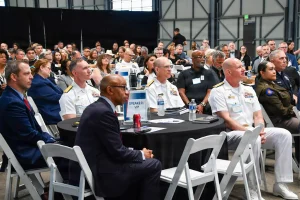
Think about the resources that exist across Los Angeles. A logistics company has trucks, warehouses, and people who know how to move things. A grocery company has food and a distribution network. A telecommunications company has equipment and technical expertise. A construction company has heavy equipment. A hotel company has rooms. A nonprofit may know a neighborhood better than almost anyone else. A foundation can provide funding. The military has logistics, communications, medical, and transportation capabilities. Government understands what is happening across the City and where the greatest needs may be. Individually, all of those organizations have capabilities. The real power comes when we connect them. That is the basic idea behind LADRRC: bring businesses, nonprofits, philanthropy, military organizations, and government together before a disaster, help them understand one another, and create a network that can be activated when Los Angeles needs it. It isn't very complicated. But doing it well requires trust.
You Don't Build Trust During a Disaster
I say this often because I believe it: You don't want to be exchanging business cards for the first time in the middle of a crisis. When something goes wrong, things move quickly. Information is incomplete. Needs change. People are under pressure. Everyone is trying to solve a problem at the same time. That is not the ideal moment to start figuring out who has trucks, who has food, who knows the right government contact, who can help with communications, or which nonprofit actually has relationships in the affected neighborhood. Those relationships should already exist. That is why a large part of LADRRC's work happens when there isn't a disaster. We bring people together. We share information. We participate in training and exercises. We introduce organizations that might otherwise never meet. We help businesses understand emergency management and emergency managers understand the capabilities available in the private and nonprofit sectors. Sometimes the most valuable outcome of a meeting is simply that two people now have each other's phone number. It may not sound very exciting until the day someone needs to make that call.
How This Connects to the City of Los Angeles
This is the part of LADRRC that I think is especially important to understand. LADRRC isn't operating separately from the City's emergency-management structure. Pacific Battleship Center has a formal relationship with the City of Los Angeles Emergency Management Department, or EMD, and LADRRC supports the City's Business Operations Center, commonly called the BOC. Our organization provides administrative support for the Collective, helps organize donations, and facilitates its efforts in alignment with our memorandum of understanding with EMD. The Business Operations Center serves as a link between the City's emergency management system and the private and nonprofit sectors. During a significant emergency, Los Angeles may activate its Emergency Operations Center (EOC), which serves as the central point for coordinating the City's response across departments and agencies. The City's BOC can operate as part of that structure, helping bring business and nonprofit capabilities into the response and providing information back out to those sectors. That connection is important. Government has tremendous capabilities, but government cannot own every truck, every warehouse, every hotel room, every piece of equipment, or every community relationship it might need during a major disaster. Nor should it. Much of that capability already exists in the community. Our job is to help connect it.
Matching a Need With a Resource
Imagine there is a significant disaster and an urgent need develops. Maybe a shelter needs bottled water. Maybe an organization needs transportation. Maybe emergency workers need meals. Maybe a community organization needs generators. Maybe a business has 20 pallets of something it wants to donate but doesn't know where those supplies would actually be useful. This is where coordination matters. Well-intentioned donations can actually create problems during disasters if nobody has asked for them or there is no system in place to receive, store, and distribute them. Anyone who has worked around disaster response has seen this happen. People want to help—and that instinct is good—but sending a truckload of something to the wrong place doesn't necessarily solve the problem. A network like LADRRC helps create a better path. What is the need? Who can meet it? How do we connect the two? The City's own emergency plans incorporate the Business Operations Center into donation and resource coordination, including connecting private-sector resources with identified needs. That's the work. It is not about collecting things just because people want to donate them. It is about helping get the right resource to the right place at the right time.
Then January 2025 Happened
The fires that swept through Southern California in January 2025 were a painful reminder of how quickly life can change. Entire neighborhoods were devastated. People lost homes, businesses, and places that had been part of their communities for generations. First responders worked around the clock. Government agencies, nonprofits, businesses, and individuals all began looking for ways to help. Pacific Battleship Center immediately began working with the City of Los Angeles to support disaster-relief efforts and provide a way for people to contribute. For me, it reinforced why this work matters. A disaster isn't an abstract planning exercise when you know the people affected. It isn't a PowerPoint. It is someone's house. Someone's business. Someone's school. Someone's neighborhood. And recovery does not end when the fire is extinguished. It can take years. That is why our name includes both Recovery and Resilience. Response matters. Recovery matters as much. And resilience means taking what we learn and using it to prepare better for whatever comes next.
Pacific Battleship Center Has a Unique Role
People sometimes ask why an organization known for Battleship IOWA and LA Fleet Week is involved in disaster preparedness. To me, it actually makes a lot of sense. Our organization has always been about more than preserving a ship. We bring people together. We work with the military. We work with first responders. We work with government at the local, state, and federal levels. We work with businesses, nonprofits, veterans, community organizations, and volunteers. LA Fleet Week has given us years of experience bringing many of those sectors together around public engagement, community service, preparedness, and resilience. LADRRC takes that network and applies it to another mission: helping Los Angeles become better connected before, during, and after a disaster. The City of Los Angeles has also designated the Pacific Battleship Center to facilitate donations of funds, grants, products, and services in support of the City's emergency management efforts. That is a responsibility we take seriously. We are not the first responders. We are not the Emergency Management Department. We aren't trying to replace anybody. We are a connector. And sometimes connecting the right people is one of the most valuable things you can do.
Businesses Have an Important Role
One area where I believe we have enormous opportunity is the business community. Businesses are often viewed primarily as donors after disasters. Write a check. Donate some products. Sponsor a recovery effort. Those things are valuable, but businesses can contribute much more. They understand logistics. Supply chains. Communications. Technology. Transportation. Construction. Healthcare. Cybersecurity. Food distribution. Facilities. Workforce. Finance. And thousands of other specialties. They also need information. During a major incident, companies make decisions about employees, facilities, operations, and customers. Better information helps them make better decisions, which ultimately helps the entire region recover. LADRRC allows businesses to be part of that conversation, build relationships with emergency management partners, and contribute expertise and resources when appropriate. Membership is free. What we ask for instead is participation—show up, build relationships, share expertise, participate in training, and be willing to help when the network needs you. I think that's a pretty good trade.
The Same Is True for Nonprofits
Nonprofits bring something equally important. They know people. A community organization may know exactly which families are struggling, which languages are spoken in a neighborhood, where seniors live, which residents have transportation challenges, or why a particular government message isn't reaching the people who need to hear it. You cannot replace those relationships with technology. Government needs those organizations. Businesses need those organizations. And those organizations need access to resources and information that may exist elsewhere in the network. Again, the value is in the connection.
Preparing for What's Ahead
Los Angeles has an unusual few years ahead. We are hosting major international events, welcoming millions of visitors and preparing for the 2028 Olympic and Paralympic Games. At the same time, the hazards we have always lived with aren't going away. If anything, the need for coordination becomes greater. The City is already planning complex, multi-agency command-and-coordination structures for the 2028 Games, with EMD among the principal public-safety stakeholders. That creates an opportunity. The relationships we build preparing for major planned events can also make us stronger when dealing with events nobody planned for. We can learn together. Train together. Solve problems together. And hopefully, become a little better each time.
What Success Looks Like
I don't think success for LADRRC is measured by how many people sit in a meeting. It isn't how many names are on a membership list. It is whether the network works when somebody needs it. Can we identify a need? Can we find someone who can help? Do the organizations already trust one another? Can we move information quickly? Can we prevent duplication? Can we help resources get where they will actually make a difference? And after the immediate emergency is over, can we stay involved long enough to help communities recover? Those are the questions that matter. Because resilience isn't a slogan. It is a capability. And capability is built over time.
Stronger Together
No organization in Los Angeles can handle a catastrophic disaster on its own. Not the City. Not the military. Not a corporation. Not a nonprofit. Not Pacific Battleship Center. But collectively, Los Angeles has extraordinary resources. We have some of the best first responders in the world. We have major corporations and small businesses. Universities. Hospitals. Ports. Transportation networks. Community organizations. Philanthropy. Military installations and units. Nonprofits. Volunteers. And millions of people who will step forward when their neighbors need help. The question is whether those pieces know how to find one another. That is what we are trying to build through LADRRC. A network based on relationships. A way to share knowledge. A way to connect resources. And a way for people who care about Los Angeles to be useful when Los Angeles needs them. We hope the next major disaster is a long way off. But hope isn't a plan. The time to build the network is now. If your business, nonprofit, philanthropic organization, or government agency has expertise, resources, or simply a desire to help build a stronger Los Angeles, I hope you'll join us. Get involved. Meet people. Learn what others can do. Please tell us what you can do. Because when the next emergency comes, none of us will care whose logo is on the truck, the box, the building, or the uniform. We'll care that the right help got to the right place. And we'll be glad we knew each other before we needed each other.
Limited time only!
Kids Board Free
In the all-new Life of a Sailor experience, kids become sailor recruits, building their skills, following the story of a famous sailor, and joining Vicky the Dog on a scavenger hunt through Battleship IOWA.
Kids board free with a paid adult.