Coming soon!:
Life of a Sailor: Fire Control Brings Battleship IOWA's Gun Plot Back to Life
What did it take to aim Battleship IOWA's massive 16-inch guns?
Starting with Life of a Sailor: Fire Control, visitors can do more than learn the answer. They will step into the role of the sailors who once made the system work.
Scheduled to open in time for the 2026 holiday season, the new immersive experience aboard Battleship IOWA, home of the National Museum of the Surface Navy, will transform guests into newly assigned members of the ship's Fire Control crew. Participants will meet their Chief, learn how sailors lived and worked aboard the battleship, report to their stations, and then operate a working recreation of the Mk 38 Gun Fire Control System used to direct IOWA's 16-inch guns. The experience builds on the museum's broader Life of a Sailor concept by having visitors become part of the crew rather than observe.
The difference is important. The new experience is not simply a simulator placed inside a museum. It moves from historical interpretation to participation. Guests begin as inexperienced sailors reporting aboard, learn why their jobs matter, see the original machinery, and then move into the recreated plotting room, where their performance affects the mission's outcome.
Reporting for Duty
The preshow establishes that idea immediately. Guests meet a veteran Chief Fire Controlman in a berthing compartment, where he introduces them to life aboard ship with the kind of dry humor sailors might use among themselves. He explains that sailors sleep in stacked bunks, eat when they are told, and quickly learn where every low doorway is. Then he makes clear why these particular recruits have been assigned to him: when the battleship fires its big guns, Fire Control is responsible for making sure they hit what they are supposed to hit.
From there, the Chief leads them through the ship and into IOWA's original Aft Main Battery Plot. Along the way, he tells them that the Chief who trained him learned the job from someone who had walked the same passageways when the ship was new. That passing of knowledge from sailor to sailor becomes one of the most important ideas in the experience. The technology mattered, but so did the people who understood it, trained others to use it, and depended on one another to make the entire system function.
Inside the Brain of the Big Guns
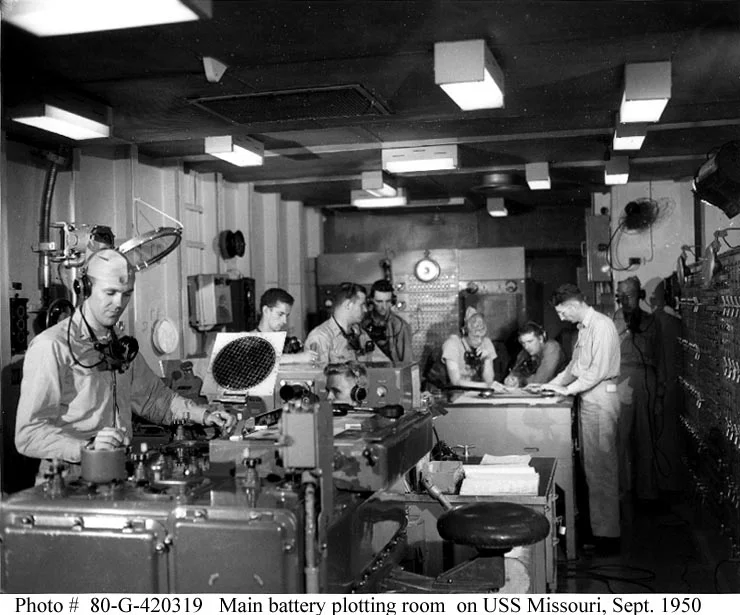
Inside Aft Plot, the work becomes clearer. The room sits deep inside the ship, behind armor, with no windows and no view of the ocean. The sailors working there couldn't see the enemy and, in many cases, couldn't even see the guns they were directing. Instead, they worked with dials, handwheels, plotting tables, radar information, mechanical computers, and reports from elsewhere on the ship. Their task was to take all of that information and determine where a moving target would be when a shell traveling miles across the ocean finally arrived.
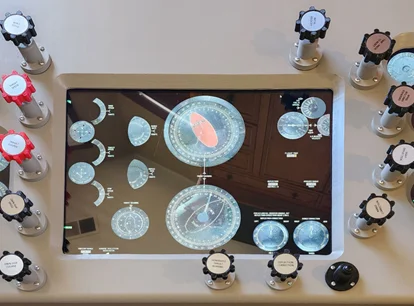
The Chief describes the space as the brain of the big guns. The comparison is apt. The Mk 38 Gun Fire Control System connected observations from directors and radar with plotting equipment, the Mk 8 Rangekeeper, the Mk 48 Dead Reckoning Tracer, communications systems, switchboards, and the turrets themselves. Each component did something different, but the system worked only when trained sailors coordinated them.
That is where the visitor's own training begins.
Guests learn each station's responsibilities before entering the simulator. The range operator tracks the target's distance and corrects shots that land long or short. The bearing operator follows the target's direction and corrects shots that fall left or right. At the center position, another sailor keeps the system oriented toward the target, tracks time of flight, and helps coordinate information moving through the machine. Other sailors work the plotting table, recording the target's position at regular intervals so the crew can determine its course and speed. If the target changes direction, they must recognize it. If a salvo misses, spotting information returns to the plotting room, and the crew adjusts the solution before firing again.
At the center of that process is the Mk 8 Rangekeeper, one of the ship's most remarkable pieces of machinery. It has no computer monitor and no software interface in the modern sense. It performed calculations through gears, cams, shafts, electrical signals, and continuous mechanical movement. The ship moved. The target moved. The ship rolled and pitched. Wind, projectile characteristics, and time of flight all affected the result. The system had to continuously calculate not just where the target was, but where it would be.
The machinery could perform those calculations, but only if the operators supplied accurate information and kept the system coordinated. That relationship between people and technology is what the experience is designed to reveal.
Same Wheels. Same Dials. Different Hands.
At the end of the preshow, the Chief stands in IOWA's original plotting room with the historic equipment behind him. The machines the sailors once used remain there. The working recreations the guests are about to operate are only a few steps away. He explains that the new machines function like the originals, right down to the handwheels. Then he hands the visitor a plotting pencil and sends the new crew to its next assignment.
"Your turn."
"Report to Plot."
The transition is simple, but it changes the experience. The visitor has moved from hearing about Fire Control to being expected to perform it. The preshow summarizes that handoff in one line: "Same wheels. Same dials. Different hands."
The Mission Begins
Once inside the simulator, the Mission Commander assigns the crew to their stations. Guests take responsibility for range, bearing, radar operations, spotting, dead reckoning, chart plotting, and other elements of the firing solution. One of them receives the firing key. Together, they must track the target, maintain the information the system requires, recognize changes, make corrections, and coordinate the simulated firing mission.
No single station can complete the mission alone. A mistake in one place affects the rest of the crew. Accurate information must move from one station to another, and every participant must understand how their responsibility contributes to the larger task. The complete experience is expected to last approximately one to one and a half hours, moving guests from orientation and training into an operating Fire Control team.
The Guns Everyone Sees - and the System Behind Them
The scale of the challenge becomes clearer when you compare it to the weapons the system controlled. Iowa-class battleships carried nine 16-inch/50-caliber Mark 7 guns in three turrets. The "16-inch" designation refers to the bore diameter, while "50-caliber" means the bore length was 50 times that diameter, about 66.7 feet. The guns fired approximately 2,700-pound armor-piercing projectiles and 1,900-pound high-capacity projectiles. A full service propellant charge weighed roughly 660 pounds, helping launch projectiles to ranges approaching 24 miles.
Those enormous barrels are among the first things visitors notice when they see IOWA, but the guns themselves were only the visible end of a much larger system. Behind them were directors, radar sets, mechanical computers, plotting equipment, switchboards, communications systems, turret machinery, and sailors stationed throughout the ship. Standing beneath a 16-inch gun conveys the scale of battleship firepower. Working inside Gun Plot reveals the complexity required to use it.
Could Your Crew Have Done It?
That complexity becomes especially meaningful during the historical missions the museum is developing for the experience.
One mission draws on IOWA's February 1944 operations near Truk (now Chuuk) during Operation Hailstone. IOWA and NEW JERSEY participated in a surface sweep in which IOWA engaged the Japanese cruiser Katori and later fired at the fast-moving destroyer Nowaki. IOWA's action report recorded the initial range to Nowaki at approximately 35,700 yards, later increasing to roughly 39,000 yards. As glare, haze, and distance obscured the destroyer, IOWA fired her final two salvos under full radar control.
In the museum experience, that history becomes a problem for the guest crew to solve. Participants must track a moving target across miles of ocean while their own ship is moving, maintain the firing solution, process new information, and make corrections. Afterward, their performance can be compared with what IOWA's sailors faced in the actual engagement.
The result changes the nature of the historical question. Instead of simply asking what IOWA did, visitors can ask: Could our crew have done it?
Tracking What You Cannot See
Another episode from IOWA's wartime history shows how capable the fire-control system could be. During the May 1944 bombardment of Ponape, a hangar being used as a tracking reference disappeared behind a ridge. IOWA continued maneuvering and changed course approximately 180 degrees while the target reference remained out of sight. The rangekeeper continued calculating its position. When the landmark reappeared roughly fifteen minutes later, the recorded discrepancy was only about one mil in bearing and 100 yards in range.
As the ship maneuvered, the crew and machinery maintained a constantly changing mathematical picture of something they could no longer see. That ability also helps explain why battleship crews trained for both direct and indirect fire. Spotting information could come from the ship, radar, another observer, or eventually aircraft, and crews had to incorporate all of it into the firing solution.
From Mechanical Computing to Drone Spotting
The technology continued to evolve. In the 1980s and early 1990s, the Iowa-class battleships combined their World War II-era 16-inch guns with much newer systems. Pioneer uncrewed aerial vehicles provided spotting information, including during Gulf War operations by MISSOURI and WISCONSIN. In one widely remembered episode, Iraqi defenders reportedly signaled their desire to surrender after seeing a Pioneer overhead following bombardment of Faylaka Island.
The contrast is striking: massive guns rooted in 1940s technology operating alongside uncrewed aircraft. Yet the underlying problem remained familiar. Accurate information still had to reach the right people, be interpreted correctly, and be translated into action.
Explore the LA Waterfront
Battleship IOWA is located on the LA Waterfront in San Pedro, part of the City of Los Angeles and home to the Port of Los Angeles. The waterfront lets visitors combine the museum with restaurants, harbor views, maritime attractions, public spaces, and other destinations throughout San Pedro and nearby Long Beach.
Visitors can make Battleship IOWA part of a full day exploring the waterfront or include it as a distinctive stop during a larger Los Angeles itinerary.
Recreating the Mk 38
Recreating that system for today's visitors required far more than making equipment that looked authentic.
The IOWA team conducted nearly a year of intensive technical research using Navy range tables, equipment manuals, schematics, training documentation, fire-control materials, historical records, and other sources. The resulting simulation represents an integrated recreation of the Mk 38 Gun Fire Control System, including Mk 38 Gun Director emulators, Mk 13 Main Battery Radar, the Mk 8 Rangekeeper, Mk 48 Dead Reckoning Tracer and Indirect Fire Computer, a simplified fire-control switchboard, turret emulator, AN/SPA-25G radar console, and AN/SPS-64 surface-search radar.
What matters is that these components don't function as isolated exhibits. They interact. A change entered at one station affects information somewhere else. Range, bearing, own-ship movement, target movement, spotting corrections, radar information, and firing orders all become part of the same connected process.
That interconnectedness is one reason the project has taken years to develop.
Preserving More Than Machinery
The simulator represents nearly three years of research, engineering, programming, fabrication, historical study, testing, and training by Battleship IOWA's Innovation, Engineering, and Technology team, largely made up of volunteers. Behind the scenes, 15 digital computers reproduce the behavior of systems that originally relied on mechanical and electromechanical computation.
Recreating the machinery was only part of the challenge. The volunteers also had to recreate the knowledge required to operate it.
That may ultimately be one of the most important things Life of a Sailor: Fire Control preserves. Historic equipment can remain aboard a ship for generations. A rangekeeper can be restored. A radar console can be displayed. A director can remain in place. But if no one understands how those machines interacted, how sailors operated them, and how information moved through the system, an important part of the history is still lost.
The simulator aims to preserve both the machines and the understanding behind them.
One Generation Teaching the Next
Volunteer Alison Spack's story illustrates that process. When she first began volunteering aboard IOWA, she did not consider herself especially technical. She started by cleaning brass and helping care for areas of the ship. Then she joined the gun-simulator training program and discovered an interest in the big guns and the systems behind them. She kept learning and became increasingly involved. Today, she is the simulator's principal trainer and one of the team's leading experts on the recreated gun fire-control system.
Her path mirrors the experience's larger idea. People don't always know what they are capable of until they get the chance to try something unfamiliar. A complicated engineering system that looks intimidating from the outside becomes understandable when someone explains the job, assigns a station, and lets a participant join the process.
The Beginning of Something Larger
That idea is also helping shape the next generation of experiences aboard IOWA. The Fire Control project is intended to serve as a model for future interactive experiences that bring other parts of the battleship to life, including the ship's engineering plant. Instead of simply showing visitors where sailors worked, the museum can increasingly allow them to understand what those sailors did and why their individual responsibilities mattered to the entire crew.
For the National Museum of the Surface Navy, that is the larger opportunity. A battleship is impressive because of its size, weapons, armor, machinery, and engineering. But none of those things operated on their own. Thousands of sailors, each trained for a particular responsibility, turned the ship from a collection of machinery into a functioning naval weapon.
Life of a Sailor: Fire Control lets visitors experience a small part of that responsibility for themselves.
The original machines remain aboard IOWA. A few steps away, their functions come back to life. The hands on the controls are different now. The mission is waiting.
Report to Plot.

Limited time only!
Kids Board Free
In the all-new Life of a Sailor experience, kids become sailor recruits, building their skills, following the story of a famous sailor, and joining Vicky the Dog on a scavenger hunt through Battleship IOWA.
Kids board free with a paid adult.