
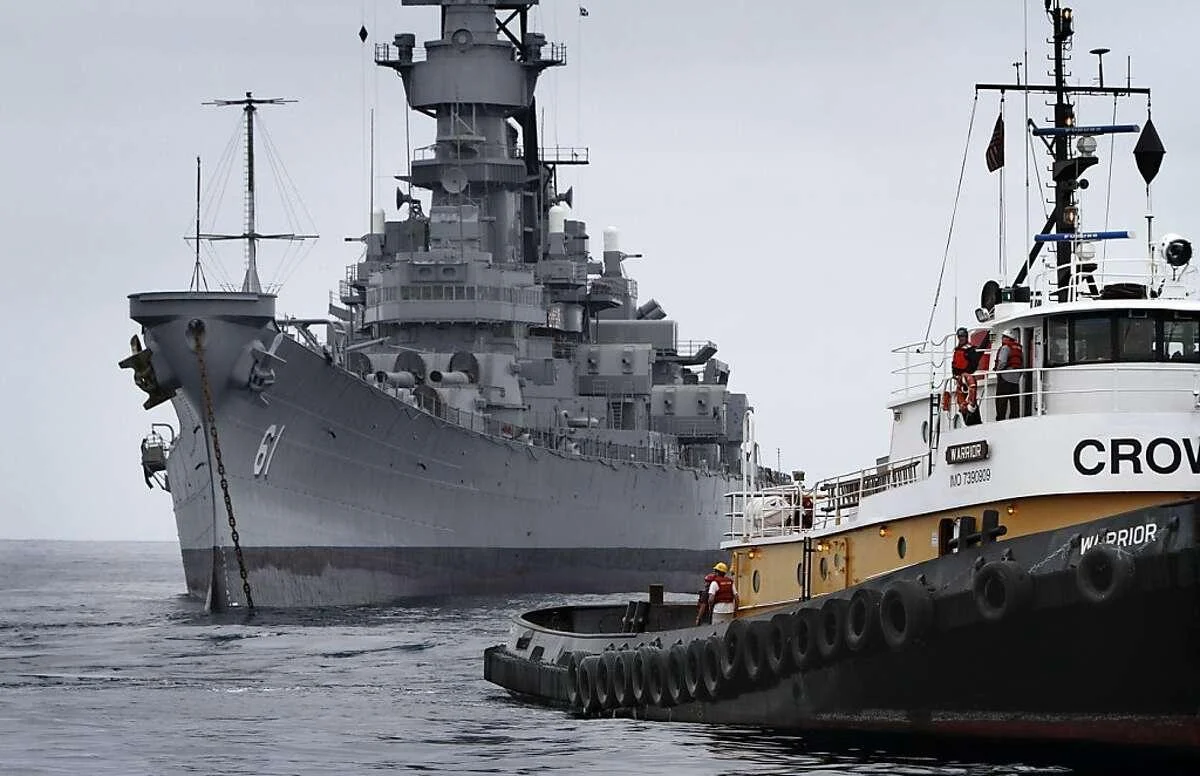
How close could the 887-foot battleship actually get to her namesake state? What would stop her, what federal restrictions apply, and what would it cost to overcome those obstacles?
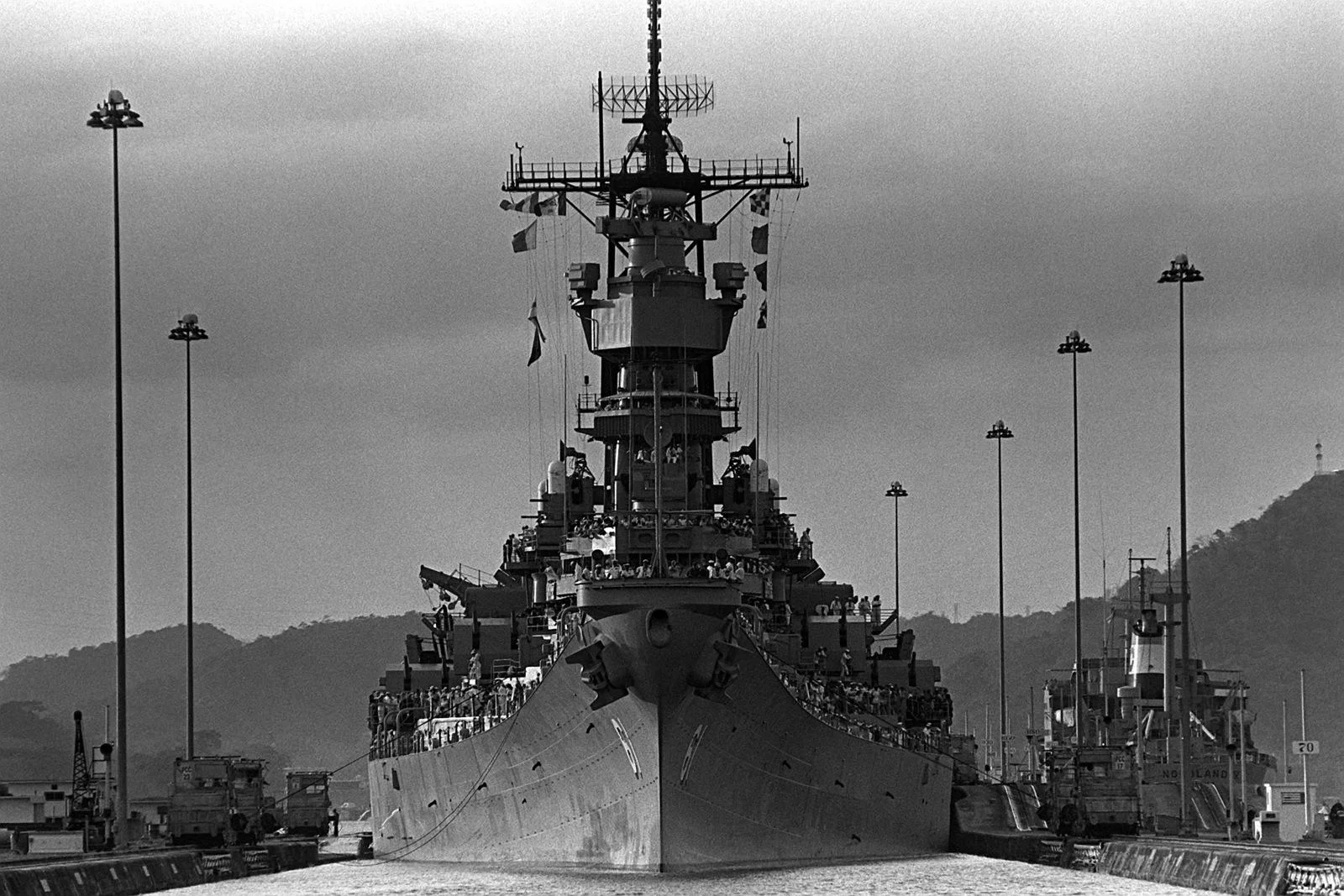
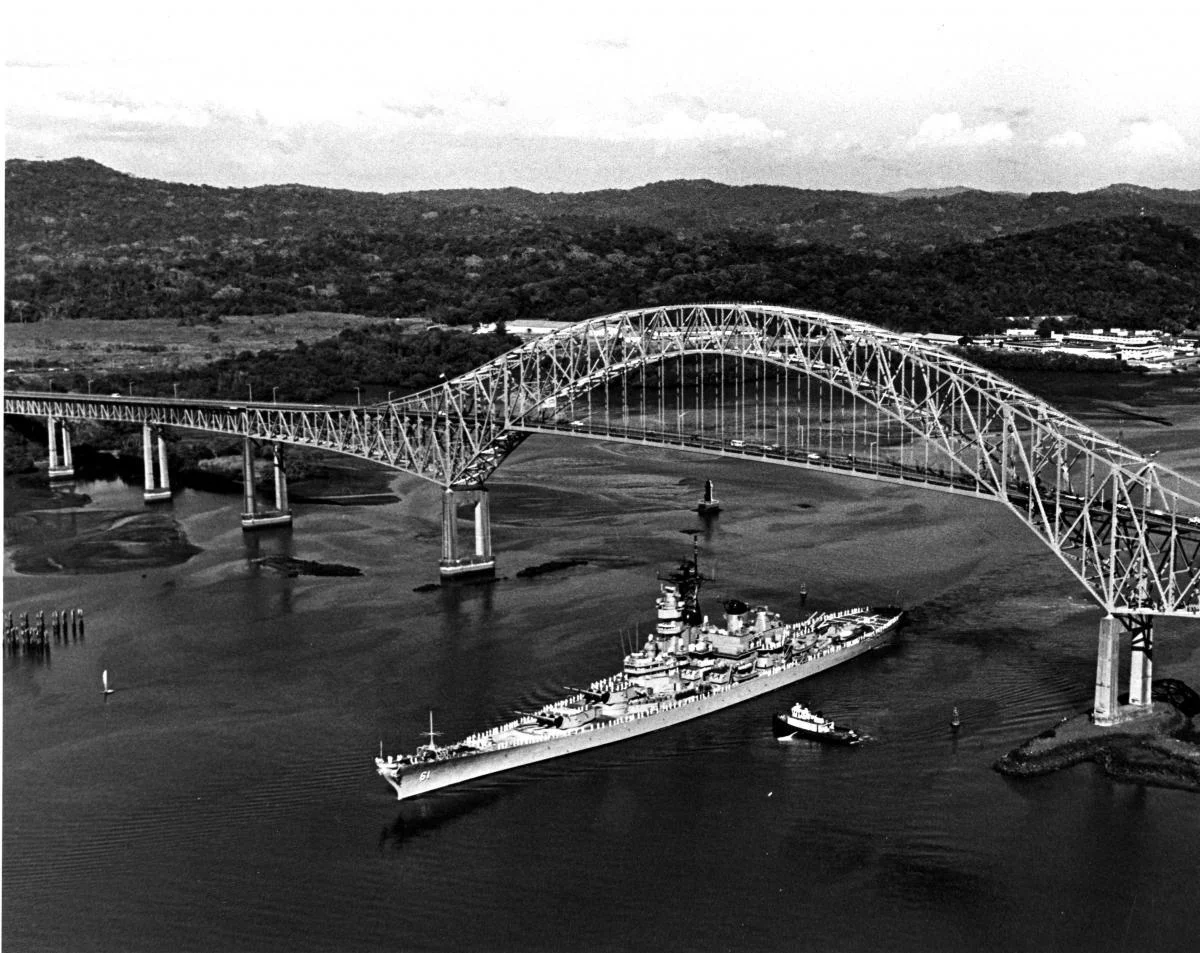
Battleship IOWA has crossed the Atlantic and Pacific, carried a president, fought in World War II and Korea, passed through the Panama Canal, and traveled thousands of miles during nearly five decades of naval service.
But could the battleship that bears Iowa’s name ever actually travel to the State of Iowa? The answer is more complicated than simply yes or no.
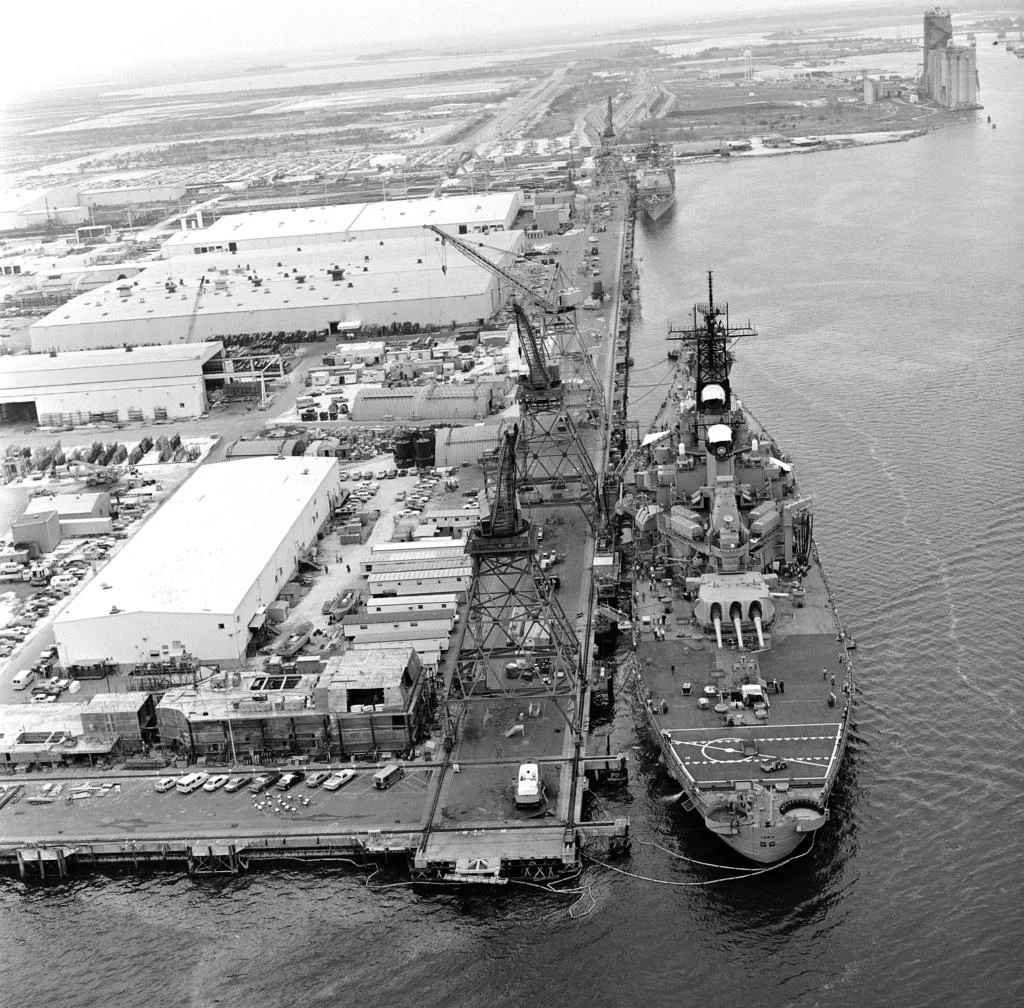
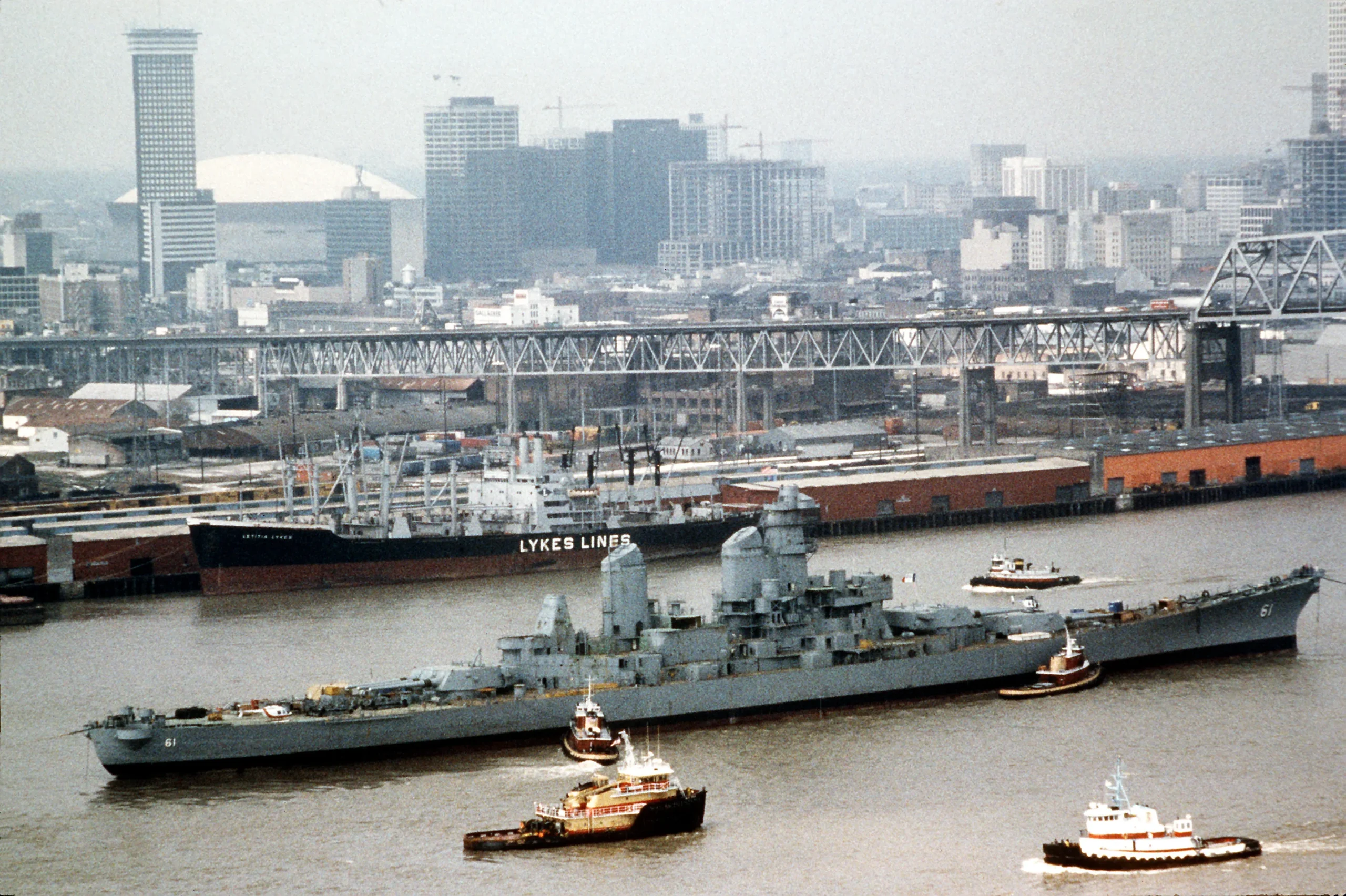
From an engineering standpoint, Battleship IOWA could be moved a remarkable distance toward Iowa via existing waterways. She could be towed from Los Angeles, transit the Panama Canal, cross the Gulf of Mexico, and enter the Mississippi River. In her present configuration, however, her approximately 174-foot air draft would prevent her from continuing beneath the bridges at New Orleans.
Could equipment be removed so she could continue toward Baton Rouge? Possibly. But the answer depends upon more than removing the mast. Engineers would first have to determine whether IOWA’s air draft could be reduced enough without cutting permanent superstructure. If it can, the Port of Greater Baton Rouge represents the logical northern limit of the existing deepwater navigation system. If it cannot, New Orleans becomes the practical limit unless portions of the ship itself are structurally altered.
Even Baton Rouge would still leave IOWA roughly 1,080 river miles from the Iowa state line. North of Baton Rouge, the Mississippi changes from a deep-draft ship channel to an inland navigation system maintained primarily for barges. Farther north, locks designed around 600-foot barge tows encounter an 887-foot battleship.
And before any of those engineering questions could actually be acted upon, there is another major obstacle, Federal law and congressional direction governing the preservation and transfer of Battleship IOWA. Congress required IOWA to remain in California, retained the federal government's authority to take the ship back during a national emergency, and subsequently directed that IOWA be treated as a potential mobilization asset whose alterations could be reversed.
That means some of the engineering solutions that are theoretically possible may not presently be legally permissible.
The answer at a glance
|
Tow IOWA exactly as configured
|
New Orleans area |
$4–8 million transportation
|
Relocation outside California would require federal action |
|
Remove reversible topside equipment only
|
Potentially Baton Rouge |
$8–15 million if feasible
|
Must remain consistent with federal/Navy preservation conditions |
|
Cut permanent superstructure
|
Potentially Baton Rouge |
$20–50 million+
|
Could conflict with reversibility and military-utility requirements |
|
Dismantle and reconstruct IOWA in Iowa
|
Iowa |
$750 million–$1.5 billion+
|
Would almost certainly require major federal/Navy action before proceeding |
|
Keep IOWA intact and rebuild the waterways
|
Iowa |
$25–50 billion+
|
Still requires federal authorization to relocate IOWA |
These figures are order-of-magnitude planning estimates, not contractor quotations or engineering estimates. No formal feasibility study has been conducted for any of these hypothetical relocations.
The dimensions that control the journey
Pacific Battleship Center’s official Battleship IOWA Crew Handbook lists the ship’s current dimensions at approximately:
- Length overall: 887 feet 3 inches
- Beam: 108 feet 2 inches
- Current draft aft: 32 feet 6 inches
- Current draft forward: 27 feet
- Current height to mast top: 174 feet above the waterline
The handbook also notes that IOWA historically drew between 36 and 38 feet, depending on her load. Today she floats considerably higher because she no longer carries the enormous quantities of fuel, ballast, powder, projectiles, and provisions that she carried in naval service.
Four measurements therefore determine nearly the entire journey:
Length. Beam. Draft. Air draft.
The ocean route can accommodate them. The inland waterways eventually cannot.
The first obstacle is legal, not physical
There are actually two related federal restrictions that matter.
Congress required IOWA to remain in California.
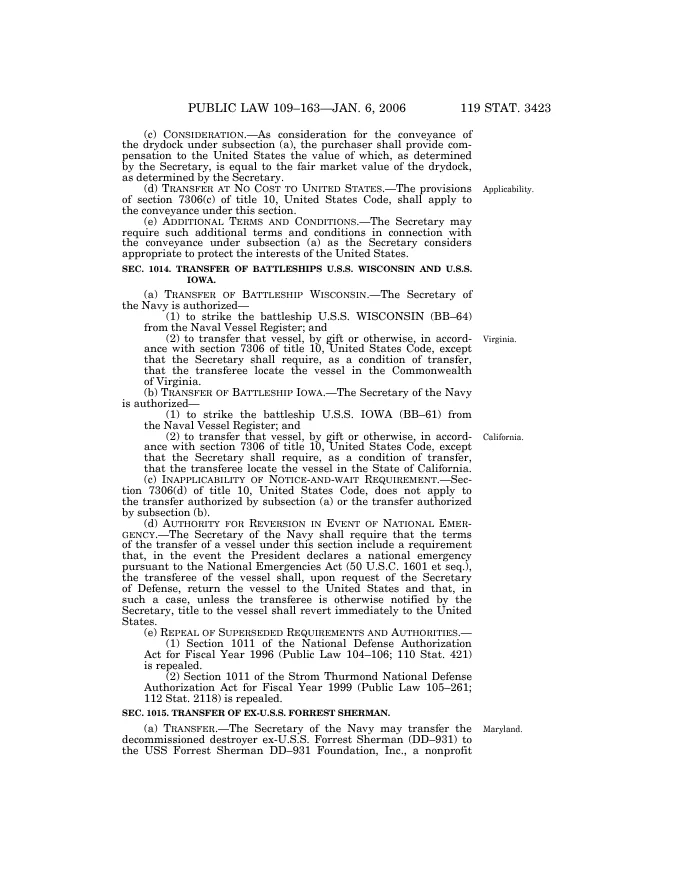
Section 1014 of the National Defense Authorization Act for Fiscal Year 2006 authorized the Navy to transfer Battleship IOWA. Still, it required, as a condition of that transfer, that the recipient locate the vessel in the State of California.
The same law also required the transfer agreement to provide that, if the President declares a national emergency, the Secretary of Defense can require the vessel to be returned to the United States, with title reverting to the federal government unless otherwise directed.
That means the Pacific Battleship Center could not simply relocate permanently to Louisiana or Iowa on its own.
The Navy would have to be involved, the terms of the donation would have to be addressed, and congressional action could be necessary to authorize a permanent move outside California.
But Congress also imposed another important preservation expectation.
Congress continued to treat IOWA as a potential mobilization asset
During consideration of the FY2007 National Defense Authorization Act, the House Armed Services Committee specifically returned to the issue of IOWA and WISCONSIN. The committee stated that both battleships were to be regarded as potential mobilization assets and instructed the Navy and the recipient organizations to treat them accordingly. Among the measures identified by the committee was that the ships should not be altered in a way that impaired their military utility.
The subsequent FY2007 conference report refined the preservation expectation. The conferees stated their understanding that the Navy would require IOWA and WISCONSIN to be preserved and that alterations made while the ships were in museum custody could be reverted.
That distinction is extremely important for this hypothetical journey. Removing an antenna and putting it back is one thing. Removing a mast that can later be reinstalled may also be possible. Cutting several levels of welded superstructure is different. Cutting the 887-foot hull into multiple sections is different again.
The farther a proposal moves from reversible alteration toward permanent structural dismantling, the more serious the federal issue becomes.
What does that mean for a move to Iowa?
The congressional language does not mean that IOWA can never be modified under any circumstances. Congress can change federal law, and the Navy can address conditions outlined in its transfer agreements within the authority Congress provides. But the present legal framework cannot simply be ignored.
Any relocation plan involving permanent structural changes would require federal legal review before engineers began cutting steel.
For purposes of the rest of this article, therefore, the engineering question is:
What could physically be done if the necessary federal approvals or legislative changes were first obtained?
Can Battleship IOWA actually be towed that far?
Yes. IOWA no longer operates under her own propulsion, so that any long-distance relocation would require an ocean-going towing vessel and substantial preparation. But towing IOWA is not theoretical.
Pacific Battleship Center developed a detailed, Navy-approved planning process in preparation for bringing the ship to Southern California. The original technical package addressed bathymetry, tides, bridge clearances, ballasting, towing bridles, emergency anchoring, tug requirements, weather limitations, and pilotage. IOWA was subsequently moved from Northern California to Los Angeles in 2012 for approximately $750,000. Modern rates would be substantially higher.
So a transcontinental tow would be expensive. The much larger problems appear when IOWA heads inland.
Could IOWA transit the Panama Canal?
Dimensionally, yes.
The Panama Canal’s 2026 vessel requirements provide Neopanamax dimensions substantially larger than IOWA, and the Canal specifically publishes procedures applicable to non-self-propelled vessels.
IOWA is approximately:
- 887 feet long × 108 feet wide
- Her present deepest draft is approximately:
- 32½ feet
The Panama Canal Authority’s current August 2026 operating adjustment reduces maximum Neopanamax draft to 48 feet beginning August 26 and 47½ feet beginning September 3—still well beyond IOWA’s current draft.
A battleship under tow would unquestionably require special review, tug arrangements, inspection, pilots, and Canal approval.
But the important point is clear:
The Panama Canal is not what prevents IOWA from reaching Iowa.
Entering the Mississippi River
After crossing the Gulf of America, IOWA could enter the Lower Mississippi.
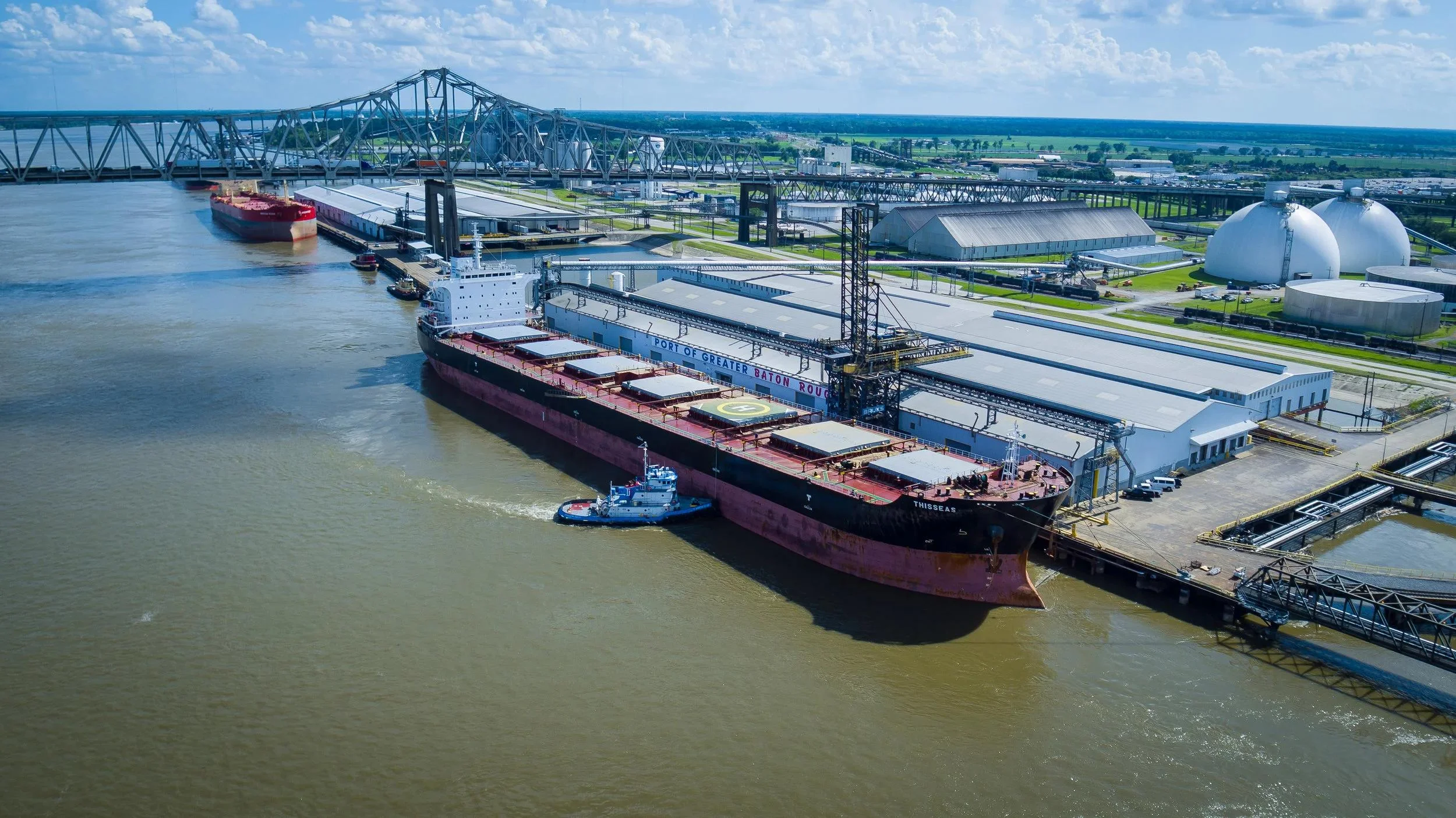
The deep-draft navigation system extends through New Orleans toward Baton Rouge. The Port of Greater Baton Rouge identifies itself as the head of deepwater navigation on the Mississippi River, served by a 45- to 50-foot shipping channel toward the Gulf.
With a present draft of approximately 32½ feet, IOWA’s underwater depth is not initially the limiting factor.
Her height is.
As IOWA sits today, New Orleans is the practical limit
Battleship IOWA presently reaches approximately 174 feet above the waterline to the mast top. NOAA notes that there are no bridges across the Mississippi below New Orleans, but multiple major bridges cross the river between New Orleans and Baton Rouge.
That means IOWA could travel up the Mississippi toward New Orleans without encountering an overhead bridge. Once she reaches the city, however, the route changes.
IOWA in her present configuration cannot fit beneath the available overhead clearances.
Therefore, if the requirement were:
Do not remove major portions of IOWA, do not dredge a special channel, and do not alter bridges.
the practical answer is:
New Orleans
A suitable deep-draft site below the first restrictive bridge represents the most defensible destination for IOWA, essentially as she sits today.
Estimated transportation cost: $4–8 million
That conceptual budget could include:
- structural and stability surveys;
- tow engineering;
- towing preparation;
- ocean-going tug;
- fuel;
- harbor assist tugs;
- Panama transit;
- pilots;
- marine surveyors;
- insurance;
- port and Coast Guard requirements;
- contingency.
It does not include construction of a permanent museum facility. A complete museum relocation with heavy moorings, utilities, public access, security, and visitor infrastructure could reasonably become a $15–30 million or greater project, depending heavily on the selected berth.
Could IOWA continue to Baton Rouge?
Possibly. But it is not as simple as removing the mast.
The Crew Handbook identifies the current mast top at approximately 174 feet above the waterline and the forward main battery director’s rangefinder, Spot 1, at approximately 116 feet. That indicates that a significant portion of IOWA’s overall height lies above the 116-foot level.
It does not tell us that everything above 116 feet is removable. IOWA has substantial permanent upper works. Her primary navigation bridge is on the 04 Level, and her secondary navigation bridge is on the 08 Level. Antennas, some mast components, communications equipment, and other fittings may be removable.
Permanent welded superstructure is another matter. Deckhouses, bridge structures, armored components, foundations and other upper works cannot simply be treated like antennas that can be disconnected and lifted off.
The controlling question therefore becomes:
- What is IOWA’s minimum air draft while leaving the permanent superstructure intact?
- That number needs to be determined from actual ship plans and a physical survey.
The Lower Mississippi clearances are tighter than they appear
NOAA’s 2026 Coast Pilot identifies several significant overhead restrictions above New Orleans.
Most importantly, overhead electrical cables near Harahan are reported to have a minimum clearance of approximately 145 feet.
The highway bridges farther upriver also impose substantial restrictions. NOAA has recently completed new lidar-based clearance work for the bridges between New Orleans and Baton Rouge and emphasizes that actual available clearance depends upon river stage.
A ship cannot plan around nominal bridge height alone.
The engineering study would need to establish:
- the elevation of every permanent structure on IOWA;
- which antennas and mast components can be reversibly removed;
- river stage during the proposed transit;
- actual air gaps;
- required navigation safety margins;
- and whether any proposed alteration is consistent with the federal requirement that alterations be reversible.
Only then could Baton Rouge be confirmed as achievable without cutting permanent ship structure.
Two very different ways of reaching Baton Rouge
Scenario 1: Reversible removal is sufficient
If antennas, mast components, and other legitimately removable equipment can reduce IOWA’s air draft enough while leaving the permanent superstructure intact, she could potentially continue through the existing deepwater system toward Baton Rouge.
This would remain primarily a ship relocation project. It would also be the solution most consistent with the congressional expectation that alterations made in museum custody could be reversed.
Estimated transportation cost: $8–15 million
A conceptual allowance could include:
- the ocean tow;
- naval architecture and air-draft surveys;
- crane mobilization;
- removal of approved topside equipment;
- storage and protection;
- Mississippi River pilotage;
- additional tug assistance;
- reinstallation of removed equipment;
- insurance and contingency.
This budget should remain conditional until an actual air-draft survey proves the route feasible.
Scenario 2: Permanent superstructure must be cut
If the ship remains too high after conventionally removable equipment is taken away, reaching Baton Rouge could require cutting portions of IOWA’s welded superstructure. That would be a fundamentally different undertaking.
Potential work might affect:
- structural steel;
- decks;
- bulkheads;
- electrical systems;
- piping;
- ventilation;
- foundations;
- historic spaces;
- armored structures;
- watertight and weather boundaries.
From an engineering standpoint, this could be done. But it would also run directly into the federal preservation issue. Congress instructed that the battleships not be altered in ways that would impair their military utility, and the subsequent conference report contemplated alterations that could be reversed.
A proposal to remove major welded structural components would therefore require legal review by the Navy and the federal government before it could be considered a viable solution.
Preliminary engineering allowance: $20–50 million+
This is a much less certain estimate. A limited structural alteration could fall toward the lower end. Removing and reconstructing major portions of the superstructure could cost substantially more.
And unlike the reversible scenario, cost would not be the only hurdle. Federal authorization could become the controlling issue.
Is Baton Rouge therefore the closest port to Iowa?
The most accurate answer is:
Baton Rouge is the northern end of the existing deepwater navigation system that IOWA could reach.
The Port of Greater Baton Rouge is officially the head of deepwater navigation on the Mississippi River. But whether IOWA herself can reach it without cutting permanent structure has not been established.
So the conclusion must be stated carefully:
New Orleans is the practical limit for IOWA in her present configuration.
Baton Rouge is the potential maximum deepwater destination if engineering demonstrates that sufficient air draft can be achieved through reversible alterations. If permanent structural cutting is required, Baton Rouge becomes both an engineering and a federal legal question.
Even Baton Rouge is still about 1,080 river miles from Iowa
Reaching Baton Rouge would sound like IOWA had traveled deep into the heart of the country. But by river, Iowa would still be a long way away. The distance from Baton Rouge to the Ohio River at Cairo, Illinois, is approximately 720 river miles. From Cairo, another roughly 360 miles along the Upper Mississippi River separate the junction from the southeastern edge of Iowa near Keokuk. The result is approximately 1,080 river miles from Baton Rouge to Iowa and the waterway immediately changes character north of Baton Rouge.
North of Baton Rouge: the nine-foot problem
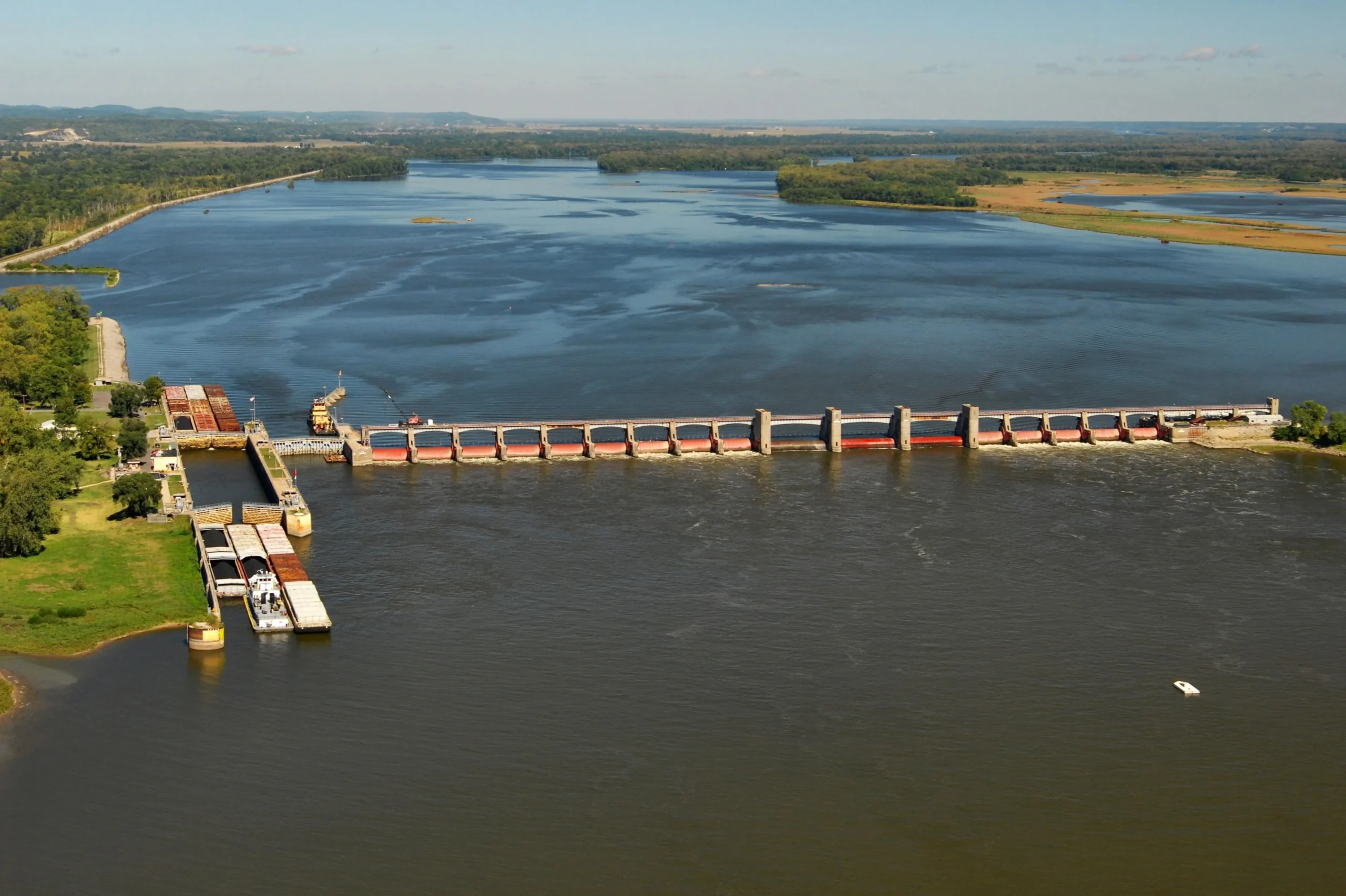
The inland Mississippi navigation system is maintained primarily for barges. The federally authorized navigation channel upriver is approximately nine feet deep.
| Inland Mississippi navigation channel |
9 feet
|
| IOWA forward draft |
27 feet
|
| IOWA aft draft |
32½ feet
|
The ship needs more than three times the maintained navigation depth.
And remember that IOWA is already lightly loaded compared with her naval service condition.
There is no realistic amount of unloading that turns this battleship into a nine-foot-draft river vessel.
Isn’t the Mississippi deeper than nine feet in places?
Yes, some parts of the Mississippi are far deeper. But isolated deep areas do not create a continuous navigation route for a battleship.
IOWA would require adequate depth through every crossing, bend, shoal, approach, bridge, restrictive reach, and turning area. An intact transit north would therefore require extensive hydrographic surveys and almost certainly major dredging and river engineering.
Even solving the depth problem would not solve the next obstacle.
IOWA is too long for many Upper Mississippi locks
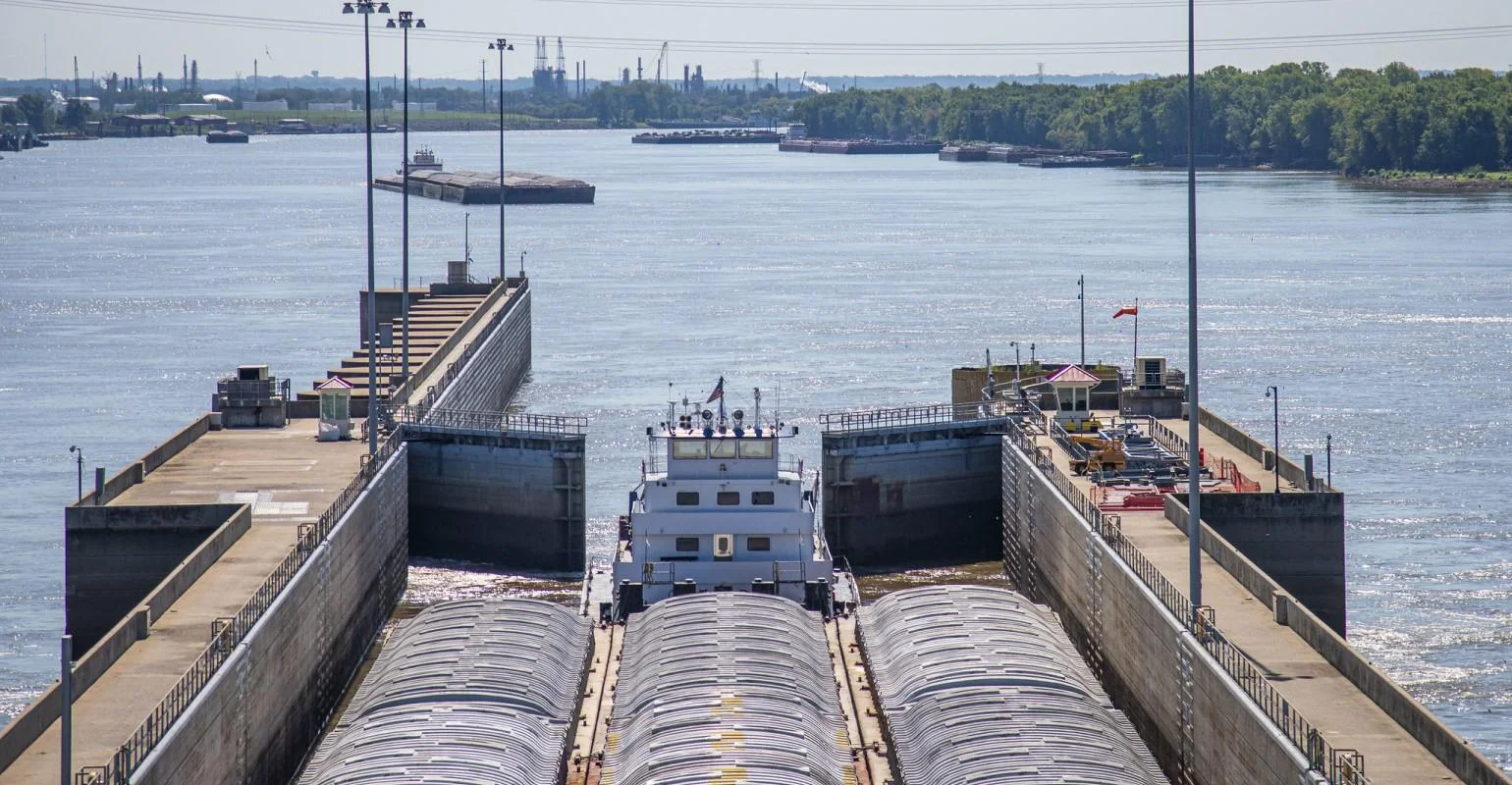
Most of the Upper Mississippi lock chambers were constructed during the 1930s and are approximately 600 feet long. IOWA is 887 feet 3 inches long, approximately 287 feet longer than a 600-foot lock chamber. Commercial barge tows can be broken apart and passed through a lock in sections. A battleship cannot.
Width presents another concern wita mny chambers approximately 110 feet wide. IOWA is approximately 108 feet 2 inches wide. Even where a chamber is long enough, the available lateral margin could be extraordinarily small and would necessitate detailed naval-architecture and lock-transit analysis.
How much does replacing one lock cost?
The Corps of Engineers is building a useful real-world comparison at Lock and Dam 25. The new project will add a 1,200-foot lock beside the existing 600-foot chamber.
The Corps’ current estimated cost is $732 million for that one project. The Corps identifies Lock 25 as one of seven new 1,200-foot lock projects planned under the Navigation and Ecosystem Sustainability Program. That illustrates the scale quickly.
Five comparable lock projects alone would approach $3.7 billion. And none of that would solve the hundreds of miles of inadequate channel depth.
Could IOWA approach Iowa by the Missouri River instead?
The Missouri eliminates some of the lock problem. It does not eliminate the depth problem. The Corps’ Bank Stabilization and Navigation Project creates a navigation channel approximately 9 feet deep × 300 feet wide. IOWA still draws more than 30 feet.
So whether she approaches Iowa from the Mississippi or Missouri, the same fundamental problem remains:
America’s inland waterways were designed around barges, not ocean-going battleships.
Option 3: Rebuild the waterways for an intact IOWA
If the objective is absolute, Battleship IOWA must arrive in Iowa as an intact ship, the waterways themselves would have to change.
A project could require:
- hundreds of miles of deep-channel construction;
- dredging and disposal;
- rock removal;
- widening restrictive reaches;
- river-training structures;
- replacement or bypass of locks;
- bridge and overhead utility modifications;
- turning basins;
- environmental mitigation;
- and construction of a battleship-scale berth in Iowa.
Conceptual budget: $25–50 billion+
There is no engineering study for such a project, so this is deliberately an order-of-magnitude estimate rather than a project estimate. A single 1,200-foot lock is already estimated at $732 million. Creating and indefinitely maintaining a battleship-scale navigation corridor for hundreds of additional river miles would be far more extensive.
And there is an ironic legal point:
This solution avoids cutting IOWA apart, making it much more compatible with federal requirements for reversibility and preservation.
But Congress would still have to address the separate requirement that IOWA remain in California.
Option 4: Dismantle IOWA to fit the waterways
The opposite approach is to change the battleship instead of the river. Large steel ships can be cut apart and reassembled. That part is not science fiction. Modern shipyards routinely undertake major vessel conversions and ship-lengthening projects that involve transverse cuts through the hull.
But simply cutting IOWA in half would not solve the problem. Two shorter pieces may fit a 600-foot lock, but every section would still be approximately 108 feet wide and would still weigh thousands of tons. Most importantly, their draft would remain well over nine feet.
Actual inland transport would require much more extensive dismantling. What would have to come apart?
A theoretical dismantling program might remove masts, antennas, radar systems, directors, permanent superstructure, gun barrels, gun mounts, machinery, furnishings, museum collections, piping, electrical systems, ventilation, armor and structural components where feasible.
The hull itself would then have to be divided into transportable sections. If necessary, it could be cut transversely to reduce length and longitudinally to reduce beam. Individual pieces could then travel as cargo on barges, heavy transporters, or other specialized equipment. At that point, the inland waterway problem becomes solvable.
The nine-foot channel no longer has to carry an 887-foot battleship. It only has to carry appropriately sized pieces.
But federal law becomes a major problem
This is where the dismantling solution differs fundamentally from the others. Congress instructed that IOWA be treated as a potential mobilization asset and that the ship not be altered in ways that impaired its military utility.
The FY2007 conference report further expressed the understanding that alterations made while IOWA was in museum custody could be reverted. Cutting IOWA into multiple hull sections is difficult to reconcile with that concept. The pieces could be welded together again. But “technically capable of reconstruction” is not necessarily the same thing as a reversible museum alteration.
Therefore, a proposal to section the hull should not be described merely as an expensive engineering option. It would first require resolution of the federal restrictions governing IOWA. Congress could enact new legislation.
The Navy could enter into new arrangements within the authority Congress provided. But absent those actions, wholesale dismantling should not be treated as a presently available option.
What would dismantling and rebuilding cost?
Even if the federal issues were resolved first, the engineering project would still be extraordinary.
It would require:
1. complete laser scanning and documentation;
2. structural analysis of the entire ship;
3. engineering of each major cut;
4. removal and cataloging of equipment;
5. temporary reinforcement;
6. watertight closures or heavy-lift transport systems;
7. hazardous-material controls;
8. barge and land transportation;
9. construction of an assembly facility in Iowa;
10. precision realignment of the hull;
11. extensive structural welding;
12. reconstruction of superstructure;
13. reinstallation of weapons and equipment;
14. restoration of historic spaces;
15. development of a permanent museum site.
Conceptual budget: $750 million–$1.5 billion+
No comparable battleship relocation has ever established a direct cost benchmark. The range should therefore be understood only as an indication of scale. The final cost could easily rise depending on how much of the original fabric had to be reconstructed and how closely the completed ship was expected to replicate its pre-dismantling configuration.
Would it still be the historic Battleship IOWA?
That question becomes unavoidable. Historic ships are not significant merely because they have the correct silhouette. Their original steel, internal relationships, machinery, spaces, construction, and physical integrity are part of the artifact.
There is a clear progression:
- Remove an antenna.
- Remove a mast.
- Cut permanent superstructure.
- Cut the hull into multiple pieces.
Each step moves farther from reversible alteration and closer to reconstruction. The federal preservation conditions reinforce that distinction. So does historic-preservation philosophy.
At some point the question changes from:
How do we move Battleship IOWA?
to:
How much of Battleship IOWA can be dismantled and reconstructed before the project becomes the reconstruction of a historic ship rather than its relocation?
Comparing the realistic alternatives
IOWA as she sits today
Physical limit: New Orleans area
Estimated transportation: $4–8 million
Technically achievable as a conventional marine tow, but a permanent move outside California would first require the federal location restriction to be addressed.
Reversible reduction of air draft
Physical limit: Potentially Baton Rouge
Estimated transportation: $8–15 million
Potentially practical if a survey determines that removable equipment alone can create adequate clearance. This is also the approach most consistent with the requirement that museum alterations remain reversible.
Cutting permanent superstructure
Physical limit: Potentially Baton Rouge
Estimated cost: $20–50 million+
Technically possible, but now both an engineering and federal legal issue. The more extensive the structural cutting, the harder it becomes to reconcile the work with the congressional preservation and reversibility requirements.
Dismantle and reconstruct IOWA in Iowa
Physical destination: Iowa
Estimated cost: $750 million–$1.5 billion+
Technically conceivable, but it would likely require Congress and the Navy to change or release existing conditions before major dismantling began. It would also present substantial historic-integrity questions.
Rebuild the waterways and keep IOWA intact
Physical destination: Iowa
Estimated cost: $25–50 billion+
The most expensive solution by an enormous margin. It preserves the ship but requires portions of the nation’s inland navigation infrastructure to be rebuilt around an 887-foot battleship.
So how close can Battleship IOWA really get to Iowa?
There are three answers.
- As she sits today: New Orleans
- With reversible removal of equipment: Potentially Baton Rouge
- Into Iowa itself: Not intact using the waterway system that exists today. IOWA would either have to be substantially dismantled, or the inland navigation system would have to be substantially rebuilt.
So the most realistic answer is also the simplest:
IOWA can travel surprisingly close to her namesake state without fundamentally changing the ship—but bringing the entire historic battleship into Iowa would require changing not only the ship or the waterways at a cost of tens of billions of dollars, but also the federal framework under which she is preserved.
How the cost estimates were developed
The figures used in this article are conceptual 2026 planning ranges, not engineering estimates or contractor bids.
Benchmarks include:
- Pacific Battleship Center’s actual 2012 Crowley towing agreement.
- Current large-vessel marine towing market rates.
- Panama Canal transit requirements and operating limits.
- The Army Corps of Engineers’ $732 million estimated cost for one new 1,200-foot lock at Lock and Dam 25.
- The scale of existing Mississippi River deep-draft navigation projects.
- Contemporary major historic-vessel restoration and commercial ship-conversion projects.
Any real estimate would require naval architecture, hydrographic surveying, shipyard engineering, towing proposals, environmental review, bridge-clearance analysis, preservation review, and consultation with the Navy and other federal agencies.
Principal References
- National Defense Authorization Act for Fiscal Year 2006, Public Law 109-163, Section 1014 authorizes IOWA’s transfer, requires that she be located in California, and establishes federal reversion authority during a national emergency.
- House Report 109-452, National Defense Authorization Act for Fiscal Year 2007 states that IOWA and WISCONSIN were to be treated as potential mobilization assets and identifies preservation of their military utility as a congressional concern.
- Conference Report 109-702, John Warner National Defense Authorization Act for Fiscal Year 2007 states the conferees’ understanding that the battleships would be preserved and that alterations made while in museum custody could be reverted.
- Pacific Battleship Center — Official Battleship IOWA Crew Handbook.
- Pacific Battleship Center / Crowley Marine Services — USS IOWA Tow Plan.
- NOAA — U.S. Coast Pilot 5. Current Lower Mississippi River navigation information, including overhead cables and bridge restrictions between New Orleans and Baton Rouge. NOAA Office of Coast Survey — Lower Mississippi Bridge Clearance Program updated lidar-based bridge-clearance information and methodology for calculating available air gap from current river stages.
- Port of Greater Baton Rouge identifies Baton Rouge as the head of deepwater navigation on the Mississippi River.
- U.S. Army Corps of Engineers — Lock and Dam 25 New 1,200-Foot Lock provides dimensions and the approximately $732 million cost benchmark for a modern Upper Mississippi lock project.
- U.S. Army Corps of Engineers — Missouri River Bank Stabilization and Navigation Project documents the approximately nine-foot-deep by 300-foot-wide Missouri River navigation channel.
- Panama Canal Authority — 2026 Vessel Requirements and Operating Advisories provides current Neopanamax dimensional requirements and draft limitations.
Technical and legal note
This article is a feasibility analysis, not a tow plan, engineering opinion, or legal opinion. River depths, bridge clearances, Panama Canal requirements, and vessel condition change over time. Likewise, the precise legal effect of the donation agreement, congressional reports, and subsequent federal actions would require review by qualified counsel and the U.S. Navy before any relocation or major structural alteration was contemplated.

Limited time only!
Kids Board Free
In the all-new Life of a Sailor experience, kids become sailor recruits, building their skills, following the story of a famous sailor, and joining Vicky the Dog on a scavenger hunt through Battleship IOWA.
Kids board free with a paid adult.