
Why Is San Pedro Called “Battleship Country”?
From the Great White Fleet’s 1908 visit to the Battle Fleet’s home port years later, San Pedro Bay built a relationship with battleships that extended far beyond the anchorage.
On April 18, 1908, Theodore Roosevelt’s Great White Fleet arrived off San Pedro. Its sixteen white-painted battleships anchored in the outer harbor during their journey around the world. Crowds gathered on the beaches and bluffs, and the ships put on a searchlight display after dark. Some spectators faced overcrowded trolleys home; others stayed on the bluff overnight. The fleet moved on, but the visit showed how powerfully the sight of battleships could bring the harbor and its neighbors together.
That visit was a beginning, not the start of a home port. The deeper reason for the name “Battleship Country” came eleven years later, when San Pedro Bay became home to the Navy’s Battle Fleet.
The Battle Fleet comes to San Pedro Bay.
On August 9, 1919, Admiral Hugh Rodman's newly organized Pacific Fleet arrived in San Pedro Bay aboard its flagship, USS New Mexico, with other warships. USS Mississippi had also sailed west that summer to take up her new base at San Pedro; the Navy's ship history does not give her exact arrival date. For roughly two decades, the San Pedro–Long Beach anchorage served as the Battle Fleet’s home port. Battleships returned from exercises, took on supplies, and sent their crews ashore. The harbor offered deep water, access to training areas near the Channel Islands, and proximity to Southern California’s oil supplies.
The concentration of ships was substantial. By the fall of 1934, the local anchorage held a force that included fourteen battleships, two aircraft carriers, fourteen cruisers, and sixteen support ships, according to Beigel. Ships such as USS California, USS Arizona, USS West Virginia, USS Tennessee, USS Maryland, and USS Mississippi gave the anchorage a changing skyline of masts and gun turrets. Their sailors visited local businesses, played sports, and made homes with their families in the harbor area. Beigel later gave the era its name in Battleship Country: The Battle Fleet at San Pedro–Long Beach, California, 1919–1940.
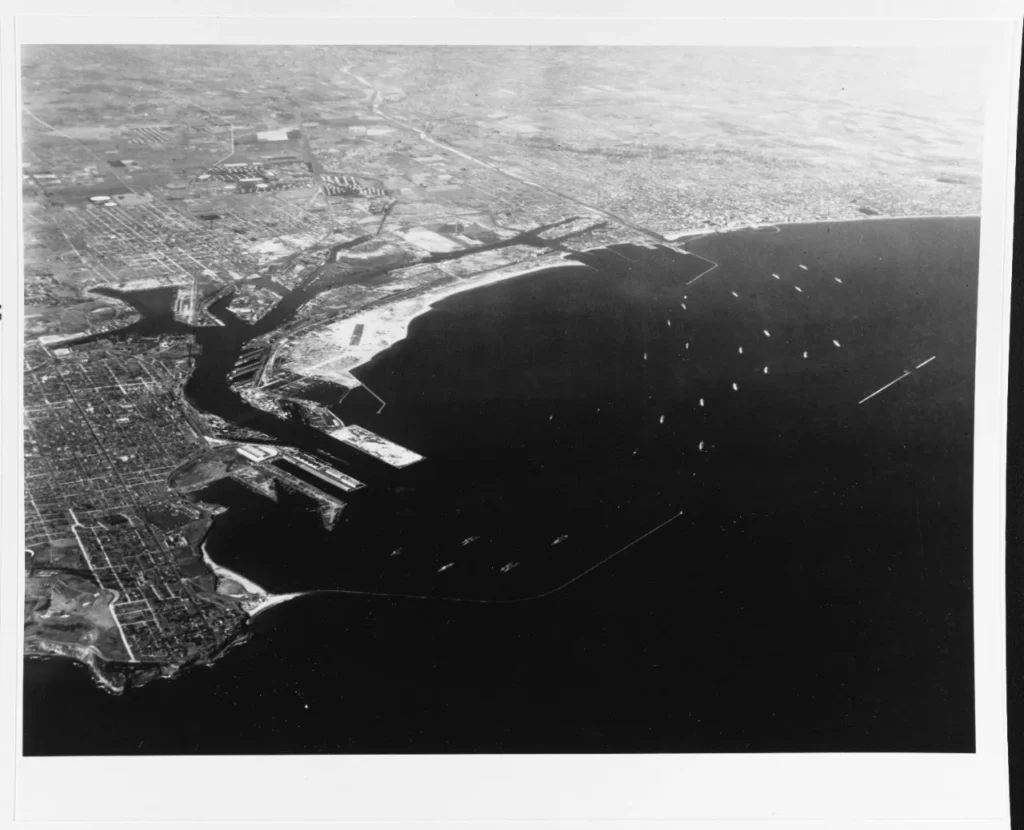
San Pedro Bay with Navy ships anchored. Photo credit: San Pedro HIstorical Society.
The waterfront that kept the fleet running
A home port required more than water deep enough for battleships. It needed a way to move people, fuel, mail, food, and equipment between shore and ships at anchor. The 22nd Street landing area was one of the human connections to that fleet. As preserved in local museum memory, whaleboats brought sailors ashore there: the first step of a sailor's trip into San Pedro, and the last before returning to the ship. Beigel's history also describes the Navy's shore landings and the daily boat traffic between the anchorage and town. The precise historic berth used by each ship's boats deserves confirmation against period harbor plans and photographs.
Fuel followed a different route. Beigel describes Navy oil storage ashore and a pipeline to a dock at 22nd Street. Barges took the fuel from that dock to the anchored battleships. Repair ships, including USS Vestal and USS Medusa, provided maintenance near the breakwater. Shore boats, fuel barges, piers, tanks, and floating workshops together made a fleet of enormous ships workable in a busy commercial harbor. This is why the story belongs to San Pedro's working waterfront as much as to the warships offshore.
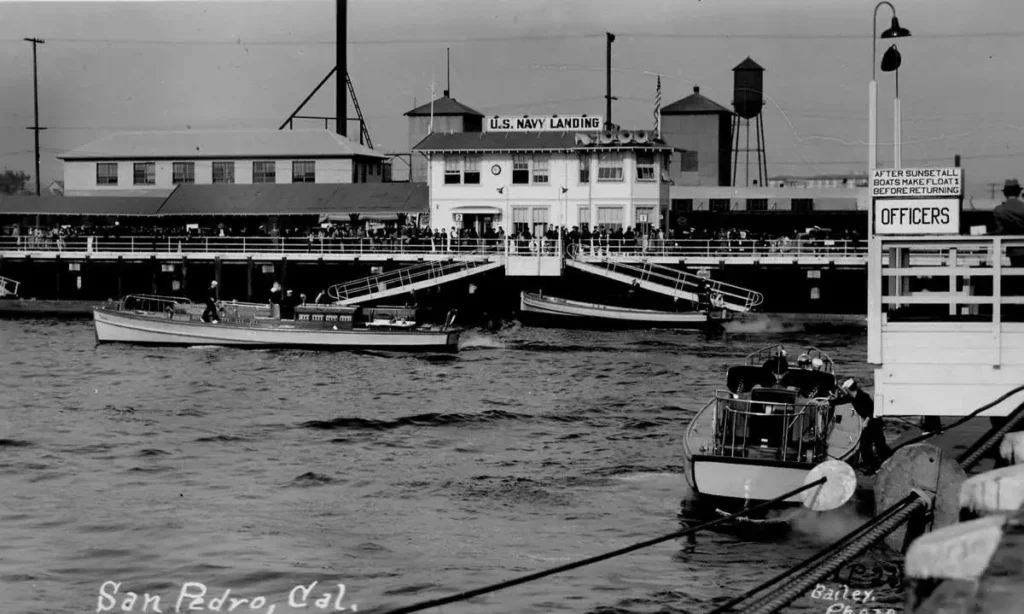
22nd Street (Navy) Landing, San Pedro, CA. Photo credit: San Pedro Historical Society.
Sailors had a life ashore.
The harbor’s Navy history survives in its buildings and gathering places. The Army and Navy YMCA opened at 921 South Beacon Street in 1926. Its lounges, gymnasium, swimming pool, and 410-bed dormitory gave service members a place to rest and connect while ashore. The building still stands as Harbor House.
At Cabrillo Beach, the public Bath House opened in 1932, during the Battle Fleet years. It provided changing and shower facilities, beach rentals, and gathering space at the end of a Pacific Electric streetcar line. For families looking out toward the breakwater, Cabrillo Beach was part of the shared geography of a naval town. The Bath House was a public recreational building rather than a Navy installation, and it survives today.
Athletics connected shipmates with spectators. Battleship baseball teams played at Bloch Field; San Pedro’s Navy Field also hosted fleet sports. Beigel describes the city-run Navy Field’s two baseball diamonds, along with a basketball stadium and pool serving sailors. These games could lead to contests far beyond the harbor. In 1927, USS California won the Battle Fleet baseball championship and met USS Wright, champion of the Scouting Fleet, for the U.S. Fleet title at Guantánamo Bay. California won the middle game 7–1, but Wright took the first and third games, winning the series two games to one. A surviving scorecard and photographs of the 1927 series identify the teams and venue. A 1930 tournament program also records a meeting between the baseball clubs of battleships USS Maryland and USS California, again at Guantánamo. Wright went on to win fleet titles in 1930 and 1931. The games in Cuba show how the shipboard rivalries familiar to San Pedro traveled with the fleet.
The crews also competed on the water. The Battenberg Cup began as a challenge trophy for enlisted boat crews, whose cutter and whaleboat races made the ships' rivalries visible. The Navy's photograph of the cup's engraved winners records USS Arkansas among the repeated winners of the late 1920s; USS Utah also won in October 1928. A Navy photograph published in All Hands shows USS Arizona's winning crew posing with the cup in 1931. USS Tennessee won in 1937, and USS West Virginia won the final prewar race in 1940. The trophy was aboard West Virginia when she sank at Pearl Harbor and survived. Fleet Forces Command recounts that history. The winners belong to the story of the Battle Fleet, although the available records do not place every one of those races in San Pedro Bay.
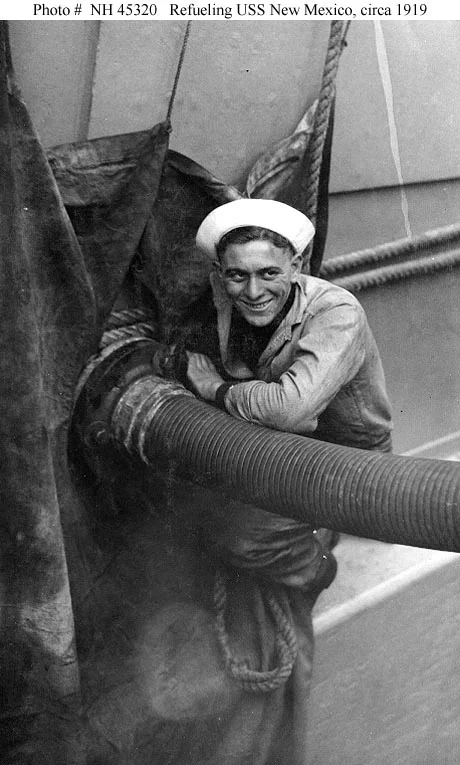
A sailor handles a fuel connection aboard New Mexico, circa 1919. Photo credit: Navy History and Heritage Command.
Fleet Week before LA Fleet Week
Residents did more than watch the ships from shore. They organized celebrations around the fleet and welcomed its people into their communities. The Great White Fleet’s reception in 1908 offered an early example. During the Battle Fleet years, Navy Day brought further public festivities to the area.
There was even a Fleet Week across the bay. Beigel records that Long Beach’s chamber of commerce and naval affairs committee organized one to welcome the Navy back from an East Coast cruise. Its program included a carnival, vaudeville, street dancing, and a beauty pageant. The Navy scheduled football games and lit up its ships at night. These were occasions when sailors and residents could meet, celebrate, and see the fleet as part of local life.
Today’s LA Fleet Week is a modern Pacific Battleship Center program, created generations after the Battle Fleet era. It is a distant cousin of those earlier celebrations: visiting ships, community events, competitions, and chances for Southern Californians to meet the people serving at sea. The organizers and the Navy have changed, but the harbor’s impulse to welcome the fleet remains recognizable.
San Pedro mourned with USS Mississippi.
The bond between the fleet and the community was also visible in grief. On June 12, 1924, a fire in USS Mississippi’s No. 2 gun turret during gunnery practice off the coast killed forty-eight men. Five days later, the Navy held a funeral at Trona Field in San Pedro. The San Pedro Bay Historical Society records 1,200 people standing beside the coffins and another 2,700 sailors observing the service.
The memorial plaque displayed in the Battleship IOWA Museum brings that moment into the present. It reminds visitors that “Battleship Country” was home to crews and shipmates, and that their losses were felt ashore.
That relationship also mattered when the surrounding community needed help. After the destructive 1933 Long Beach earthquake, the Navy sent thousands of sailors and Marines ashore to provide relief. Beigel describes rescue and firefighting parties and a medical unit from the cruiser USS Omaha. The fleet that depended on the harbor for a home port could, in an emergency, help its neighbors in return.
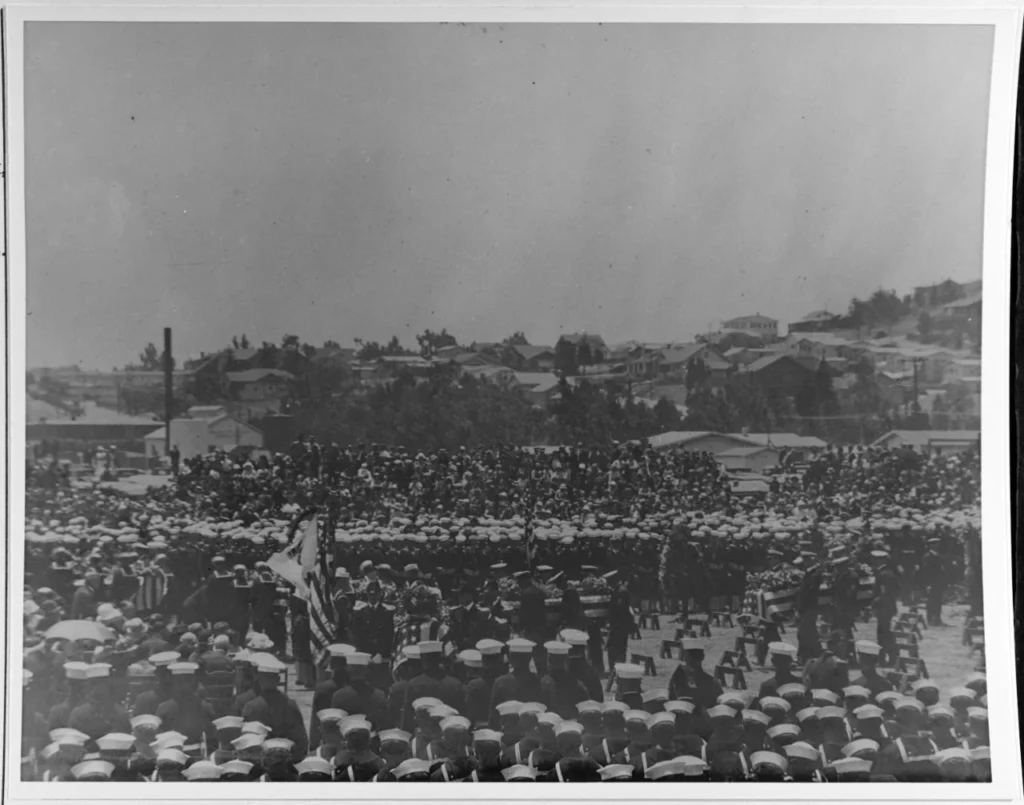
USS Mississippi funeral for 48 sailors lost in turret explosion off the coast of San Pedro. Photo credit: San Pedro Historical Society.
Families, wartime departures, and homecomings
When the Battle Fleet's battleships shifted to Hawaii in 1940, the harbor's naval story continued on shore. During World War II, the Naval Operating Base at Terminal Island operated a receiving station, a naval fuel annex in San Pedro, and facilities to repair and supply ships. Its own administrative history devotes an entire chapter to housing and identifies a U.S. Naval Personnel Separation Center among its activities. Across the harbor, the Army operated the Los Angeles Port of Embarkation in Wilmington. These were different services and facilities, but together they made the harbor a place of departures, returns, and transitions.
Those movements had a family history. Spouses and children built routines in San Pedro and surrounding communities while loved ones served across the Pacific. Wartime housing was an urgent local issue: Channel Heights war housing was built in San Pedro in 1943, and the San Pedro News-Pilot was still reporting plans for housing for Navy men in June 1945. The Army and Navy YMCA on Beacon Street remained a point of contact between service members and civilian life. For some families, ties forged during the war became ties to the Los Angeles area across generations. That history is best told through the families' own photographs and testimony, rather than by claiming that every returning sailor settled here.
For returning Navy personnel, the separation center at Terminal Island made the harbor one route from uniformed service back to civilian life. Others arrived through the Army's nearby port or passed through on their way elsewhere. The harbor was thus more than a place to send ships to war: it also helped people come home, reunite, and decide where to build their lives.
Wartime change also meant loss for existing harbor families. In 1942, Japanese American fishing families on Terminal Island were forcibly removed from their homes. A Library of Congress photograph and caption preserve a view of their former dwellings. Their story belongs alongside the account of the harbor's growth and homecomings.
A later generation of battleships
The Battle Fleet’s regular home port era ended when the Navy kept its major combat ships in Hawaii in 1940. Decades later, the harbor played another role in battleship history. Long Beach Naval Shipyard played a role in the 1980s reactivation and modernization of Iowa-class ships. USS New Jersey, for example, arrived at Long Beach in 1981 to be returned to service.
Battleships continued to visit or be based in the area. Then, in 2012, USS Iowa arrived at the Port of Los Angeles and opened to visitors that July. She remains an accessible link to the ships, sailors, and waterfront communities behind the name.
San Pedro is called Battleship Country because the ships were part of the harbor’s working and civic life. The fleet depended on its landings, oil dock, barges, and repair ships; its crews came ashore to rest, compete, and celebrate; and their losses were mourned here. Families waited, worked, reunited, and in some cases made lasting homes around the harbor. The Great White Fleet’s 1908 arrival introduced the spectacle, the Battle Fleet’s two decades made it a way of life, and wartime homecomings, the later shipyard, the museum, and LA Fleet Week carried the connection forward.
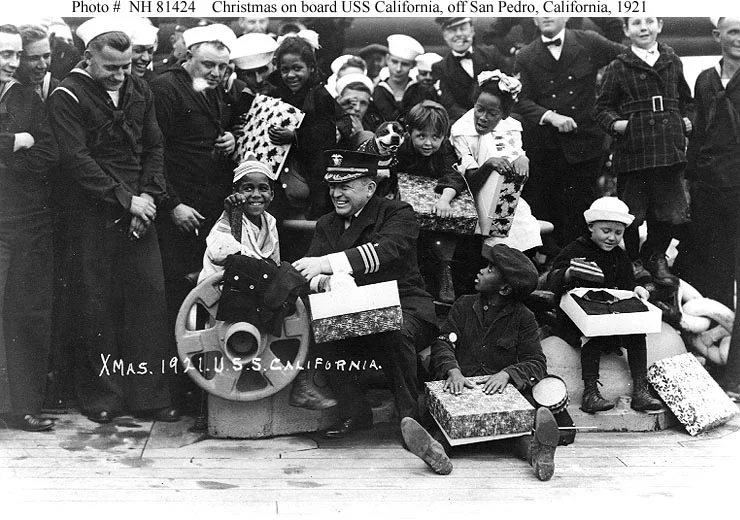
Christmas on board USS California, off San Pedro, Caliornia in 1921. Photo credit: Navy History and Heritage Command.
References
- San Pedro Bay Historical Society, “The Great White Fleet Visit of 1908”
- Naval History and Heritage Command, “New Mexico (Battleship No. 40)”
- Naval History and Heritage Command, “Mississippi III (Battleship No. 41)”
- Harvey M. Beigel, “The Battle Fleet’s Home Port: 1919–1940,” U.S. Naval Institute Proceedings (1985)
- Harvey M. Beigel, Battleship Country: The Battle Fleet at San Pedro–Long Beach, California, 1919–1940 (book information)
- Los Angeles Conservancy, “Harbor House”
- Cabrillo Beach Bath House, Los Angeles Historic-Cultural Monument marker
- SanPedro.com, Bathhouse history
- Chevrons and Diamonds, “1927 United States Fleet Baseball Championship,” scorecard and photographs
- Chevrons and Diamonds, “1930 Battlefleet Group Tournament: USS Maryland vs. USS California,” program
- Puget Sound Navy Museum, “Baseball Warms Up for World War II”
- Naval History and Heritage Command, Battenberg Cup photograph, NH 86406
- U.S. Navy All Hands, USS Arizona whaleboat crew with Battenberg Cup, 1931 photograph
- Fleet Forces Command recounts that history.
- LA Fleet Week
- San Pedro Bay Historical Society, “USS San Pedro – Navy Days”
- U.S. Navy, administrative history of Naval Operating Base, Terminal Island
- California State Military Museum, Los Angeles Port of Embarkation historical record
- Pacific Coast Architecture Database, Channel Heights Housing Project
- San Pedro News-Pilot, June 8, 1945, housing report
- Library of Congress, photograph of former Terminal Island dwellings of Japanese American fishermen, April 1942
- Battleship New Jersey Museum, “History”
- Battleship IOWA, “2012: The Year Battleship IOWA Came Home to Los Angeles”
Limited time only!
Kids Board Free
In the all-new Life of a Sailor experience, kids become sailor recruits, building their skills, following the story of a famous sailor, and joining Vicky the Dog on a scavenger hunt through Battleship IOWA.
Kids board free with a paid adult.