
What Can a Collection Tell Us That A Battleship Alone Cannot?
Exploring the broader connections of the artifacts at the National Museum of the Surface Navy
What Can a Museum Collection Tell Us That a Battleship Alone Cannot?
Battleship IOWA is, in one sense, an unusually simple museum collection to understand.
Its largest artifact is 887 feet long.
The ship herself preserves the spaces where sailors lived, the machinery they operated, the weapons they maintained, the passageways they moved through, and physical evidence of more than five decades of naval service. Battleship IOWA’s curatorial team has described the vessel as “Artifact #1”- the central object around which the museum’s larger collection is built.
But the ship cannot tell her entire story by herself.
Battleship IOWA, home of the National Museum of the Surface Navy, also cares for thousands of additional artifacts, including photographs, documents, personal materials, digital images, art, equipment, and objects connected both to USS Iowa and to the broader history of America’s Surface Navy.
Those materials provide something the battleship alone cannot: detail.
A photograph can identify a sailor. A uniform can help trace a career. A handwritten document may preserve an experience that never entered an official record. A personal object can reveal something about daily life at sea. A piece of equipment can help explain not only what the ship contained, but how people actually used it.
Battleship IOWA provides the setting.
The collection helps populate that setting with people, experiences, and evidence.
Together, they allow the museum to preserve something larger than a battleship: the human history of the Surface Navy.
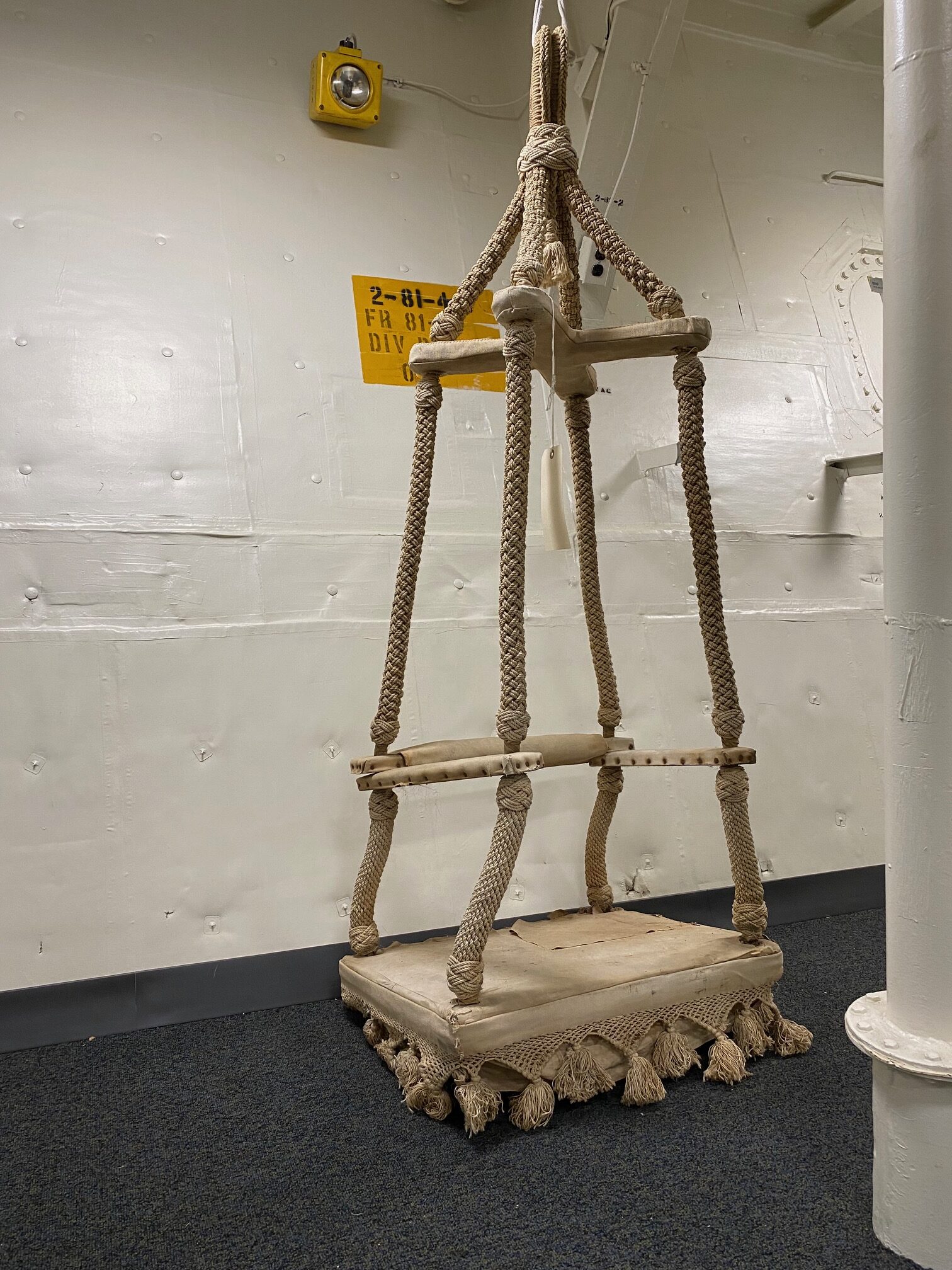
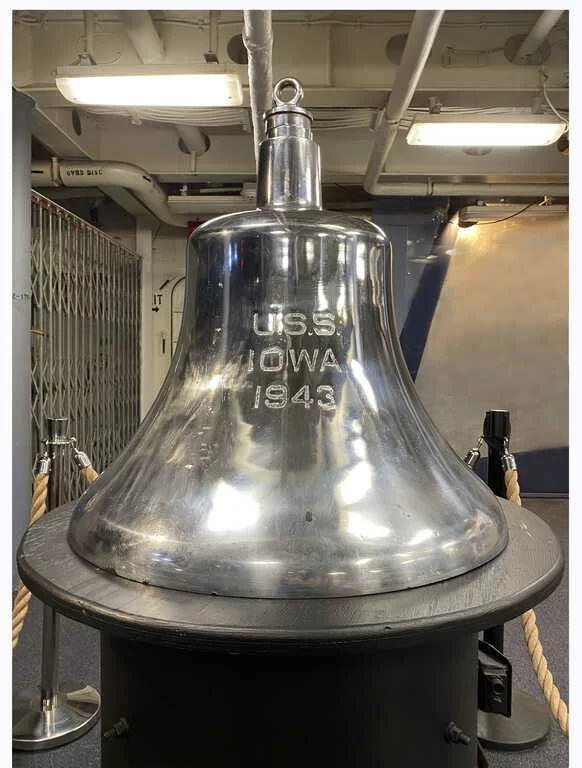
Why Does Battleship IOWA Need a Collection When the Ship Is the Main Artifact?
A historic battleship preserves physical context extraordinarily well.
Visitors can stand on the bridge, move through crew spaces, enter engineering compartments, and see weapons and machinery in the places where they were used. Few conventional museums can preserve the relationship between an artifact and its environment on that scale.
But a ship has limitations as a historical source.
It cannot identify every sailor who worked in a compartment. It cannot explain what someone thought during a deployment. It cannot tell visitors what a sailor stored in a locker, how families experienced long separations, or how someone remembered an event decades later.
It also cannot explain every change made to the vessel over more than fifty years of service without additional evidence.
That is where collections become essential.
Objects, photographs, documents, recordings, oral histories, and personal accounts can establish names, dates, functions, relationships, and experiences. They can also preserve histories connected to ships and sailors beyond Battleship IOWA, allowing the National Museum of the Surface Navy to tell a story that reaches across the Surface Navy’s past, present, and future.
The battleship gives history scale.
The collection gives it detail.
What Counts as an Artifact at Battleship IOWA?
An artifact does not have to be rare, valuable, or visually dramatic.
It needs to help document the past.
Battleship IOWA’s collection includes thousands of physical and digital items. An artifact might be a uniform, photograph, piece of shipboard equipment, technical document, work of art, personal possession, or object associated with another ship or period in naval history.
The ship herself is also an artifact.
That changes the way collections work aboard IOWA.
In a conventional museum, curators may remove an object from storage and place it in a gallery. On Battleship IOWA, many historically significant objects remain embedded in Artifact #1. A control panel can still be located where sailors operated it. Machinery remains inside the compartment for which it was designed. A bulkhead may carry evidence of modifications separated by decades.
The distinction between museum building and museum object therefore becomes unusually complicated.
The building is part of the collection.
And sometimes the history being studied is still physically attached to it.
Why Is the Story Behind an Artifact So Important?
Consider an old Navy photograph with no information attached to it.
It may show several sailors aboard ship, but without names, a date, location, ship identification, or an explanation of what was happening, much of its historical meaning can be difficult to recover.
Now imagine that same photograph accompanied by the names of the sailors, their ranks, the dates, their divisions, and a short account from someone who was there.
The photograph has not changed.
Its historical value has.
That is one of the fundamental responsibilities of a museum collection: preserving context along with the object.
Battleship IOWA’s growing Those Who Served collection demonstrates why that matters. The collection preserves photographs and personal histories associated with sailors who served aboard USS Iowa from World War II through the Cold War. Entries can include rates or ranks, divisions, periods of service, photographs, and personal memories provided by veterans and families.
The result is more than a list of names.
It is a growing record of the people who made the battleship function.
An object can survive for generations.
The knowledge attached to it can disappear much faster.
Why Are Sailors’ Personal Stories Part of the Collection?
More than 50,000 sailors served aboard Battleship IOWA over the course of her active career, and no two experienced the ship in exactly the same way.
A sailor working deep inside engineering inhabited a different IOWA from someone standing watch on the bridge. A sailor aboard in 1944 encountered different technology, missions, and conditions from someone serving after the ship’s modernization in the 1980s.
Official Navy records can document deployments, orders, battles, organizational structure, and equipment.
Personal histories preserve something different.
They can describe what a machinery space sounded like, how sailors actually used a piece of equipment, or how daily routines worked when the ship was underway. They can preserve friendships, traditions, frustrations, humor, fear, pride, and countless other details that rarely appear in formal reports.
Those details matter because a museum devoted only to machinery can explain what a Navy ship was.
A museum that also preserves the voices of sailors can begin to explain what serving aboard one meant.
That people-centered approach is especially important to the National Museum of the Surface Navy, whose broader story is not simply about ships and technology, but about the people who designed, built, operated, and maintained them.
Why Are Family Collections Important to Naval History?
Some of the most valuable historical material does not begin in a museum.
It begins in a drawer, footlocker, photo album, garage, closet, or family archive.
Letters may preserve observations that exist nowhere else. Photographs may identify sailors whose stories have disappeared from the official record. Cruise books, menus, patches, recordings, documents, and personal objects can show how service was experienced by individuals rather than institutions.
They do not document a major battle or strategic decision.
They preserve the stories of families trying to remain connected.
That is part of naval history too.
The history of the Navy does not happen only aboard ships. It also happens in homes, in letters and recordings sent across oceans, in objects sailors bring back, and in stories passed from one generation to the next.
When families preserve those materials—and preserve the information attached to them—private memory can become part of the historical record.
How Does a Museum Know What an Artifact Really Is?
An artifact entering a museum can create as many questions as answers.
Who owned it? Was it actually aboard Battleship IOWA? When was it used? What was its purpose? Has it been modified? Is the date attached to it correct? Are there photographs showing it in use? Can a veteran identify it? Does the story associated with it match other records?
Answering those questions is collections research.
Cataloging gives the museum a way to connect an object with the information known about it. Those records can later support preservation, research, exhibits, interpretation, and education.
The process also protects against one of the biggest risks in museum collections: the slow loss of knowledge.
An object whose history seems obvious today may become mysterious twenty years from now if the person who donated it is no longer available and the information was never documented.
Good collections work tries to preserve the answer while someone still knows it.
That is also why provenance matters.
Provenance is the documented history connecting an artifact to its origin, ownership, use, or historical context. It is what allows a museum to move from saying, “This is a Navy object,” to saying that a particular sailor used it, aboard a particular ship, during a particular period.
That difference can turn an illustrative object into historical evidence.
What Happens When an Artifact Is Donated?
Donating an artifact to a museum involves more than handing over an old object.
The museum first has to understand what is being offered and determine whether it fits the institution’s collecting mission. Information about the object’s history, ownership, condition, and connection to a person, ship, or event can be as important as the artifact itself.
Accepting an object also creates a long-term responsibility.
The museum may need to catalog and photograph it, create permanent records, provide appropriate storage, monitor its condition, conduct research, and preserve it for future generations.
Some artifacts may eventually appear in exhibits.
Others may never be displayed but remain valuable for research, documentation, education, or future interpretation.
That is why museums cannot simply accept every object offered to them.
Collecting responsibly means determining both what an item contributes to the historical record and whether the institution can care for it properly.
For someone considering donating material, the most valuable contribution may be information.
An ordinary-looking object with a well-documented history can be far more useful than a dramatic object whose origin cannot be established.
Why Doesn’t Every Artifact Go on Display?
Museum collections are usually much larger than the number of objects visitors see at one time.
There are practical reasons for that.
Some artifacts are too fragile for prolonged display. Others may duplicate material already on view. Some become especially useful only when a particular story is being interpreted. Photographs and documents may require environmental conditions that are difficult to maintain in exhibition spaces.
Objects may also be held for research or exhibits that do not yet exist.
Collections are therefore not simply inventories used to fill display cases.
They are long-term historical resources.
That is particularly important as Battleship IOWA continues to develop as the home of the National Museum of the Surface Navy. Experiences such as Life of a Sailor depend on personal stories, historic images, shipboard context, and interpretation focused on the people of the Surface Navy.
A deep collection gives future exhibits authentic material to draw from.
It also gives the museum flexibility to tell stories that may not yet have been identified.
How Is Collections Care Different Aboard a Historic Ship?
Caring for a collection aboard Battleship IOWA presents a challenge most museums do not face.
The collection exists inside another artifact.
Traditional museums are generally designed around preservation. Temperature, humidity, light, storage, visitor circulation, and building systems can all be planned with collections care in mind.
A World War II battleship was designed for sailors, weapons, machinery, ammunition, supplies, and combat operations at sea.
It was not designed as climate-controlled museum storage.
That means collections care has to coexist with preserving and operating the ship itself.
The surrounding environment adds another complication. Battleship IOWA remains beside salt water on the Los Angeles Waterfront, where moisture and corrosion are continuing concerns.
Collections professionals therefore have to care for objects inside a historic structure that also requires constant preservation.
That makes the ship both the collection’s greatest strength and one of its most difficult preservation challenges.
Can Battleship IOWA Still Reveal New Historical Evidence?
Yes.
Battleship IOWA is not simply a container for known history. It contains layers of physical evidence created as the ship changed over decades of service.
Weapons were installed and removed. Compartments were repurposed. Electronics changed. Structures were modified. Later systems were sometimes installed over traces of earlier ones.
Evidence of those changes can remain hidden until preservation work exposes it.
A weld pattern, old opening, removed fitting, bolt arrangement, or covered structure may reveal how a part of the ship looked or functioned in an earlier period.
The crew sometimes refers to discoveries like these as “battleship archaeology.”
Once found, that evidence has to be studied and documented before restoration work covers or alters it again.
In that sense, the museum can discover new collection information inside Artifact #1 itself.
The ship is still producing historical evidence.
Why Do Digital Collections Matter?
Not every important artifact needs to be physically owned by a museum.
Digital collections allow historical information to be preserved even when the original object remains with a veteran, family, archive, or another institution.
Photographs can be digitized. Documents can be scanned. Audio can be preserved. Personal accounts can be recorded. Information about sailors can be added to searchable databases.
Battleship IOWA already treats digital images as part of its collections responsibility, and Those Who Served shows how digital collecting can expand the historical record by allowing veterans and families to contribute information.
Digital collections also dramatically expand access.
Only a small number of people can enter museum storage. Far more can view a digitized photograph, search a sailor’s history, or read a personal account online.
The digital copy does not necessarily replace the original.
It expands what the original can do.
That is particularly valuable for a national museum whose audience extends far beyond people able to travel to Los Angeles.
Why Are Photographs Especially Valuable?
A photograph can perform several historical jobs at once.
It can document what a compartment looked like at a particular moment. It may reveal equipment that was later removed, show where something was located, or record signs, uniforms, tools, furniture, modifications, and procedures that formal plans do not capture.
Most importantly, photographs preserve people.
For a museum focused on the Life of a Sailor, that matters enormously.
A machinery space without people can become an engineering exhibit. A photograph of sailors working inside that same machinery space helps establish it as a workplace.
A bunk is an object.
A photograph showing sailors living around rows of bunks begins to communicate something about shipboard life.
Photographs can also help recover information years later. Veterans or family members may recognize someone, correct a caption, identify a location, or remember the story behind what the camera recorded.
In that way, collections can become collaborative.
The museum preserves the evidence.
The community can help recover its meaning.
Can Ordinary Objects Be Historically Important?
Often they are among the most revealing objects in a collection.
Major weapons and machinery explain what a battleship could do.
Everyday objects help explain how people lived while doing it.
A menu can show what sailors ate. A handwritten note can reveal how they communicated. A photograph can show how they relaxed. A shipboard publication can reveal how information moved through the crew. A personal object can connect an enormous military institution to a single human life.
The Those Who Served collection includes an example from a sailor who worked in Battleship IOWA’s print shop and Public Affairs Office from 1987 to 1990, producing The Iowan along with FamilyGrams, holiday menus, and port-visit guides.
Those items are small compared with a 16-inch gun.
But they can reveal details about communication, family connections, morale, deployment, and everyday crew culture that the gun cannot.
Historical significance is not determined by size.
Sometimes the smallest object tells the most human story.
How Do Collections Help Preserve Accurate History?
Historical memory becomes more fragile as time passes.
Stories change when they are retold. Details disappear. Simplified versions of complicated events become accepted because the people who could correct them are no longer available.
Collections help preserve evidence against that drift.
A dated photograph can challenge an incorrect timeline. A document can establish what happened at a particular moment. A veteran’s account can preserve an operational detail absent from official histories.
No single source always tells the entire story.
But several sources considered together can reveal where memories agree, where they differ, and what can be supported by surviving evidence.
That is one reason collections work becomes more important with time.
As the distance from World War II, Korea, the Cold War, and other periods of naval service increases, the opportunity to ask eyewitnesses directly becomes smaller.
Collections cannot preserve every answer.
They preserve enough evidence for future generations to continue asking informed questions.
How Will Collections Support the National Museum of the Surface Navy?
Battleship IOWA’s expanding museum role creates a larger responsibility for collections.
The National Museum of the Surface Navy is intended to connect Americans not only with one battleship but with the broader story of the people and ships of the Surface Navy.
Its growing interpretation includes personal stories, ship technology, career exploration, historic environments, and the lived experience of sailors.
Collections provide the source material that makes those stories possible.
Future exhibits may require photographs from different eras. Educational programs may draw on personal accounts. Researchers may need technical documentation. Digital experiences may use historic images, voices, or documents.
Stories about particular occupations, communities, technologies, ships, or events depend on evidence being collected before it disappears.
That means the value of a collection is not limited to what a museum can do with it today.
It also creates possibilities for stories the museum does not yet know it will need to tell.
Why Is Collections Work Often Invisible to Visitors?
A successful exhibit can make an artifact look effortless.
Visitors see an object, photograph, or story accompanied by a clear explanation.
They do not see the work that came before it.
They may not see the correspondence surrounding a donation, the database record documenting the object, the photography used to record it, the research required to identify it, the storage materials protecting it, or the questions curators had to resolve before presenting it publicly.
That invisible work is part of what makes a museum trustworthy.
Collections professionals and volunteers are not simply caretakers of objects.
They are caretakers of evidence.
Their work determines whether the information attached to an artifact will still be available when the next researcher, student, veteran, family member, or exhibit designer asks a question about it.
The farther society moves from the people who experienced these periods of naval history firsthand, the more important that responsibility becomes.
Why Should Veterans and Families Preserve Their History Now?
Historical information is easiest to preserve while someone still remembers it.
A family may own photographs without knowing everyone pictured in them. A veteran may recognize every face immediately.
A patch may mean little to a grandchild. The person who wore it may remember exactly where it came from.
A handwritten abbreviation may appear indecipherable decades later but be obvious to someone who worked in that division.
That is why documenting a family collection can be as important as preserving the objects themselves.
Record names, dates, ships, ranks, rates, divisions, locations, and stories while someone can still provide them. Digitize fragile photographs and recordings. Ask what an object was used for and why it mattered.
For veterans and families connected to USS Iowa, Those Who Served provides one way to contribute that information to a growing public record.
The best time to preserve a story is before it becomes a mystery.
What Does Battleship IOWA’s Collection Ultimately Preserve?
Battleship IOWA’s collection preserves objects, but objects are not really the final purpose.
A photograph matters because someone is in it.
A uniform matters because someone wore it.
A piece of equipment matters because someone relied on it.
A letter matters because someone wrote it to someone they missed.
A shipboard publication matters because a crew read it.
An oral history matters because someone experienced something future generations cannot experience for themselves.
Even Battleship IOWA - the largest artifact in the collection - ultimately matters because of people.
Specifications such as length, displacement, horsepower, armor, and gun caliber explain what Battleship IOWA was physically capable of doing.
They do not explain the thousands of individual lives required to make those capabilities possible.
That is the larger purpose of the collection at Battleship IOWA and the National Museum of the Surface Navy.
The ship preserves the place.
The collection preserves the evidence that gives that place meaning.
Together, they allow people who were never there to understand something about those who were.
How Can the Public Help Preserve Battleship IOWA’s Collection?
The public plays an important role in building and protecting the historical record.
Veterans and families connected with Battleship IOWA can contribute information to Those Who Served, helping preserve individual service histories for future generations. People considering donating artifacts or other historic material can contact the museum so staff can determine whether an item fits the collection and what information should accompany it.
Visitors, donors, volunteers, sponsors, and philanthropic partners also help support the work required to care for Battleship IOWA’s spaces, artifacts, records, and collections.
But the most useful first step for someone who owns historic material may be much simpler.
Find out what you have.
Ask who used it.
Write down the story.
Because an artifact can survive for generations while the knowledge that gives it meaning disappears in one.
Battleship IOWA’s collections exist to prevent that loss—and to ensure that the history of America’s Surface Navy is not merely stored, but understood.
TICKETS
Experience the Life of a Sailor.
Life of a Sailor
Our general admission experience shows how sailors live, work, and serve.
President’s Tour
It's November 1943, and Battleship IOWA is on a covert mission. President Franklin Delano Roosevelt and his entire staff are aboard, headed for top-secret […]
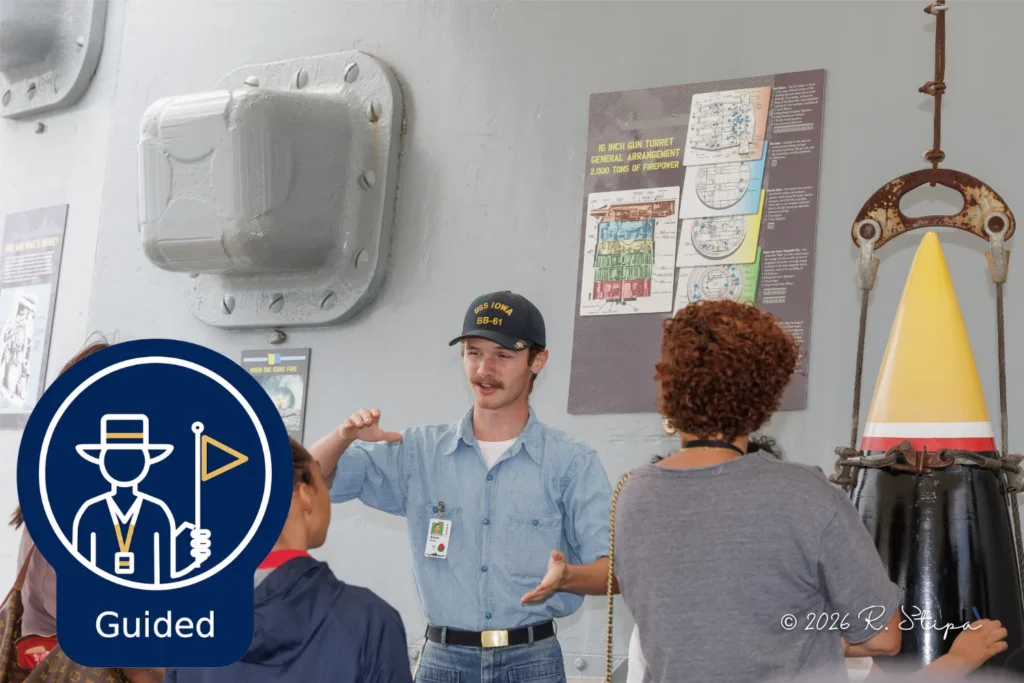
Overview Experience
The overview experience is a 90-minute crew-led tour that brings the ship's legacy to life through the stories of those who served, and those […]
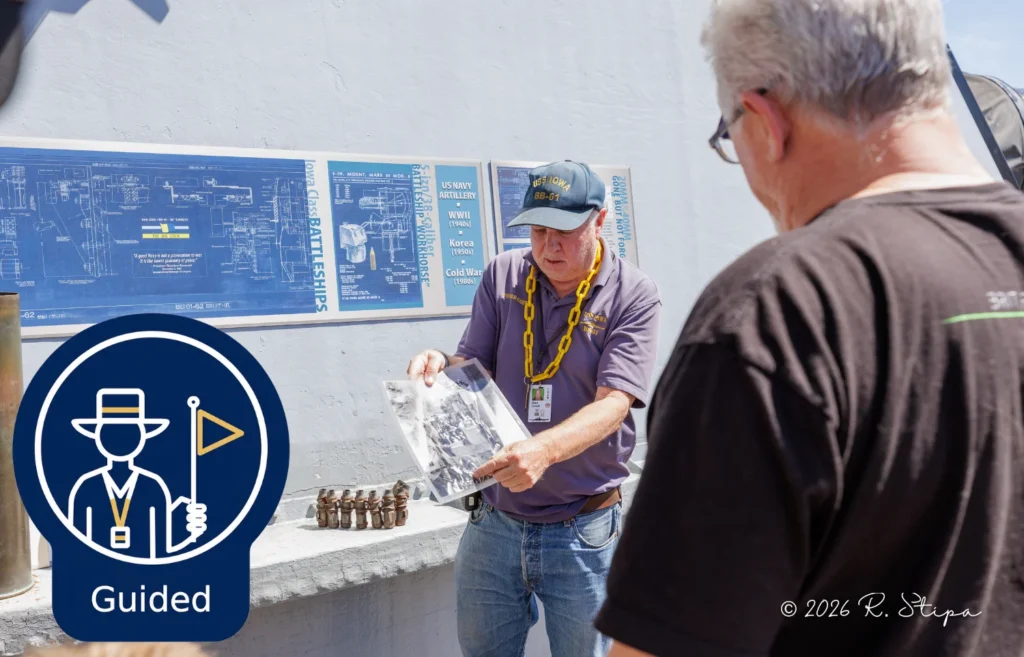
Gun Tour Experience
This exclusive, behind-the-scenes journey puts you inside the systems that made Battleship IOWA one of the most powerful warships ever built.
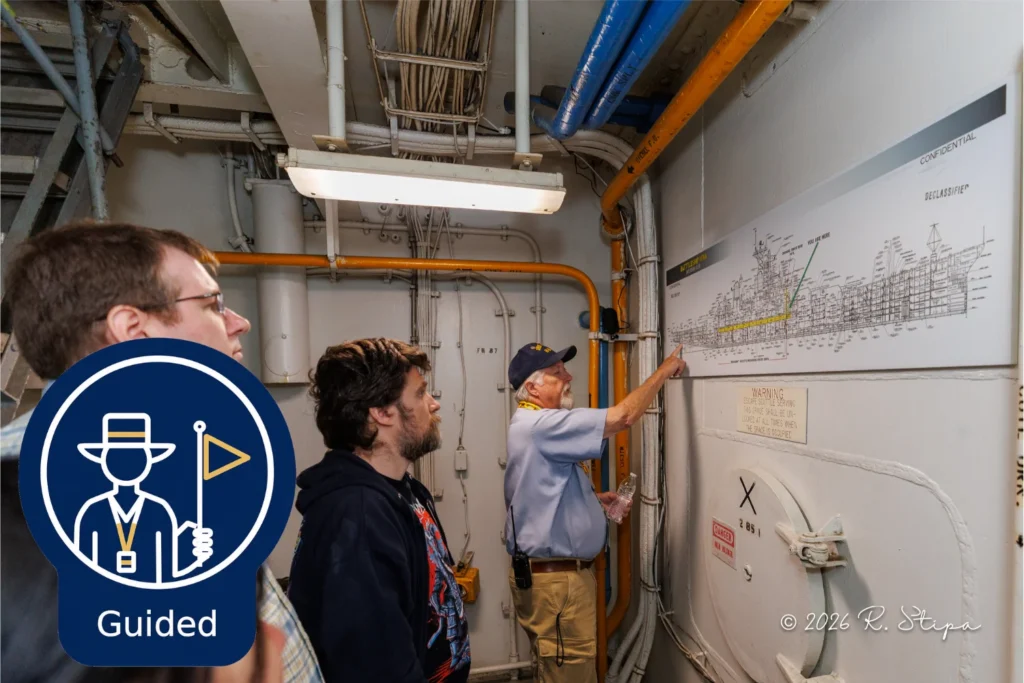
Engineering Tour Experience
The Engineering Tour takes you below into the hidden heart of Battleship IOWA, where eight boilers and four steam turbines once generated 212,000 shaft […]
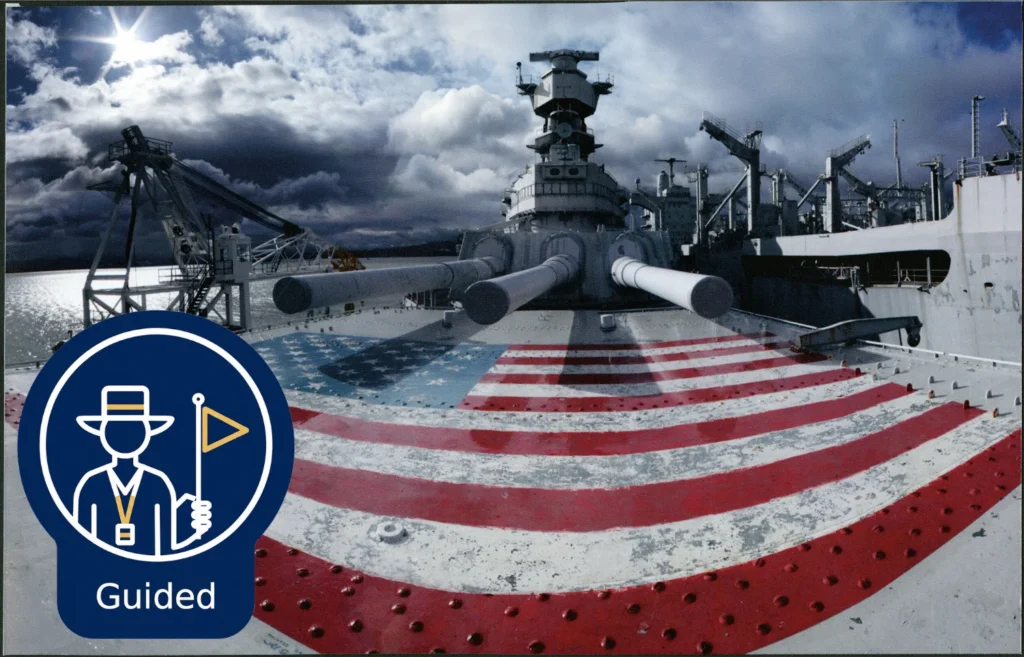
Escape the Fleet Adventure
In 2011, a small team raced against time to pull Battleship IOWA out of the Navy's reserve "ghost fleet" — or watch her be […]
Included with Admission
Life of a Sailor
Our general admission experience shows […]
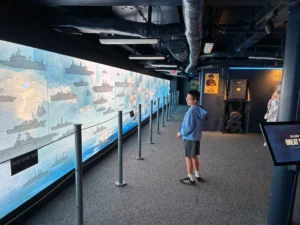
Great Ships
Explore the ships of America's […]
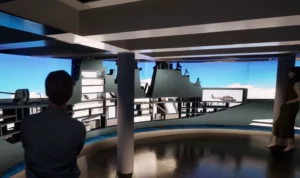
Ship Cutaway
See inside a Navy ship […]
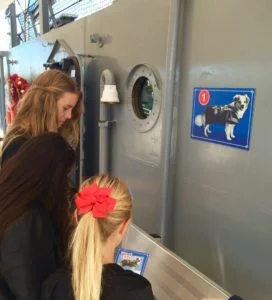
Vicky’s Scavenger Hunt
Find Vicky throughout your shipboard […]
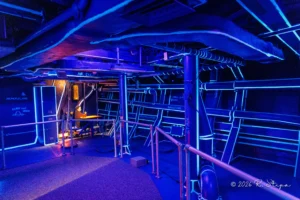
Living Blueprint
Immerse yourself in a blueprint […]
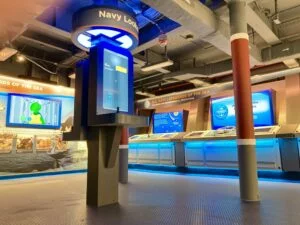
Stewards of the Sea
Explore how the Navy protects […]
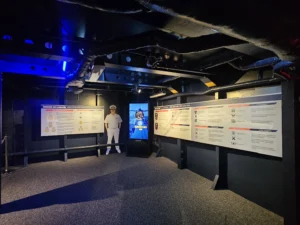
What’s My Rate?
Find the Navy career that […]
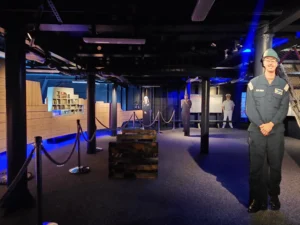
Every Sailor has a Story
Meet the people who serve.
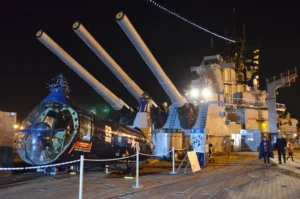
HUP-2 Retriever Helicopter
Korean War-Era HUP-2 Retriever Helicopter.
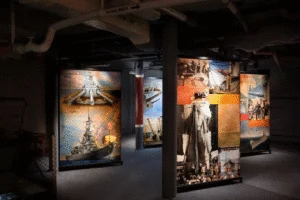
Sticks Art Gallery
Discover IOWA's story through art.
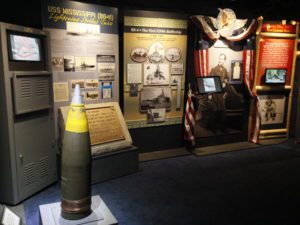
Gunnery Incidents
A dive into Navy gunnery […]

Limited time only!
Kids Board Free
In the all-new Life of a Sailor experience, kids become sailor recruits, building their skills, following the story of a famous sailor, and joining Vicky the Dog on a scavenger hunt through Battleship IOWA.
Kids board free with a paid adult.