
What Can Students Learn from a Battleship?
What Can Students Learn From a Battleship?
A battleship may not look like a classroom, but few learning environments bring as many subjects together in one place.
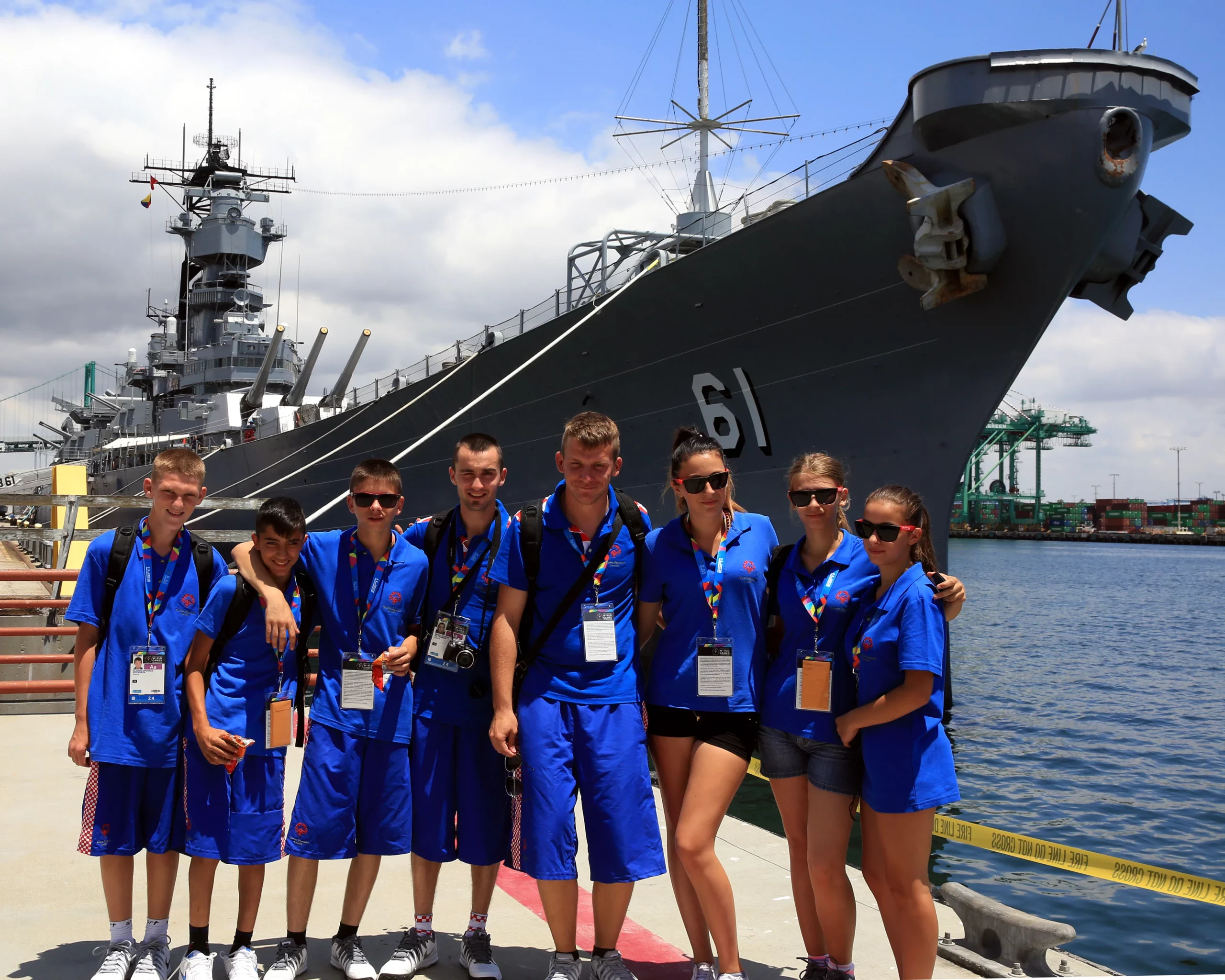
Inside Battleship IOWA are boilers, turbines, gun systems, navigation equipment, electrical networks, crew quarters, communications spaces, miles of piping and cable, and hundreds of compartments contained within an 887-foot steel ship. For students, that makes IOWA much more than a historic artifact. She becomes a place where history, engineering, physics, mathematics, geography, technology, leadership and teamwork can all be explored through the same real-world object.
The educational value begins with questions.
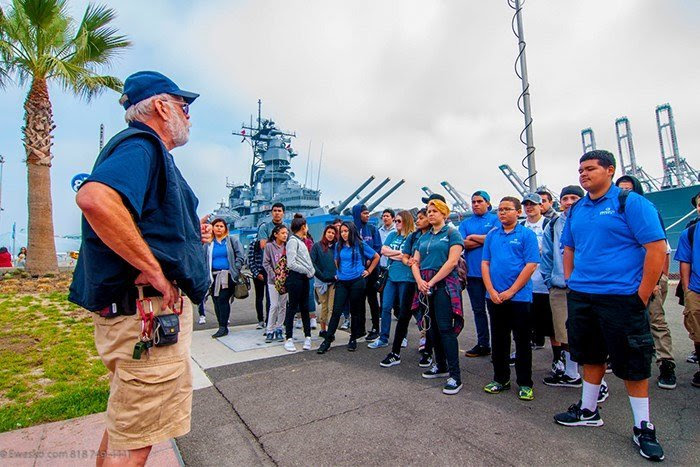
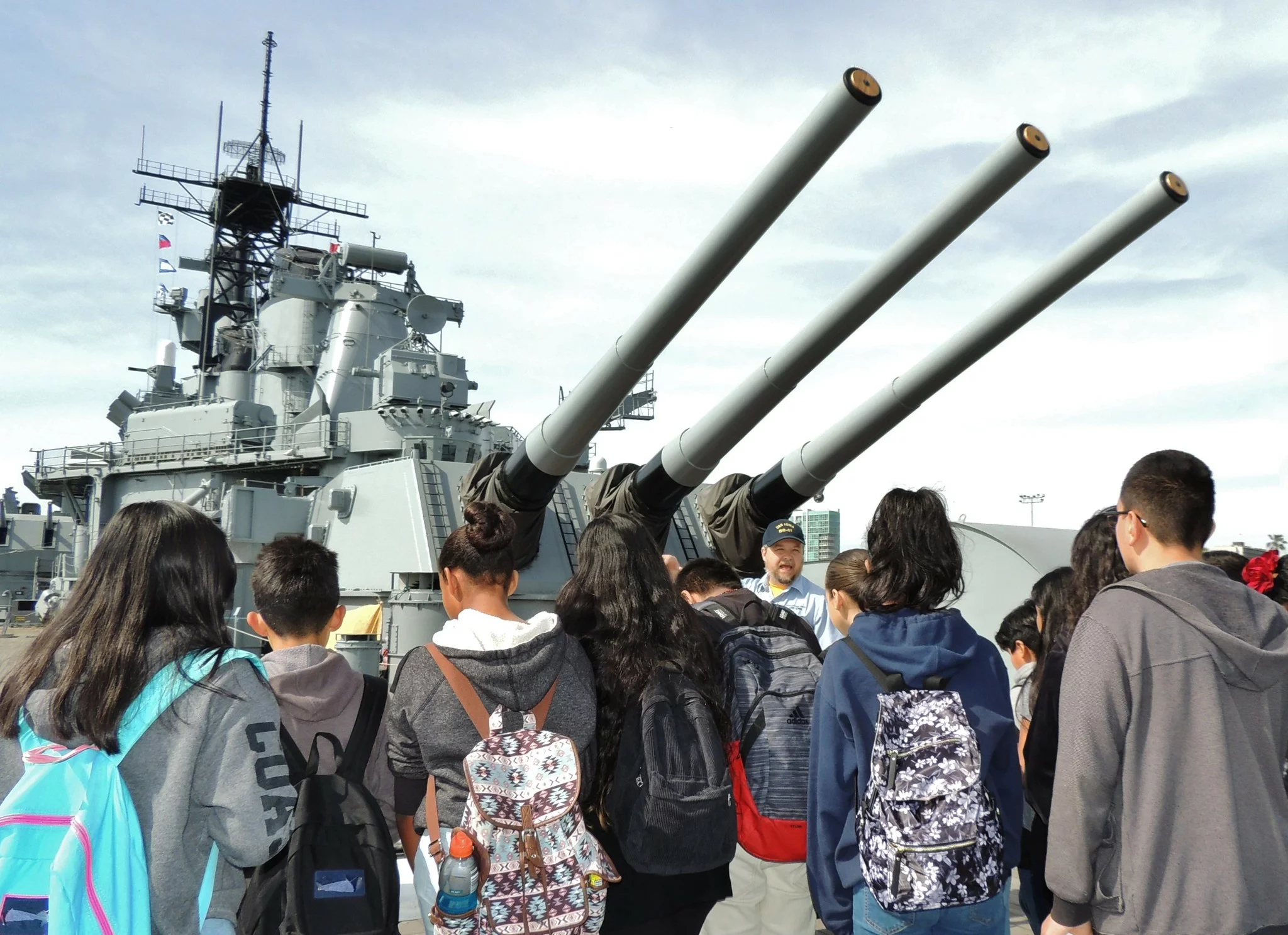
How does something this large float? How do you produce enough power to move tens of thousands of tons through the water? How did sailors navigate before GPS? How could thousands of people live and work inside one ship? Why does steel corrode near salt water? What happens when one part of a complicated system stops working?
Aboard Battleship IOWA, the answers are not confined to a textbook. Much of the evidence is physically present around the student.
Why Is Battleship IOWA Such a Strong STEM Learning Environment?
Almost everything aboard an Iowa-class battleship exists because someone had to solve a problem.
Naval architects had to design a steel hull large enough to carry enormous weight while remaining stable and fast. Engineers had to create propulsion systems capable of moving the ship across oceans, electrical networks that could distribute power throughout an 887-foot vessel, and mechanical systems that could operate reliably far from shore.
The crew faced another set of challenges. Sailors needed to communicate, navigate, generate fresh water, ventilate compartments, move ammunition, maintain machinery and respond when equipment failed.
Those challenges make Battleship IOWA a natural STEM learning environment because science, technology, engineering and mathematics do not appear as separate subjects. They work together.
The propulsion plant is a good example. Eight boilers and four steam turbines produced 212,000 shaft horsepower, allowing a ship weighing tens of thousands of tons to reach speeds approaching 35 knots. That single system can introduce questions involving heat, pressure, energy conversion, mechanical power and efficiency.
Elsewhere aboard the ship, navigation connects mathematics with geography. Radar and communications can introduce electromagnetic waves. The hull creates a real-world example of buoyancy, density and displacement. Preservation work can lead into chemistry, materials science and corrosion.
The advantage is not simply that these subjects can be taught aboard a ship. It is that the ship gives students a reason to ask why the concepts matter.
How Can Battleship IOWA Help Students Understand Physics and Engineering?
One of the simplest questions a student can ask aboard IOWA is also one of the best: How does a steel ship this large stay afloat?
Battleship IOWA has enormous mass, but its hull displaces enough water to create the buoyant force required to support its weight. A question prompted by simply looking at the ship can therefore become a lesson involving density, volume, force, displacement and Archimedes' principle.
The same pattern appears throughout IOWA.
The propulsion system demonstrates energy conversion. Gun systems can introduce force, motion and trajectory. Navigation involves speed, distance and direction. Radar and communications provide entry points into wave behavior and the electromagnetic spectrum.
Engineering takes those concepts a step further by showing how individual systems must work together.
A turbine cannot operate without steam. Steam requires boilers, fuel, water, controls, maintenance and trained operators. A weapon depends on ammunition handling, electrical power, communications, targeting information and the sailors operating the system.
That is one of the most important engineering lessons the ship can offer. Engineering is not simply about inventing an individual machine. It is about designing systems that can work together reliably under real-world constraints.
An Iowa-class battleship makes that idea visible on an extraordinary scale.
Can a Historic Battleship Teach the Engineering Design Process?
Engineering aboard Battleship IOWA did not end when the ship left the shipyard.
USS Iowa changed repeatedly during decades of service as technologies, missions and strategic requirements evolved. Equipment was installed, removed and modernized. Systems designed for one era had to coexist with technologies introduced decades later.
Today, preservation presents a new set of engineering challenges.
The ship exists in a harsh marine environment where steel, wood, coatings and other materials are continually exposed to moisture and salt air. Preservation therefore requires the same kind of structured problem solving used in other engineering fields: identify the problem, understand the constraints, evaluate alternatives and implement an appropriate solution.
Deck preservation provides one example. When deteriorated exterior decking allowed water to reach the steel beneath it, the preservation team had to consider the historic appearance of the ship along with durability, cost, material availability and sustainability. The eventual use of high-quality synthetic marine decking in selected areas reflected a design process in which no single consideration could determine the answer.
That is an important lesson for students because real engineering problems rarely have one perfect solution.
Engineers work within limitations involving materials, cost, safety, longevity, labor, environmental conditions and intended use. The goal is to develop the best solution within those competing requirements.
Students can see that process taking place on a historic object that must continue to survive in the real world.
What Can Students Learn About American History Aboard Battleship IOWA?
Battleship IOWA connects more than five decades of American history through one physical object.
USS Iowa entered service during World War II. Early in her career, she carried President Franklin D. Roosevelt across the Atlantic during the first stage of his journey to meet Allied leaders Winston Churchill and Joseph Stalin before the Tehran Conference. She later served in the Pacific, returned to combat during the Korean War and was recommissioned during the Cold War in the 1980s.
In a classroom, those periods are often taught as separate chapters. The ship connects them.
Students can stand aboard a vessel constructed during America's World War II industrial mobilization and see technologies added during later eras. They can ask how naval warfare changed, why the ship was repeatedly modernized and how changes aboard IOWA reflected changes in America's role in the world.
That makes the ship useful for much more than military history. IOWA can provide entry points into presidential history, diplomacy, industrial production, international relations, technological change and geography.
In that sense, the ship functions almost like a primary source large enough to walk through.
What Can Students Learn From the Sailors Who Operated the Ship?
Battleships are often described through specifications: horsepower, speed, armor, displacement and gun caliber. Those figures help explain the ship's capabilities, but they do not explain what it took to make the ship work every day.
People do.
Thousands of sailors had to eat, sleep, communicate, navigate, stand watch, repair equipment, maintain machinery, handle ammunition, provide medical care and perform hundreds of specialized jobs. Crew spaces make that human system easier to understand.
A bunk shows how little personal space a sailor might have had. A mess area raises questions about feeding thousands of people. A machinery compartment reveals a demanding working environment. A narrow passageway makes the physical realities of moving through the ship immediately apparent.
Those details can lead students into broader discussions of service, responsibility, teamwork and leadership.
No individual could operate Battleship IOWA alone. Engineers depended on electricians. Weapons crews depended on communications and fire-control personnel. Everyone relied on supply, food service, medical teams, maintenance crews and sailors standing watches throughout the ship.
That interdependence provides a useful lesson well beyond naval history. Complicated organizations work because people with different responsibilities understand their own roles and how those roles affect everyone else.
The ship also offers a practical way to discuss leadership. Although a naval vessel has a formal chain of command, responsibility exists throughout the organization. Sailors at every level had to know their jobs, communicate clearly, maintain equipment, follow procedures and respond appropriately when circumstances changed.
That makes IOWA a setting for questions students encounter in their own lives: What makes a good team? How is trust earned? Why does communication matter? What does accountability look like when other people depend on you?
How Can a Battleship Teach Geography, Navigation and the Importance of the Ocean?
A battleship operates in a world defined by oceans, coastlines, ports, islands, weather, distance and direction, making geography a natural part of learning aboard IOWA.
USS Iowa traveled across enormous areas during her career. Following those movements on a map helps students understand the scale of oceans and regions in a way that a conventional map alone may not.
Navigation adds mathematics to that geography.
Long before modern GPS, sailors still had to determine where the ship was, where it was going, how fast it was traveling and how changing weather or sea conditions might affect the voyage. Those practical requirements create opportunities to explore latitude and longitude, coordinates, speed, distance, direction and map reading.
The ship's location on the Los Angeles Waterfront adds another layer.
Students can look from a historic Navy ship toward a working port and connect naval and maritime history with the world around them today. Clothing, electronics, vehicles, food, fuel, raw materials and countless other products move through ports and across oceans as part of the modern global economy.
A lesson that begins with USS Iowa can therefore expand into global trade, supply chains, maritime transportation, economics and international relationships.
The ocean stops being simply a setting for events in the past. It becomes part of understanding how the modern world works.
Can Battleship IOWA Introduce Students to STEM and Maritime Careers?
For some students, one of the most valuable questions prompted by the ship may be: Who does this kind of work today?
The modern maritime world depends on engineers, skilled tradespeople, logistics specialists, shipbuilders, port operators, cybersecurity professionals, communications specialists, environmental scientists, navigators, emergency-response personnel and supply-chain managers, among many others.
Students may encounter these careers for the first time through something they see aboard IOWA.
A student interested in the propulsion plant may begin asking about marine engineering. Someone fascinated by navigation may discover maritime operations. Watching cargo move through the nearby port may lead another student toward transportation, logistics or supply-chain management.
Pacific Battleship Center's broader Maritime Pathways approach is designed around that progression: using exploration to help students make connections that may eventually lead to careers, service, leadership, volunteering or other forms of community participation.
That gives the ship's education mission a forward-looking dimension.
Battleship IOWA can help students understand the past while also showing them possibilities they may not have considered for their own futures.
Why Does Hands-On Learning Matter?
Students do not all learn in the same way, and historic ships offer something a conventional classroom cannot easily reproduce: the subject and the learning environment are the same thing.
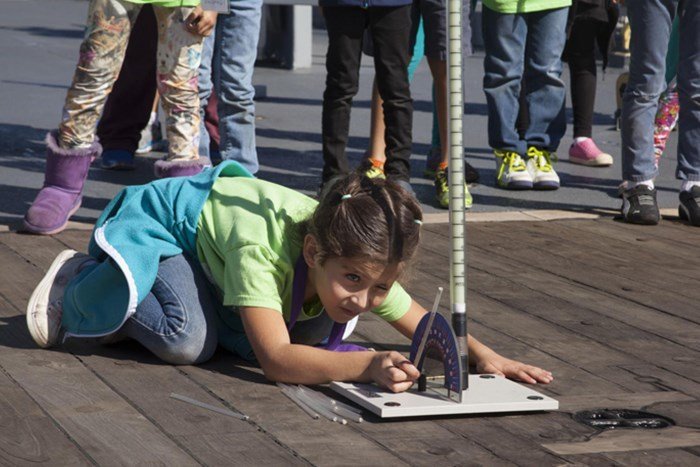
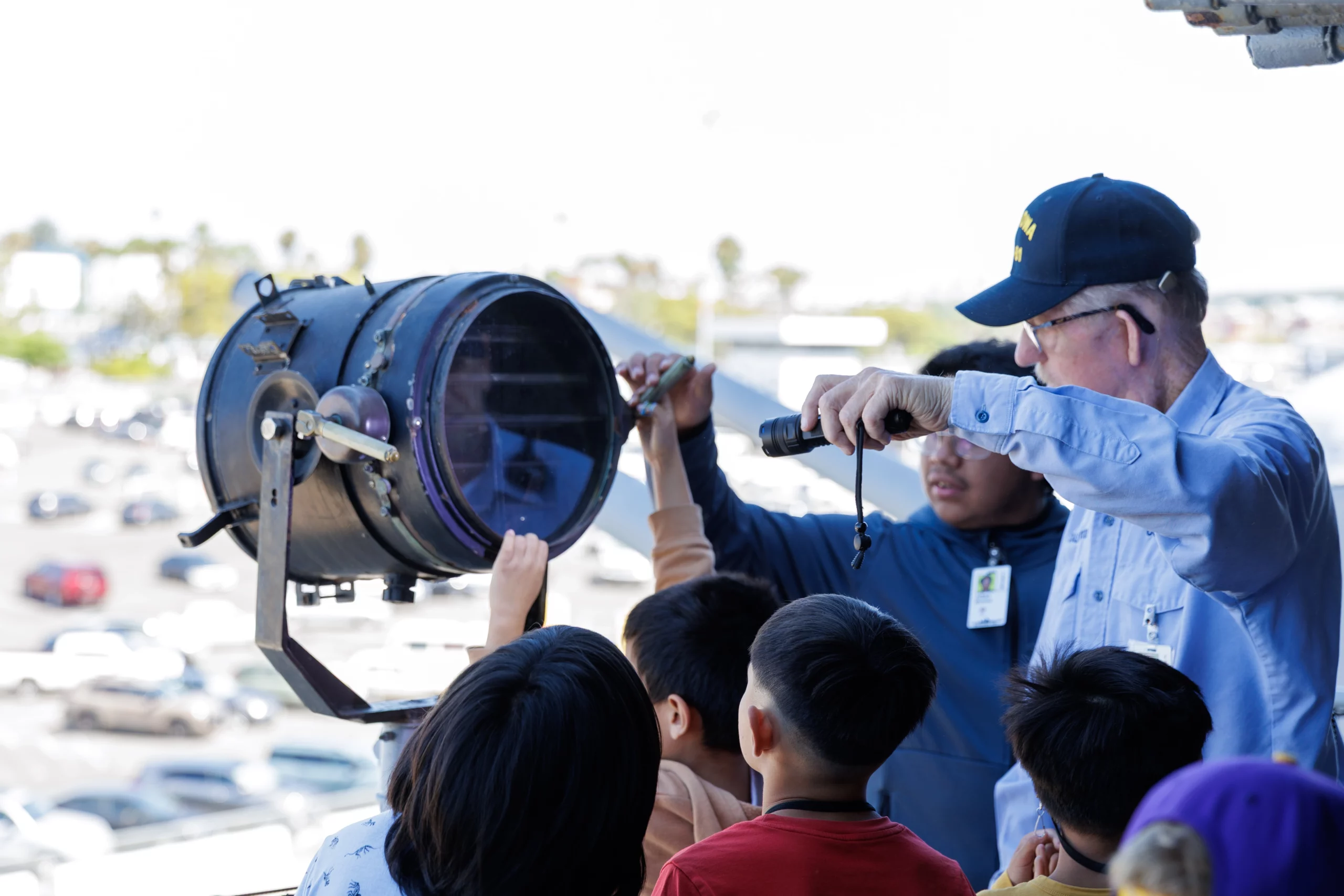
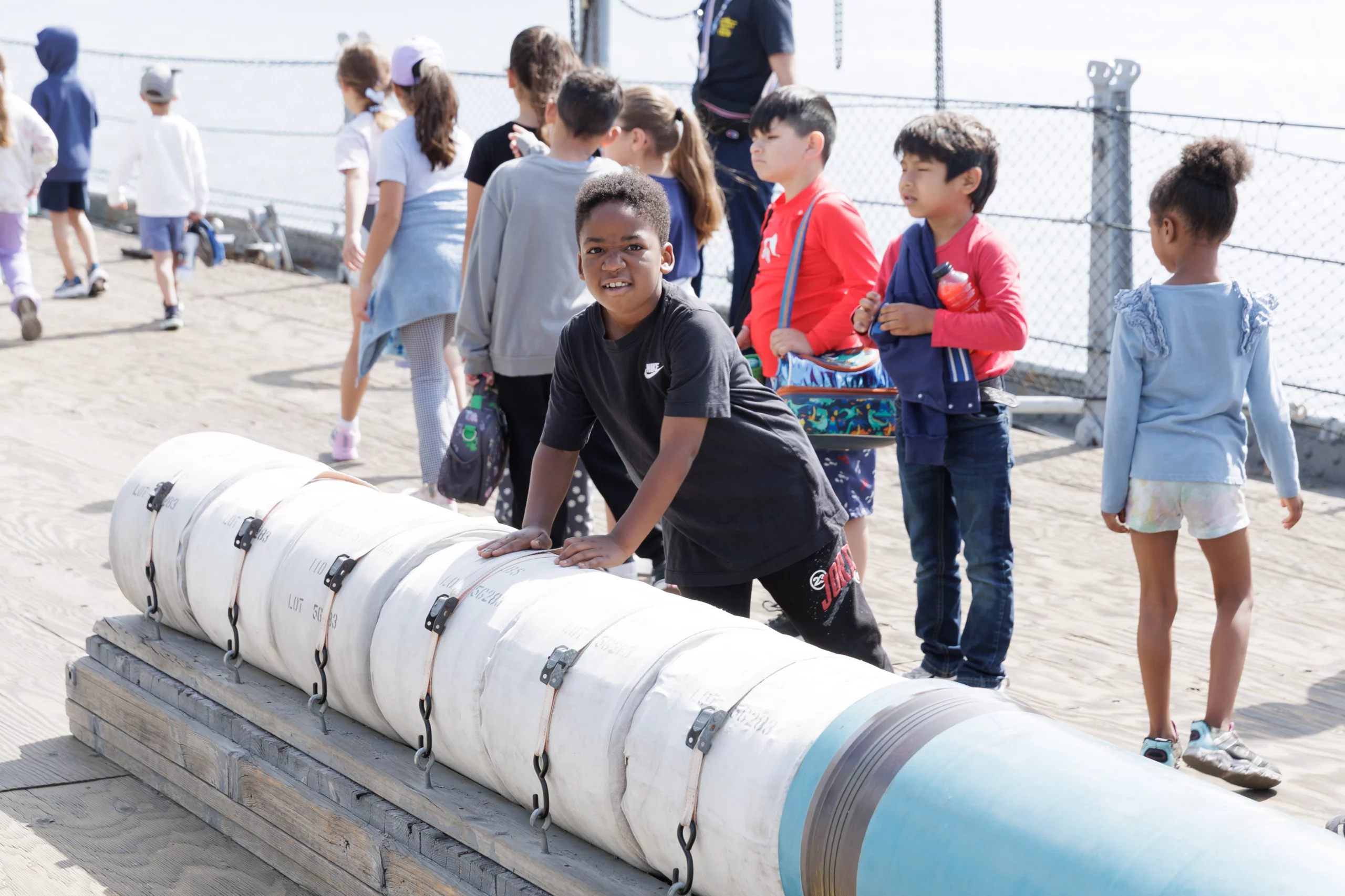
Students can stand beside machinery rather than simply look at a diagram of it. They can climb between decks and experience how the ship's layout affects movement. A watertight door can lead to a discussion about damage control. A steep ladder raises questions about design and space. Layers of pipe and cable reveal how many systems had to occupy the same finite environment.
Simple observations become useful questions.
Why are ladders so steep? Why are doors designed differently from those in a building? Why is machinery packed so tightly together? Why are certain systems duplicated? Why does the ship contain so many pipes? Why does weight matter so much?
The learning process begins with noticing something, asking why and investigating the answer.
That is one of the strengths of inquiry-based learning, and it happens naturally aboard a ship as complex as IOWA.
Can Students Learn From Battleship IOWA Without Visiting the Ship?
The educational value of Battleship IOWA is not limited to students who can travel to the Los Angeles Waterfront.
Virtual education programs and online resources allow teachers and students to use the ship as a case study for subjects including STEM, history, navigation, weather, buoyancy, communications and energy.
The essential educational asset is not simply the ability to walk aboard the ship. It is the collection of real-world questions the ship makes possible.
A teacher hundreds of miles away can still begin with: How does a steel ship this large float? How did sailors navigate across an ocean? How did steam become motion? Why does steel corrode?
The physical artifact may remain in Los Angeles, but the science, engineering, history and problem solving can travel much farther.
What Educational Experiences Does Battleship IOWA Offer Students and Schools?
Battleship IOWA can support learning across subjects rather than functioning only as a history field trip.
History teachers can use the ship to explore World War II, Korea, the Cold War, presidential history and technological change. Science teachers can focus on buoyancy, energy, waves, weather and materials. Engineering and technology classes can examine systems, design constraints and problem solving. Geography students can explore navigation and global maritime routes. Leadership programs can examine teamwork, responsibility and communication.
For some students and youth groups, that experience can extend beyond a daytime visit. Camp Battleship allows participants to spend the night aboard while combining ship exploration, maritime activities, teamwork, meals and sleeping in Navy-style racks.
An overnight changes the relationship with the ship. A bunk becomes something a student actually sleeps in. Passageways become routes they learn to navigate. The physical realities of shipboard life become easier to appreciate because students spend more time inside the environment.
Battleship IOWA also supports learning through school field trips, STEM and STEAM programs, virtual programs and educational resources designed around the ship and the maritime world.
The strongest educational experiences are not simply tours. They use the ship as the starting point for questions students and teachers want to explore.
What Is the Most Important Thing Students Can Learn From a Battleship?
A traditional classroom often begins with a subject. Battleship IOWA begins with a real object.
That difference matters because the real world does not divide itself neatly into school subjects.
A boiler can lead from physics into engineering. A navigation chart combines mathematics and geography. A sailor's bunk opens a discussion about social history. Corrosion on a steel surface can become chemistry. A container ship passing nearby can lead into economics, logistics and global trade.
The subjects overlap because the problems overlap.
Battleship IOWA is an extraordinary technological achievement, but technology did not design, build, operate or preserve itself. People did.
Engineers designed the systems. Shipyard workers built the vessel. Sailors learned how to operate it. Crews navigated, maintained machinery, communicated, prepared food, treated injuries and solved problems under demanding conditions. Decades later, another group of people preserved the ship and developed new ways for future generations to learn from it.
That continuity may be Battleship IOWA's greatest educational value.
Science explains why the ship floats. Engineering explains how its systems work. History explains why it was built and where it served. Geography explains the world in which it operated. Leadership helps explain how thousands of people worked together. The maritime economy shows why many of the same skills remain relevant today.
A battleship can teach students about the past.
Its greater value may be showing them how knowledge is used to solve real problems—and helping them begin to imagine what they might do with what they learn.
TICKETS
Experience the Life of a Sailor.
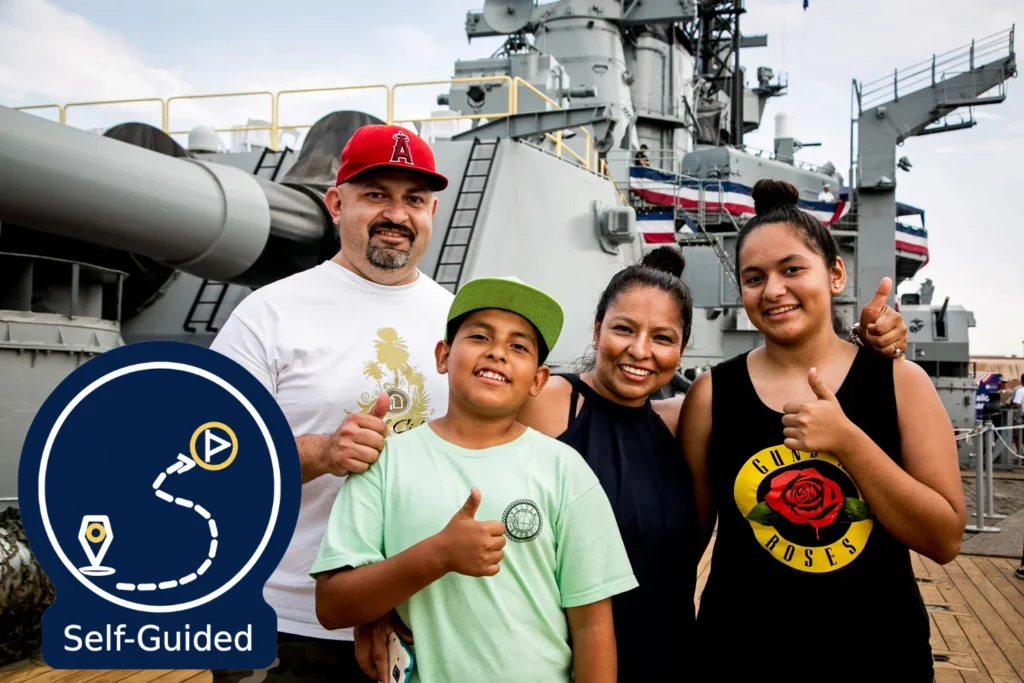
Life of a Sailor
Our general admission experience shows how sailors live, work, and serve.
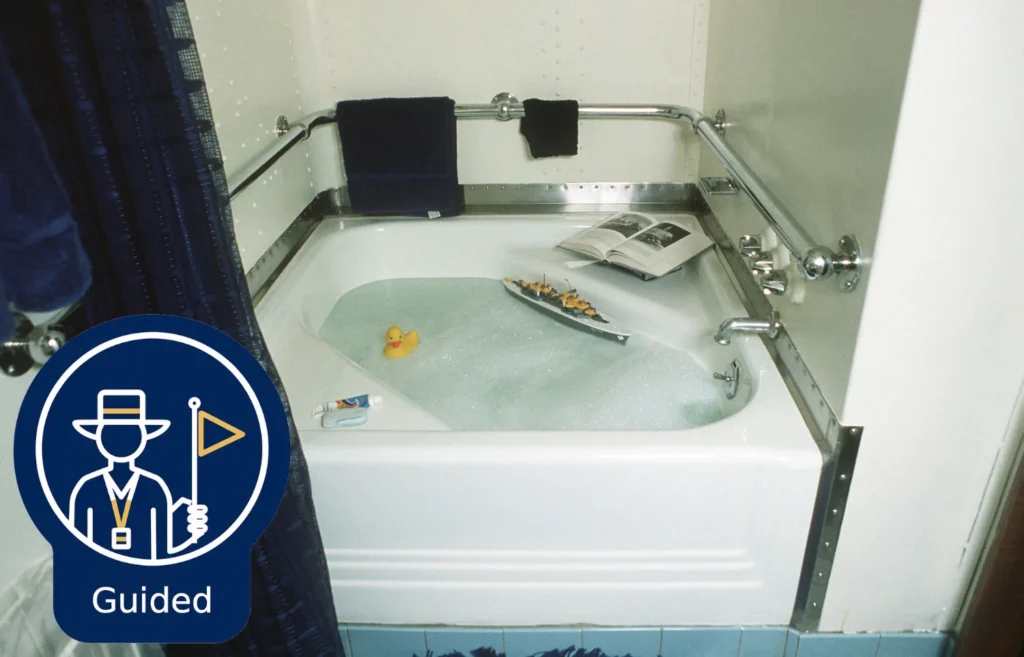
President’s Tour
It's November 1943, and Battleship IOWA is on a covert mission. President Franklin Delano Roosevelt and his entire staff are aboard, headed for top-secret […]
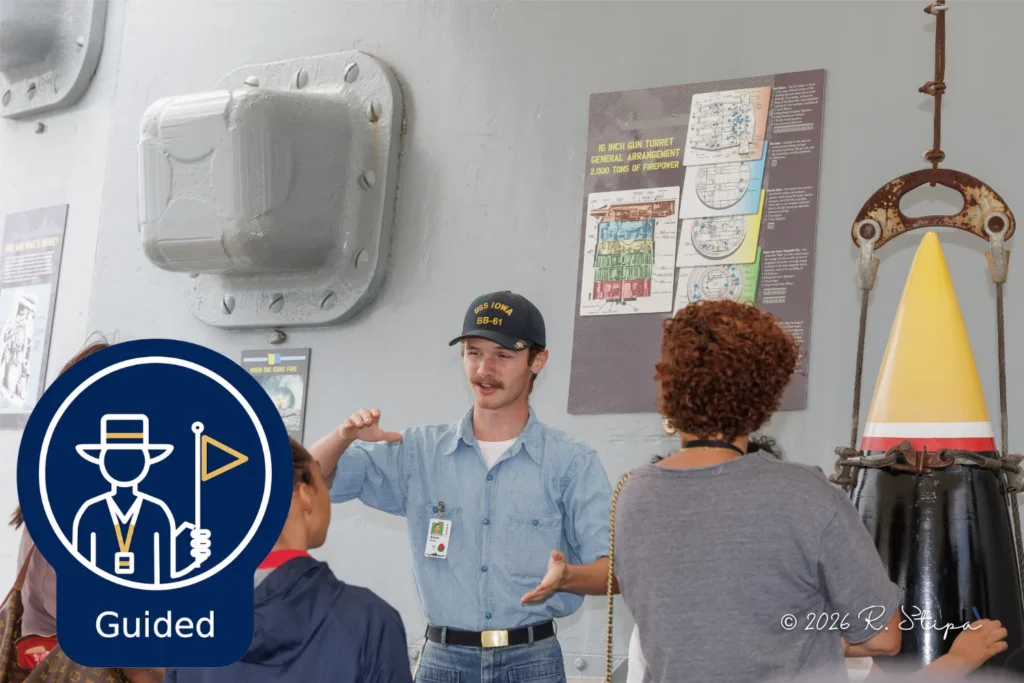
Overview Experience
The overview experience is a 90-minute crew-led tour that brings the ship's legacy to life through the stories of those who served, and those […]
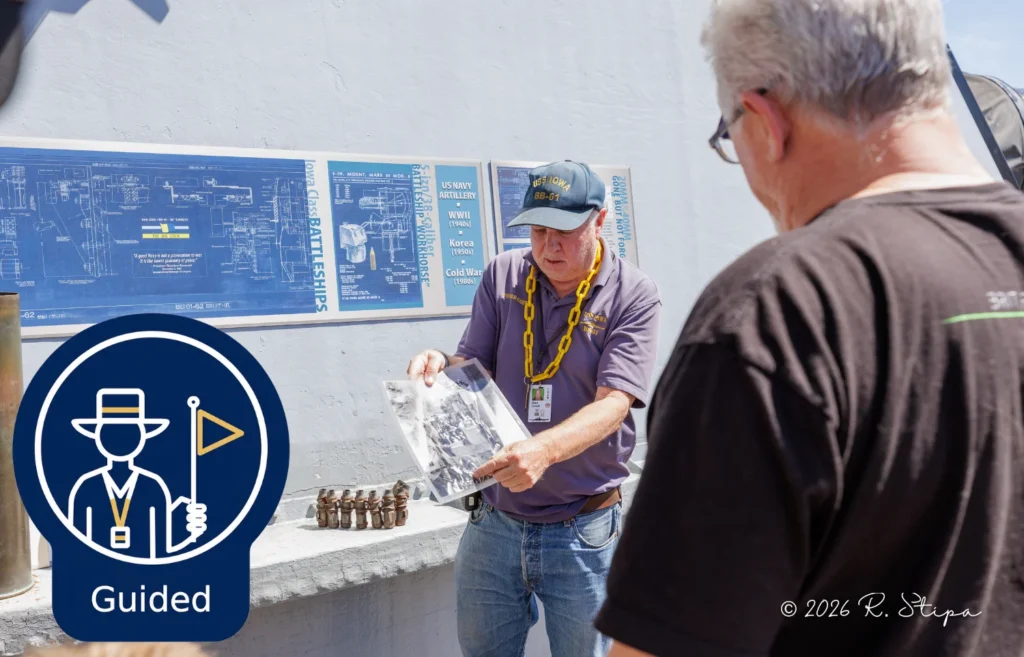
Gun Tour Experience
This exclusive, behind-the-scenes journey puts you inside the systems that made Battleship IOWA one of the most powerful warships ever built.
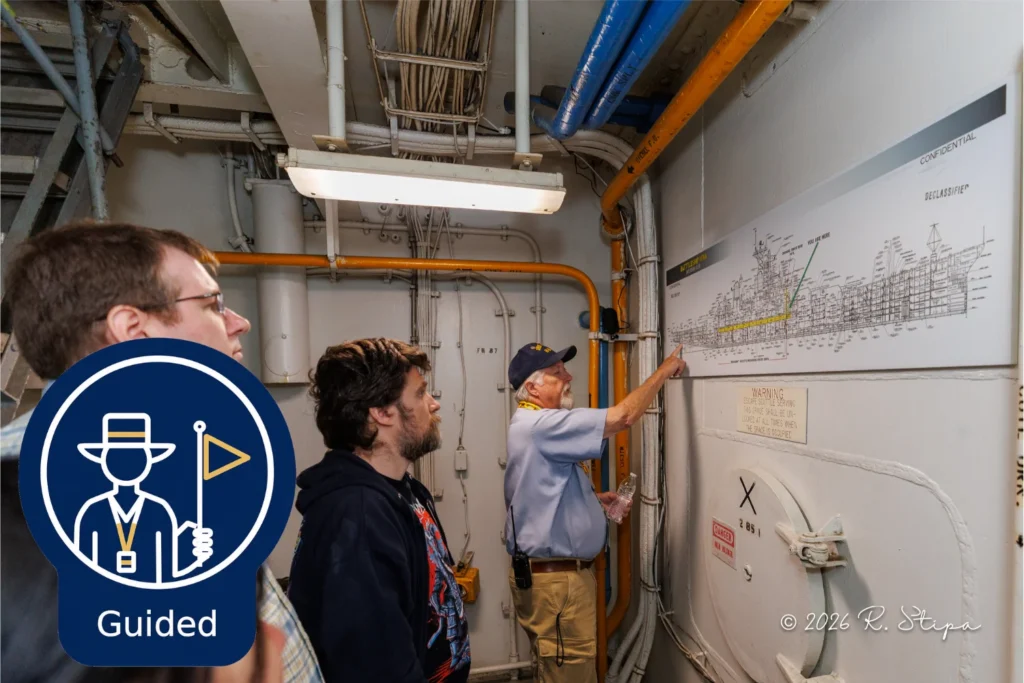
Engineering Tour Experience
The Engineering Tour takes you below into the hidden heart of Battleship IOWA, where eight boilers and four steam turbines once generated 212,000 shaft […]
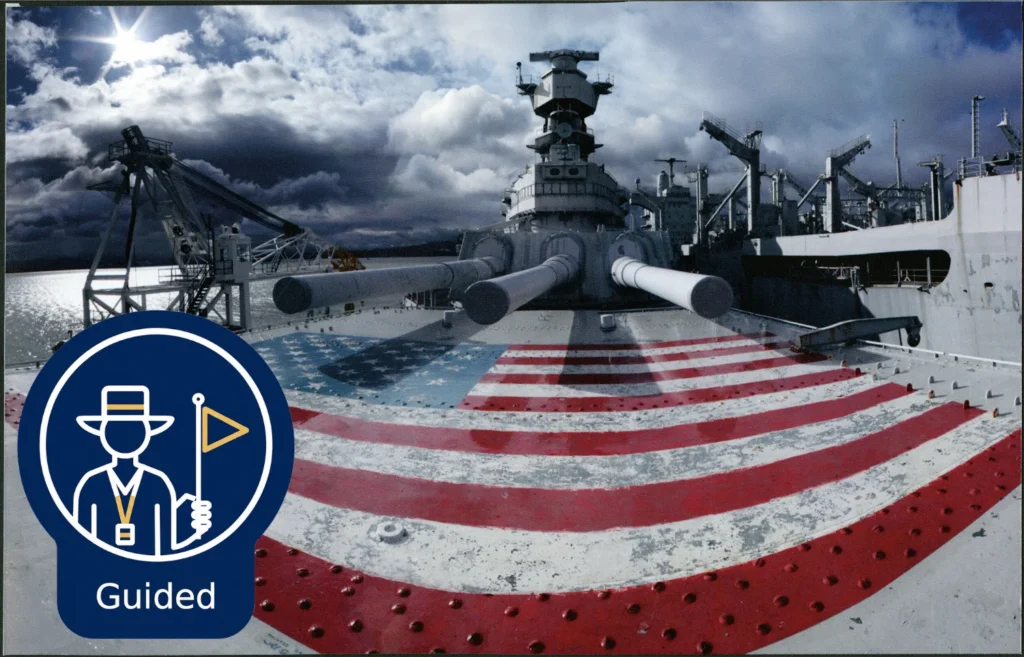
Escape the Fleet Adventure
In 2011, a small team raced against time to pull Battleship IOWA out of the Navy's reserve "ghost fleet" — or watch her be […]
Included with Admission
Life of a Sailor
Our general admission experience shows […]
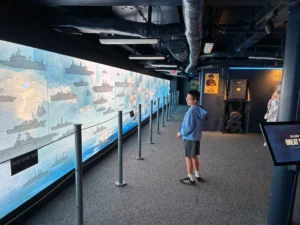
Great Ships
Explore the ships of America's […]
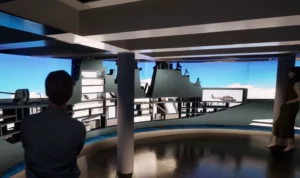
Ship Cutaway
See inside a Navy ship […]
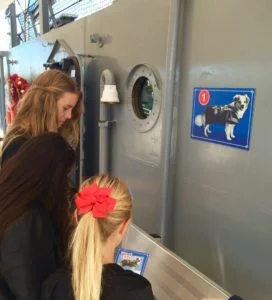
Vicky’s Scavenger Hunt
Find Vicky throughout your shipboard […]
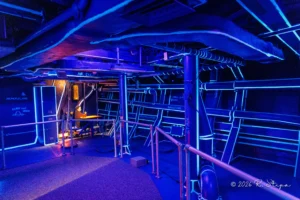
Living Blueprint
Immerse yourself in a blueprint […]
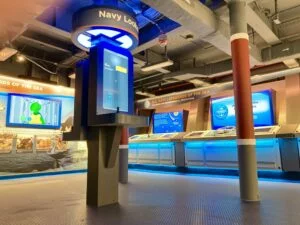
Stewards of the Sea
Explore how the Navy protects […]
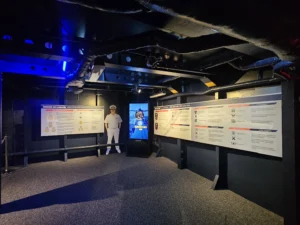
What’s My Rate?
Find the Navy career that […]
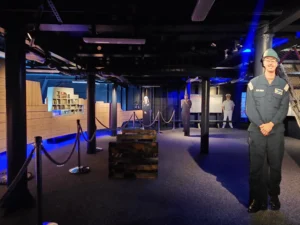
Every Sailor has a Story
Meet the people who serve.
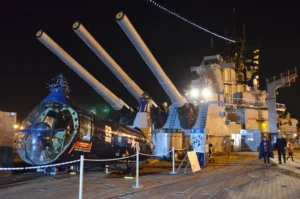
HUP-2 Retriever Helicopter
Korean War-Era HUP-2 Retriever Helicopter.
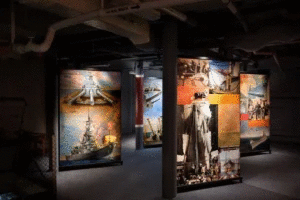
Sticks Art Gallery
Discover IOWA's story through art.
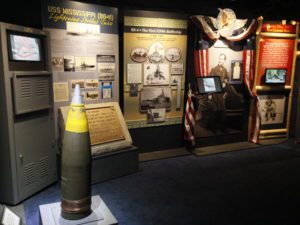
Gunnery Incidents
A dive into Navy gunnery […]
Limited time only!
Kids Board Free
In the all-new Life of a Sailor experience, kids become sailor recruits, building their skills, following the story of a famous sailor, and joining Vicky the Dog on a scavenger hunt through Battleship IOWA.
Kids board free with a paid adult.