
Life of a Sailor Visitor Guide
Explore Battleship IOWA at your own pace with the Life of a Sailor Visitor Guide. Follow the tour route through the ship’s spaces, systems, sailor stories, traditions, and experiences that reveal what life aboard a Navy ship is really like.
Welcome Aboard
From the pier, Battleship IOWA can seem almost too large to understand. She stretches 887 feet from bow to stern, nearly the length of three football fields. During World War II, she carries a crew of roughly 2,800. Her nine 16-inch guns can hurl shells weighing as much as 2,700 pounds over the horizon. Yet none of those numbers explains what makes the ship work.
A ship works because its crew makes it work. Sailors stand watches through the night, maintain machinery in heat and noise, navigate across oceans, prepare meals, repair uniforms, pass signals, load ammunition, print orders, clean compartments, and depend on one another in routine and danger. A warship carries weapons, but its crew turns steel into a living community built around shared responsibility.
This journey follows the ship as sailors experience it: a place to report aboard, a chain of command, a collection of jobs and watch stations, a home, and finally a mission. Most of the work you see happens in some form across Navy ships. When a story belongs specifically to IOWA—her presidential voyage, battle damage, crew, modernization, or unique history—we call it out.
The U.S. Navy commissions USS IOWA (BB-61), lead ship of the Iowa class, on February 22, 1943. She carries President Franklin D. Roosevelt across the Atlantic later that year, fights across the Pacific, enters Tokyo Bay at the end of World War II, returns to combat in Korea as Seventh Fleet flagship, and returns to active service in 1984 after a major modernization. The Navy decommissions her for the final time in 1990. The steel around you represents several eras of service—but sailors connect every one of them.
CAPTURE YOUR MISSION: Make memories as you follow the route. Great photo stops line the way: pose with a life ring, stand on the bow with Turrets 1 and 2 behind you, sit on the large 16-inch shell, take the bridge chair, try a bunk, and finish with Vicky. Take pictures, share your experience, and tag @battleshipiowa on Instagram.
General Characteristics
Ship: USS IOWA (BB-61)
Class: Iowa-class battleship
Commissioned: February 22, 1943
Decommissioned: March 24, 1949
Recommissioned: August 25, 1951
Decommissioned: February 24, 1958
Recommissioned: April 28, 1984
Final Decommissioning: October 26, 1990
Length: 887 feet, 3 inches
Design Displacement: 45,000 tons
Full-load Displacement: 58,000 tons
Top Speed: Approximately 33 knots
World War II Crew: Approximately 2,800 sailors
Main Battery: Nine 16-inch/50-caliber guns in three turrets
Projectile Weight: Up to 2,700 pounds
Main Gun Range: More than 20 nautical miles
Secondary Battery: 5-inch/38-caliber guns
Tomahawk Missiles: 32 missiles in eight armored box launchers after 1980s modernization
Harpoon Missiles: 16 anti-ship missiles
1. Report Aboard
Every sailor’s relationship with a ship begins at the brow. Yours does too.
Quarterdeck: Join the Crew
Main Deck • Starboard • Forward
Your first stop is the Quarterdeck, the ceremonial and controlled entrance to a Navy ship. Sailors report aboard through the brow, where watchstanders enforce customs, salutes, permissions, and accountability. Crossing this point means entering a working military community.
Treat this as your own reporting-aboard moment. You arrive as a visitor; from here, imagine joining the crew for the day. Learn the language, notice the work, and ask what each space requires from the sailors who use it.
The Bow: Scale, Seamanship, and Firepower
Main Deck • Forward
Walk forward and let the ship's scale reveal itself. Anchors, heavy chain, capstans, windlasses, lines, and fittings show the work of deck sailors and Boatswain’s Mates. Anchoring a ship this size demands mechanical power, seamanship, communication, and coordinated physical work.
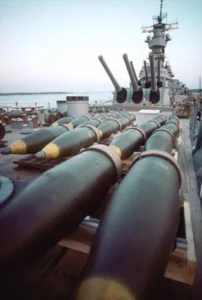
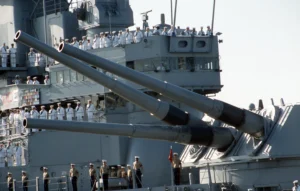
Then look aft toward Turrets 1 and 2. Each of IOWA’s three main-battery turrets carries three 16-inch/50-caliber guns. The guns dominate the view, but the real story is the team behind them: turret crews, powder handlers, projectile crews, fire-control personnel, electricians, machinists, and watch teams working across many compartments toward one result.
GO DEEPER: The Gunnery Tour / Career Track follows the weapon system below the visible guns into spaces such as the Aft Plot, the 5-inch magazine, the upper handling room, the gun house, and Turret 1. The Engineering Tour / Career Track goes deeper into the machinery that moves and powers the ship, including the anchor windlass, Broadway, Engine Room 4, Boiler Room 4, Oil Lab, Damage Control Central, Aft Steering, and—when available—the Machine Shop.
Naval architects designed IOWA for speed and firepower. Official Navy data lists her at 887 feet 3 inches long, with a design displacement of 45,000 tons and a top speed of about 33 knots. That combination lets this enormous battleship operate with the fast carrier forces that come to dominate the Pacific War.
LOOK AROUND THE HARBOR: Look beyond the ship as well. From the bow, you can watch the LA Waterfront changing around IOWA. On the starboard side of the bow, look toward the construction site for our new Freedom of the Seas Park and Pavilion. The project adds a large event venue that can host up to 550 guests for a seated meal. It creates a new setting for community events, celebrations, education, and programs beside Battleship IOWA. Across the waterfront, West Harbor transforms the former Ports O' Call area into a 42-acre district with dining, retail, recreation, public space, and entertainment. Farther down the Main Channel, look for historic Municipal Warehouse No. 1. Workers completed the six-story warehouse in 1917, and its rooftop water tower makes it one of the Port's most recognizable landmarks.
WATCH THE WATERWAY: Depending on the time of day, the harbor itself may become part of your tour. You may see a cruise ship arrive at or depart from the World Cruise Center on voyages along the Pacific Coast and to destinations such as Mexico, Hawaii, and Alaska. Watch for Los Angeles Fire Department Fireboat #2, Warner Lawrence, which operates nearby from Fire Station 112. The Port of Los Angeles describes it as one of the most powerful fireboats in the world. You may also spot Los Angeles Port Police marine patrol boats moving through the channel as officers help protect passenger, cargo, and vessel operations throughout the Port.
PHOTO OP: This is one of the best photo locations aboard. Frame yourself from the bow with Turrets 1 and 2 rising behind you, and take a turn sitting on the large 16-inch shell display for a sense of the scale of IOWA’s main battery.
Along the Port Side: A Ship Never Stops Needing Care
Main Deck • Port Side • Moving Aft
As you turn aft along the port side, notice the work a ship demands every day. Salt water, sun, vibration, heat, and constant use attack decks, fittings, paint, lines, and machinery. Sailors fight that wear continuously through inspection, cleaning, preservation, and repair.
The wooden weather deck connects you to traditions that reach back through centuries of naval service. Sailors scrub wooden decks with sandstone blocks in the practice known as holystoning, while marlinspike seamanship—line handling, knots, splices, and rigging—remains a foundational deck skill. Advanced technology never eliminates the basic work of caring for a ship.
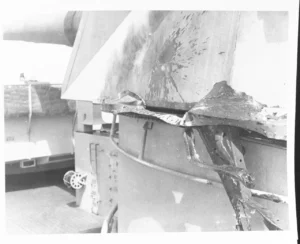
IOWA STORY — ENEMY FIRE: During a March 1944 bombardment of Japanese-held Mili Atoll, two 4.7-inch shells from a Japanese shore battery strike IOWA. The hits cause only minor damage, but they offer a rare reminder that even a heavily armored battleship can take enemy fire—and that sailors must be ready to respond immediately.
PORT IN ACTION: As you move aft on the port side, look across the Main Channel at an active working harbor. Container ships, cranes, tugs, trucks, and rail operations keep the Port of Los Angeles moving. The Port has ranked as the No. 1 container port in the Western Hemisphere for 26 consecutive years through 2025. If you are lucky, you may see a cargo ship enter port or head back to sea while tugboats assist it through the channel. The modern cargo port beside you shows how ships, people, security, and global connections continue to shape the waterfront.
PHOTO OP: This is one of the best photo locations aboard. Frame yourself from the bow with Turrets 1 and 2 rising behind you, and take a turn sitting on the large 16-inch shell display for a sense of the scale of IOWA’s main battery.
2. Learn the Chain of Command
A ship is a community, but it is also a command. The next spaces show how responsibility shapes daily life.
The Wardroom: Officers’ Country
Main Deck • Forward Interior
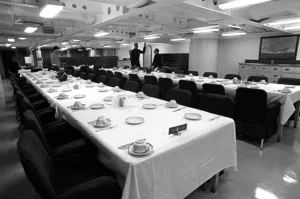
Step into the Wardroom, the professional and social center for commissioned officers. Officers eat, meet, prepare for watches, and discuss operations, engineering, navigation, gunnery, personnel, and the countless decisions required to keep a ship running.
The Wardroom shows how rank brings both authority and responsibility. Officers lead sailors, train their divisions, understand their equipment, and answer for their departments' readiness. Even a meal becomes part of the rhythm of leadership at sea.
Senior Officer Staterooms: Living at Work
Main Deck • Forward • “The Horseshoe”
Continue through the senior officer staterooms, an area sailors call the Horseshoe. These cabins give officers more privacy than enlisted berthing, but no one aboard truly leaves work behind. Department heads live only steps from the sailors, equipment, and spaces they lead.
That is one defining reality of life at sea: your workplace, home, dining room, community, and emergency station all travel together. When an alarm sounds, everyone is already at work.
Turret 2: Power and Responsibility
01 Level • Forward
As you climb beside Turret 2, the scale of the main battery becomes even more apparent. A single turret weighs roughly 2,000 tons and forms the visible top of a complex system that extends deep into the ship through gun rooms, handling spaces, magazines, electrical systems, and fire control.
IOWA’s armor and firepower are designed to help the ship fight and survive under attack. During a bombardment of Japanese-held Mili Atoll in March 1944, two 4.7-inch shells from a Japanese shore battery struck IOWA. The damage is minor, but the hits remind the crew that when the shooting goes both ways, armor, readiness, and damage control all matter.
This location also carries a solemn responsibility. On April 19, 1989, an explosion in Turret 2 killed 47 sailors. The tragedy remains one of the most painful chapters in IOWA’s history. As you pass, remember that people operate the ship’s power and accept the risks that come with service at sea.
Later in the museum route, a broader Gunnery Incidents exhibit examines accidents and lessons from naval gunnery history, including IOWA’s 1989 Turret 2 tragedy. Here, remember the 47 sailors and the shipmates who responded.
President / Captain In-Port Cabin: Command Meets History
01 Level • Starboard • Forward
From the self-guided route, look into the Captain’s In-Port Cabin. The commanding officer uses this space while the ship is in port. On IOWA, it also becomes part of presidential history in 1943 when President Franklin D. Roosevelt travels aboard on the first leg of his journey toward wartime meetings with Allied leaders.
Roosevelt’s voyage asks IOWA to serve as a warship, command platform, secure transportation, and temporary presidential residence at the same time. That mission helps establish the nickname “Battleship of Presidents.”
Only the guided President’s Tour enters the President’s / Captain’s Cabin. On that experience, you step inside the historic compartment and see the bathtub the crew installed to accommodate Roosevelt.
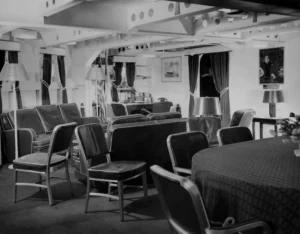
President’s & Admiral’s Veranda: A Front-Row Seat to History
01 Level • Forward
On November 14, 1943, Roosevelt watches battle drills from this part of the ship while IOWA crosses the Atlantic. During a simulated torpedo attack, escort destroyer USS William D. Porter accidentally launches a live torpedo toward IOWA. Porter breaks radio silence to warn the battleship; IOWA turns hard to starboard, and the torpedo detonates about 3,000 yards astern.
Roosevelt reportedly asks his Secret Service detail to move him where he can watch the approaching torpedo. The incident becomes one of the voyage's most famous stories, although later tales that William D. Porter’s entire crew is arrested are legend rather than documented fact.
3. Learn the Ship
A sailor learns a specialty, but also learns how the entire ship fits together. Weapons, engineering, communications, passageways, damage control, and watch stations depend on one another. The deeper Gunnery and Engineering career tracks let you follow those systems beyond the self-guided route.
5-Inch Gun Mount
02 Level • Forward
The twin 5-inch/38-caliber gun mount gives a battleship a versatile weapon against aircraft, surface ships, and targets ashore. What you see outside forms only one part of a system that reaches through handling rooms, magazines, hoists, fire control, and crew stations.
Below the mount, sailors in handling rooms and magazines move projectiles and powder upward through hoists. Inside and around the mount, Gunner’s Mates and fire-control personnel coordinate loading, aiming, and firing. Naval gunnery demands industrial teamwork across decks and armored bulkheads with precise timing and procedure.
GO DEEPER: The Gunnery Tour / Career Track follows this system into the 5-inch magazine, upper handling room, gun house, Aft Plot, and Turret 1.
GO DEEPER: The Gunnery Tour / Career Track continues through the 5-inch magazine, upper handling room, gun house, Aft Plot, and Turret 1.
Signal Deck: Voices Without Sound
03 Level • Forward
Step onto the Signal Deck and look up at the halyards. Before satellites and secure digital networks—and even when radio silence makes transmitting dangerous—ships still need ways to communicate.
Signal flags carry standardized meanings. Sailors use semaphore to spell messages and flashing lamps to send Morse code across the water when visual communication matters. On IOWA, the four-letter call sign NEPM identifies the ship across the fleet.
The lesson here is larger than flags: no mission works if people cannot communicate.
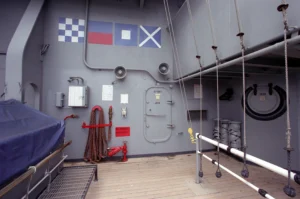
Signal Shelter
03 Level • Forward
Inside the Signal Shelter, the signalman of the watch supervises sailors working outside. This small space reveals a big Navy idea: every visible task depends on a larger watch team.
A lookout reports what is seen. A signalman sends what is ordered. A quartermaster keeps navigation records. An officer of the deck coordinates the watch. Procedures, supervision, repetition, and trust turn individual actions into shipboard readiness.
Admiral’s / Flag Bridge: Running a Fleet
03 Level • Forward Superstructure
A flagship carries more than its own captain and ship’s company. It also provides space for an embarked admiral and staff who coordinate other ships. IOWA includes those dedicated command spaces throughout her forward superstructure.
The Flag Bridge shows two layers of naval command. The captain and bridge team operate the ship, while an embarked fleet commander uses separate spaces and staff to direct a larger formation. IOWA served as Seventh Fleet flagship during her 1952 Korean War deployment, exactly the kind of mission this space supports.
4. Stand the Watch
Climb higher, and the ship becomes a place of information and decisions. From here, sailors watch the sea, maneuver the ship, communicate, track contacts, and defend against threats that change with technology.
Navigation Bridge: Where Orders Become Movement
04 Level • Forward Superstructure
On the Navigation Bridge, sailors turn a ship’s enormous size into controlled movement. The helmsman follows ordered courses, quartermasters plot position and keep navigation records, the officer of the deck supervises the watch, and lookouts scan the horizon. The captain can take command whenever the situation demands it.
IOWA’s speed matters. Naval designers created the Iowa class to operate with fast carrier task forces, and the ship’s powerful machinery can drive her at roughly 33 knots. Maneuvering a vessel nearly 900 feet long at that speed demands constant coordination, awareness, and discipline.
Notice the redundancy around the bridge and armored conning spaces. Warships assume systems can fail, so designers provide alternate ways to steer, communicate, observe, and keep fighting the ship.
PHOTO OP: Take the bridge chair and get your photo where sailors helped maneuver nearly 900 feet of battleship. Imagine the view with IOWA underway instead of secured to the pier.
PHOTO OP: Take the bridge chair and get your photo where sailors helped maneuver nearly 900 feet of battleship. Imagine the view with IOWA underway instead of secured to the pier.
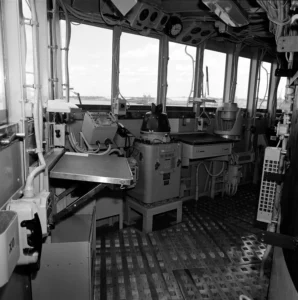
05 Level: See the Ship as a System
05 Level • Upper Bridge
From higher in the superstructure, you can see how observation becomes action. Fire-control directors, optical instruments, radar, communications, and command spaces turn information into decisions.
A battleship’s weapons only work when sailors can find a target, identify it, calculate a solution, communicate orders, and keep the equipment operating. The ship’s real power comes from linking people and systems together.
CIWS: Last Line of Defense
Upper Superstructure • Midships
Look for IOWA’s Phalanx Close-In Weapon System, or CIWS. The radar-guided 20 mm system automatically detects, tracks, and engages fast-moving threats that penetrate other defenses. The U.S. Navy still uses modern Phalanx variants today, making this another direct connection between IOWA’s Cold War modernization and the modern fleet.
Chaff and Decoy Launchers: Defending a Cold War Battleship
Upper Superstructure • Midships
By the 1980s, a battleship must defend against more than shells and aircraft. Anti-ship missiles can approach at high speed using radar or infrared guidance, forcing the crew to detect and react in seconds.
IOWA’s Mark 36 SRBOC launchers fire chaff and infrared decoys designed to confuse missile seekers and draw threats away from the ship. The launchers look small beside the gun turrets, but they represent a different kind of naval warfare built around sensors, electronics, countermeasures, and split-second reactions.
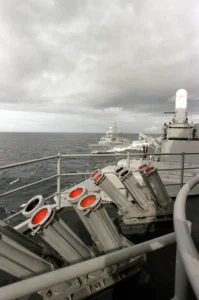

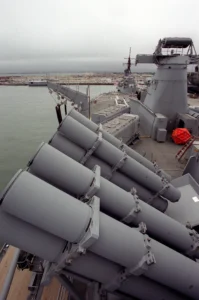
Tomahawk Battery: A 1940s Battleship Enters the Missile Age
Midships • Tomahawk Deck
When IOWA returned to service in 1984, eight armored box launchers gave her 32 Tomahawk cruise missiles, while the original 16-inch battery remained in place. The ship now combines World War II-era big guns with Cold War long-range strike technology.
The contrast makes IOWA remarkable: the Navy adapts a ship conceived before Pearl Harbor for missions more than four decades later. Sailors learn new procedures, electronics, maintenance routines, and ways of fighting. The U.S. Navy still operates modern Tomahawk variants today.
Harpoon Missiles: Fighting Beyond the Horizon
Midships • Missile Deck
Nearby, IOWA carries sixteen Harpoon anti-ship missiles designed to attack ships beyond visual range. Harpoon uses active radar guidance and low-level flight over the sea to reach targets the crew may never see with the naked eye.
Compare Harpoon with the 16-inch battery you saw at the bow. One system uses enormous guns and ballistic trajectories; the other uses a compact guided missile. The U.S. Navy still uses modern Harpoon variants today, another example of technology that connects IOWA’s Cold War service to the current fleet.
Aft Tomahawk Battery and 5-Inch Mounts: Old and New Firepower Together
Aft Superstructure
See two generations of naval weapons side by side. The 5-inch mounts reflect the ship’s World War II design, while the Tomahawk launchers show how the Navy adapts an older hull for missile-age missions.
The technology changes, but the ship still depends on sailors working across compartments as one system. Gun crews, magazine crews, fire-control teams, electricians, electronics technicians, and missile crews all connect to the same larger combat system.
5. Live Aboard
Now leave the weapons behind and enter the spaces that make a ship a home. Here, the battleship becomes most human.
Enlisted Berthing: Where the Crew Sleeps
Main Deck • Port Side • Aft
Enlisted sailors sleep in shared berthing compartments surrounded by shipmates from their divisions. Privacy stays limited, space stays precious, and the ship never truly becomes quiet. During World War II, IOWA carries a crew of roughly 2,800, making every square foot matter.
Sailors sleep around watch schedules. One group turns in while another prepares for duty. Red night lighting helps preserve night vision, while ventilation, machinery, footsteps, alarms, and shipmates create the constant soundtrack of life aboard.
Today, some of IOWA’s berthing compartments host overnight programs for youth and adults. Sleeping aboard cannot recreate wartime life—but it gives guests a small sense of what it means to make a bunk inside a steel ship your home.
TRY IT + PHOTO OP: Try lying in one of the visitor-accessible bunks and see how much personal space a sailor really has. It makes a great photo—and an even better way to understand why shipmates learn to live close together.
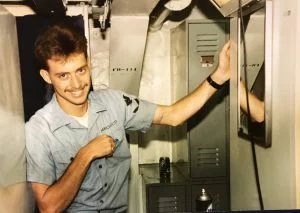
Second-Deck Berthing: A Floating City
Second Deck • Aft
More berthing makes a ship’s crew size easier to understand. A warship functions as a floating city where people sleep, eat, wash, learn, worship, exercise, relax, and work while crossing oceans.
Each rack represents a person with a job elsewhere on the ship. An engineer, signalman, cook, gunner, corpsman, yeoman, electrician, radar operator, or deck sailor can all return to similar crowded spaces at the end of a watch.
Command Master Chief Bobby Scott: Leadership from the Deckplates
Second Deck • Aft Crew Spaces
Command Master Chief Bobby Scott's stateroom introduces another side of leadership. Scott served for four decades in the Navy and became IOWA’s senior enlisted leader. A command master chief advises the commanding officer on the training, welfare, morale, readiness, and concerns of the enlisted crew.
His story highlights a Navy constant: leadership does not flow only through officers. Chief petty officers and senior enlisted leaders carry institutional knowledge, enforce standards, mentor sailors, and translate policy into the everyday reality of shipboard life.
The IOWA Crew: A Ship Is Her People
Second Deck • Aft to Midships
As you move through the crew exhibit, shift your attention from job titles to individuals. IOWA’s service spans World War II, Korea, and the Cold War, and thousands of sailors bring different technology, uniforms, missions, personalities, and memories to the same ship.
What generations of sailors share is dependence on one another. A ship’s reputation may center on speed, armor, and guns, but the crew creates the culture. Friendships, rivalries, jokes, routines, fears, pride, and professional skill are as much a part of the ship’s story as any battle.
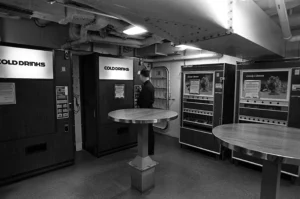
Hobby Area, Vending, and the Geedunk
Second Deck • Midships
Not every moment aboard is dramatic. Sailors need breaks, snacks, hobbies, and places to talk. The geedunk—a Navy term commonly used for a snack bar or sweets—offers small comforts between watches, while hobby spaces give sailors a chance to think about something other than the next job.
Those ordinary moments matter. Morale is not separate from readiness. A crew that works hard also needs ways to decompress, laugh, build friendships, and feel connected to life beyond the steel bulkheads.
Trash Incinerator: The Jobs Nobody Puts on a Recruiting Poster
Second Deck • Midships
A community of thousands produces waste every day. The trash incinerator reminds us that a ship depends on unglamorous work as much as dramatic work.
Sanitation, storage, disposal, cleaning, ventilation, fresh water, laundry, food service, and maintenance are easy to ignore until they stop working. A warship depends on sailors who handle the jobs most visitors never imagine when they picture naval service.
Bakery: The Smell of Home
Second Deck • Forward
Fresh bread and pastries transform the atmosphere of a steel ship. Bakers often work while much of the crew sleeps, preparing food for the next day and giving sailors on late watches something warm and familiar.
Feeding a large crew requires planning, storage, refrigeration, preparation, cooking, serving, cleaning, and then doing it all again. Food is logistics, but it is also morale.
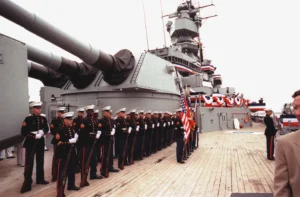
Marine Detachment: Security and Ceremony
Second Deck • Forward
IOWA also carries a Marine Detachment during her active service. Marines aboard battleships perform security, ceremonial, and shipboard defense duties. Their presence adds another community and another set of traditions to life aboard.
IOWA’s story includes more than Navy ratings. Sailors and Marines share the same hull, stand different watches, and contribute to a common mission.
Galley and Vegetable Prep: Feeding the Ship
Second Deck • Forward
The enlisted galley operates more like an industrial kitchen than a restaurant. Steam kettles, ovens, work surfaces, refrigeration, and constant preparation support meals on a scale that surprises most visitors.
In the 1980s, sailors could move through a faster line or choose a more traditional meal line. Behind both, crews clean and cut vegetables, move ingredients from storerooms, cook food in volume, wash trays, and sanitize the spaces.
On a long deployment, a good meal can break up the day. Holiday meals matter even more. Food adds structure to the day and helps a crew far from home feel like a community.
Forward Mess Deck: The Crew’s Dining Room
Second Deck • Forward
The mess deck gives sailors more than a place to eat. It brings people from different divisions together and breaks the day into recognizable moments between watches, maintenance, drills, and duties.
For a few minutes, the sailor operating a gun mount, maintaining an electrical system, standing signal watch, or working in the engine rooms could all share the same basic ritual: get a tray, find a seat, eat, talk, and get back to work.
6. Become a Sailor
The route now shifts from the ship and its crew to you. The National Museum of the Surface Navy asks a different question: after seeing how sailors live and work aboard ship, where might you fit?
Museum Transition: From IOWA to the Surface Navy
Second Deck to Third Deck
Up to this point, the ship shows you where sailors sleep, eat, communicate, lead, stand watch, and operate weapons. The museum sequence turns those observations into participation.
Life of a Sailor rests on a simple idea: people give ships life. Visitors can follow a real sailor’s story, practice core skills, explore Navy careers, and see how individual jobs connect to a crew and mission.
Sailor Roll Call: Every Sailor Has a Story
Third Deck • Museum
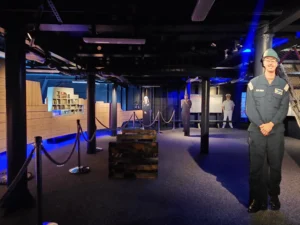
We often describe the Navy through fleets, ships, aircraft, and technology. Roll Call starts somewhere else—with names and people. Every sailor arrives with a life before the Navy: a family, hometown, interests, ambitions, doubts, and reasons for serving.
That human starting point matters. The uniform does not erase individuality. It brings individuals into a team where their choices and skills affect everyone around them.
Processing Days and Boot Camp: Becoming Part of a Crew
Third Deck • Museum
Naval service begins with transformation. Recruits learn language, customs, routines, physical standards, teamwork, and the expectation that someone else may depend on them.
In the Life of a Sailor experience, visitors encounter six shared skills: Customs and Courtesies, Seamanship, Navigation, Watchstanding, Communication, and Damage Control. The experience does not pretend a museum task equals a real Navy qualification. Instead, it lets you feel the difference between looking at a skill and trying it.
Great Ships: Welcome to the Fleet
Third Deck • Museum
Every sailor remembers a ship. Great Ships expands the story beyond IOWA with a 68-foot high-definition LED wall presenting more than 300 ships and many classes from the Surface Navy story.
Here, the battleship you have been walking through becomes one member of a much larger fleet. Destroyers, carriers, amphibious ships, support ships, and others become workplaces and homes to generations of sailors. The ship changes. The basic need for a trained crew does not.
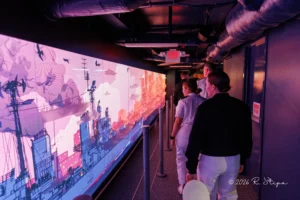
Living Blueprint: Learn the Shape of a Ship
Third Deck • Museum
A ship can feel confusing until you begin to understand its language: decks, frames, passageways, compartments, bulkheads, ladders, machinery spaces, magazines, berthing, command spaces, and service areas.
Living Blueprint helps turn the maze into a system. Think back over the route you just traveled. Naval architects do not place the wardroom, bridges, launchers, berthing, galley, and mess deck at random. They balance mission, protection, access, weight, and crew needs.
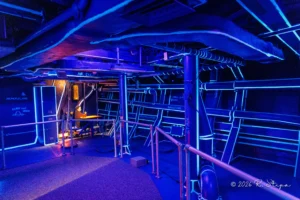
Ship Cutaway: See the Hidden City
Third Deck • Museum
The cutaway opens a modern surface ship from bow to stern and exposes what the outside hides. Machinery, weapons, living spaces, passageways, electronics, food service, storage, and damage-control systems all compete for room inside a hull.
This is the moment to look backward at IOWA and realize just how much of the ship you have not seen. Most of a warship’s life happens behind doors, below decks, and inside machinery spaces. The visible ship is only the beginning.
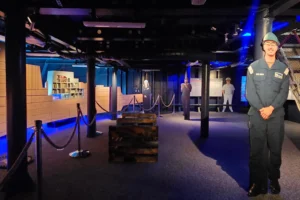
Mission Assignment: Find Your Place in the Crew
Third Deck • Museum
A sailor does not simply join the Navy and wander until something looks interesting. Training, qualifications, ratings, orders, and the needs of the service connect people to jobs and missions.
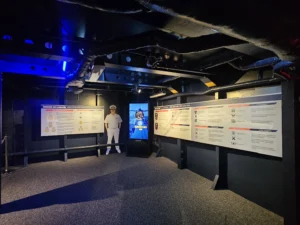
Mission Assignment asks you to think about your own abilities. Are you drawn to machinery, navigation, communication, logistics, leadership, technology, construction, or operations? A ship works because very different people bring different skills to the same mission.
Model Art Room: How Ships Become Memory
Third Deck • Museum
Models and artwork slow the journey down. Long after a ship leaves active service, people keep rebuilding it in miniature, painting it, photographing it, writing about it, and telling its stories.
That impulse forms part of naval heritage. People turn ships into containers for memory—of places visited, shipmates lost, friendships formed, and years of life spent at sea.
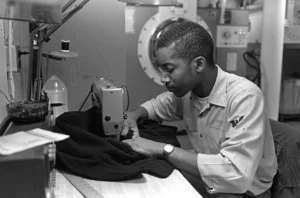
Tailor Shop: The Uniform Is Work Too
Third Deck • Service Spaces
Uniforms carry identity: rank, rating, name, service, and belonging. Aboard ship, they also wear out. Buttons come loose, seams fail, insignia change, and garments need alteration and repair.
The tailor shop shows another specialized job hidden inside a warship. Not every sailor fights the ship from a bridge or gun mount; many keep the community functioning in quieter ways.
The Brig: Standards and Accountability
Third Deck • Service Spaces
Life at sea depends on trust, and trust depends on standards. The Navy uses the brig as IOWA’s shipboard jail for short-term confinement after disciplinary action under military law.
This space reminds us that a tightly packed crew cannot function without rules, lawful orders, and accountability. Discipline is not separate from teamwork. It is one of the systems that allows people to live and work safely together under demanding conditions.
Laundry: Thousands of Uniforms, Every Week
Third Deck • Service Spaces
Imagine the laundry a crew measured in the thousands generates. Laundry crews collect, wash, dry, press, sort, and return uniforms, towels, and linens on an industrial scale.
Industrial laundry turns an ordinary household chore into a shipwide logistics problem. Like the galley, bakery, and incinerator, it reveals the infrastructure behind readiness. Sailors cannot stand a watch forever in dirty clothes any more than a ship can operate without fuel.
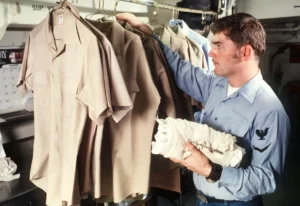
Print Shop: Information Before the Digital Age
Third Deck • Service Spaces
A floating community needs paperwork: notices, menus, forms, newsletters, instructions, and other printed material. Before email, shared drives, and digital displays, the print shop helps information move through the ship.
The space also reminds us that communication aboard a warship is not only tactical. A crew needs to know schedules, policies, events, procedures, and everyday news.
7. Service, Sacrifice, and Legacy
The route returns to the Second Deck and to memory: lives lost, traditions the crew preserves, and a ship that continues to serve by teaching.
Gunnery Incidents: Lessons from Naval History
Second Deck • Museum
This exhibit explores gunnery incidents across naval history and examines how accidents, equipment, procedures, training, and human decisions shape safer operations at sea. IOWA’s April 19, 1989 Turret 2 explosion, which killed 47 sailors, forms one important part of that broader story.
The stories show why navies study accidents as carefully as victories. Each incident carries technical lessons, but also human consequences for sailors, families, and shipmates.
Some material may not suit younger visitors. Families may choose to continue around the exhibit.
Battleships and Naval History: From Sail to the Missile Age
Second Deck • Museum
Travel from the Age of Sail to the missile age and see how warships evolve across generations. The exhibits place the battleship inside a much longer story of changing hulls, propulsion, weapons, sensors, communications, and tactics.
Sail gives way to steam. Broadside batteries give way to rotating turrets. Aircraft carriers extend the fleet’s reach, radar changes how sailors see the battlespace, and missiles push combat beyond visual range. Modern ships connect sensors, weapons, communications, and networks in ways earlier sailors could barely imagine.
Technology never stops changing, but the human requirement stays familiar: sailors still learn the ship, maintain the equipment, stand the watch, trust one another, and use powerful systems responsibly.
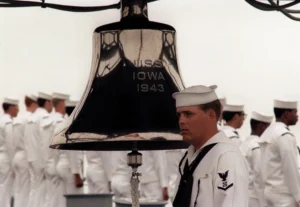
IOWA’s Bell: The Ship’s Voice
Second Deck • Museum
A ship’s bell looks simple beside the machines around it, yet sailors give it enormous symbolic weight. Bells mark time, support ceremonies, and help shape a ship’s identity.
IOWA’s bell connects the active warship to the museum you are walking through today. It reminds us that traditions often survive long after technology changes—and that objects become meaningful because generations of people attach memory to them.
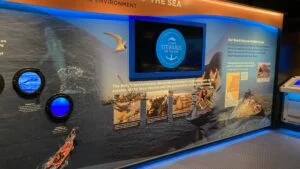
Navy Stewards of the Sea: Responsibility Beyond the Hull
Second Deck • Museum
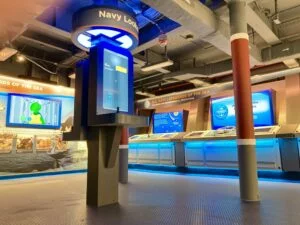
Earlier, you saw historical systems such as the incinerator. Here, the story turns toward the Navy’s continuing responsibility to operate at sea while protecting the environment in which it serves.
Modern stewardship includes how ships manage waste, fuel, hazardous materials, marine resources, training areas, and environmental compliance. The details change with regulations and technology, but the broader principle fits Life of a Sailor perfectly: every job carries responsibility beyond the immediate task.
Ship’s Store
Second Deck • Exit
The Ship’s Store marks the transition from the historic ship back to the present. Battleship IOWA survives because people choose to preserve her—as visitors, volunteers, donors, members, educators, and advocates.
The nonprofit Pacific Battleship Center operates the ship. Your visit supports our work to preserve the vessel and develop the National Museum of the Surface Navy so future generations can walk these same decks.
8. Return to the Waterfront
The final part of the route returns to open air, food, aviation, family, and the waterfront. You are still standing on history—but now the ship is also a place for today.
Vicky: IOWA’s Famous Mascot
Main Deck • Aft
Back on Main Deck, meet Victory—better known as Vicky—IOWA’s wartime dog mascot. Captain John L. McCrea brings Vicky aboard when IOWA commissions in 1943, and the crew gives the dog paperwork, a sailor uniform, and even a recruit swimming qualification. Today, Vicky guides younger visitors through a scavenger hunt of their own.
Vicky logs more than 205,000 miles aboard, becomes a Shellback after crossing the Equator, sleeps at the foot of President Roosevelt’s bed during the 1943 voyage, and is later credited as possibly the first American dog on Japanese soil after the war. His service record even includes going AWOL and a demotion—proof that shipboard personalities do not always walk on two legs.
PHOTO OP: You made it this far—get the picture. Pose with the large Vicky statue and add it to the story of your day aboard IOWA.
PHOTO OP: You made it this far, snap a photo. Pose with the large Vicky statue and add it to the story of your day aboard IOWA.
Vicky’s Doghouse Cafe
Main Deck • Fantail Area
Food follows you through the Wardroom, bakery, galley, and mess deck. At Vicky’s Doghouse, the story becomes present-day hospitality: a place to sit, eat, and talk about what you experience aboard.
Vicky’s Doghouse currently operates Friday through Sunday, although events and operations may change the schedule. Check museum information during your visit for availability.
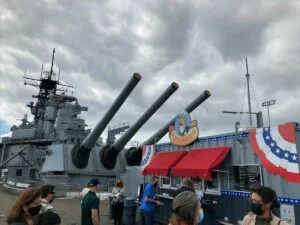
Fantail: From Aviation to Gatherings
Main Deck • Aft
Walk onto the Fantail and look across the open stern. Battleships use their aft decks for changing missions over time—from floatplanes and catapults to helicopters and other aviation support. On IOWA, the space traces that evolution from World War II into the Cold War.
Today, the Fantail serves a new mission as a place for ceremonies, programs, and private events. Preservation does not freeze the ship in time; new uses bring people aboard and keep IOWA connected to the surrounding community.
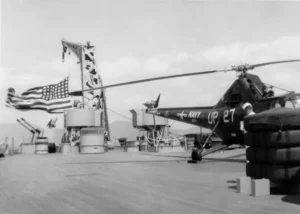
HUP-2 Retriever: Expanding What a Ship Can Do
Main Deck • Fantail
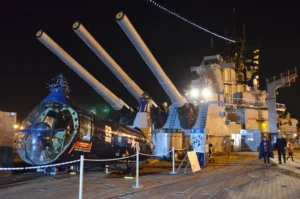
The HUP-2 Retriever represents the early years of shipboard helicopter operations. Piasecki develops the tandem-rotor helicopter, and crews use it for transport, rescue, medical evacuation, and other early Cold War missions.
Helicopters changed naval operations by letting ships move people, equipment, and assistance without a runway. They expand how sailors can reach beyond the hull—whether rescuing an aviator, moving cargo, or supporting a mission at sea.
Aft Starboard Brow
Main Deck • Starboard • Aft
Your route ends at the aft starboard brow. You will find the restrooms nearby.
Think back to where you began. At the Quarterdeck, the ship may look like one enormous object. Now you can see a collection of human systems: sailors standing watch, cooks feeding shipmates, officers making decisions, technicians maintaining equipment, deck crews handling lines, leaders mentoring sailors, and entire departments depending on one another.
That is the central lesson of Life of a Sailor. Ships matter because people give them life. You report aboard as a visitor. You return ashore carrying part of their story.
TAKE PICTURES. SHARE THE STORY: Your photos are part of the experience. Share your life ring, bow, 16-inch shell, bridge chair, bunk, Vicky, harbor views, and favorite moments from the ship. Follow @battleshipiowa on Instagram, post your pictures, and tag us so the IOWA community can see your mission aboard.
Go Deeper
The self-guided Life of a Sailor route is only the beginning. Optional guided experiences explore spaces and careers beyond the standard route.
President’s Tour: Follow IOWA’s secret 1943 presidential mission and enter the President / Captain’s Cabin, including the historic bathtub the crew installed for Franklin D. Roosevelt. Only this guided experience lets you enter the cabin.
Gunnery Tour / Career Track: Explore deeper into the systems behind the guns, including Broadway, Aft Plot, the 5-inch magazine, upper handling room, 5-inch gun house, and Turret 1. This experience can descend to the ship’s 4th Deck.
Engineering Tour / Career Track: Explore deeper into the machinery that moves, powers, steers, and protects the ship, including the Anchor Windlass, Broadway, Engine Room 4, Boiler Room 4, Oil Lab, Damage Control Central, Aft Steering, and—when operations allow—the Machine Shop. This experience can descend to the ship’s 4th Deck.
Overview Experience: Join a crew member for a story-rich guided journey through IOWA’s service and preservation while retaining access to the self-guided experience.
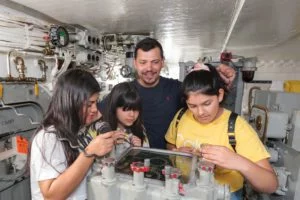
Your Story Continues
Explore Maritime Careers
Discover maritime career pathways in navigation, engineering, shipbuilding and repair, technology and defense, ports and logistics, ocean science, and more.
Share Our Story
Instagram - @battleshipiowa
Facebook - @pacificbattleship
TikTok - @battleshipiowa
Donate or Become a Crewmember
Battleship IOWA and the National Museum of the Surface Navy are operated by a privately funded 501(c)(3) nonprofit organization that relies on donations and volunteers to carry the mission forward.
Book an Event or Host a Group
Bring your own crew aboard Battleship IOWA for a private event, group visit, celebration, meeting, or special experience in one of the ship’s unique historic spaces.
TICKETS
Experience the Life of a Sailor.
Life of a Sailor
Our general admission experience shows how sailors live, work, and serve.
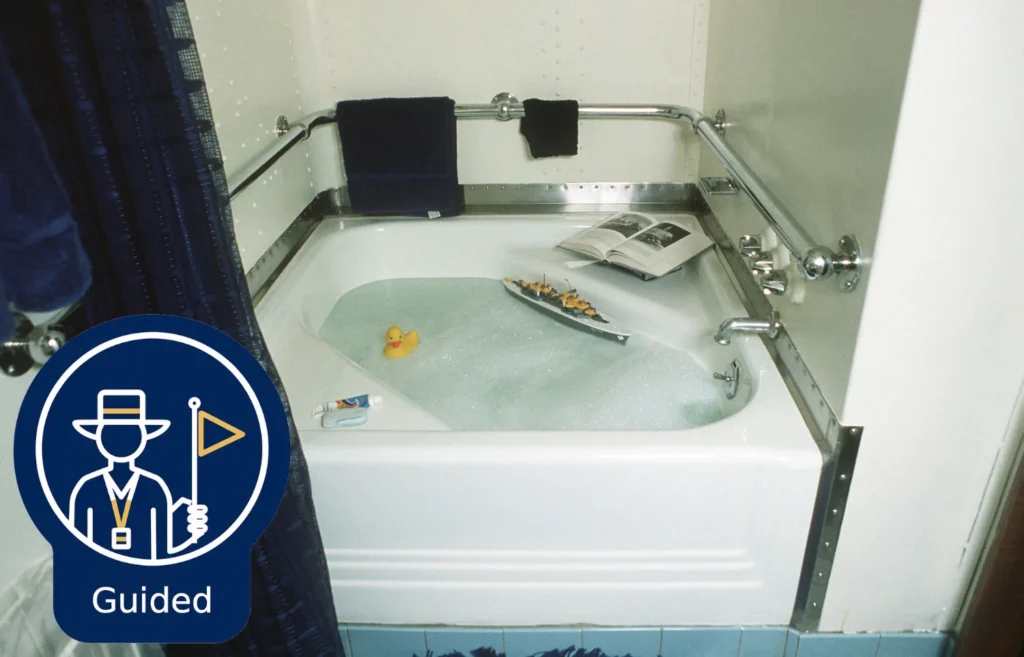
President’s Tour
It's November 1943, and Battleship IOWA is on a covert mission. President Franklin Delano Roosevelt and his entire staff are aboard, headed for top-secret […]
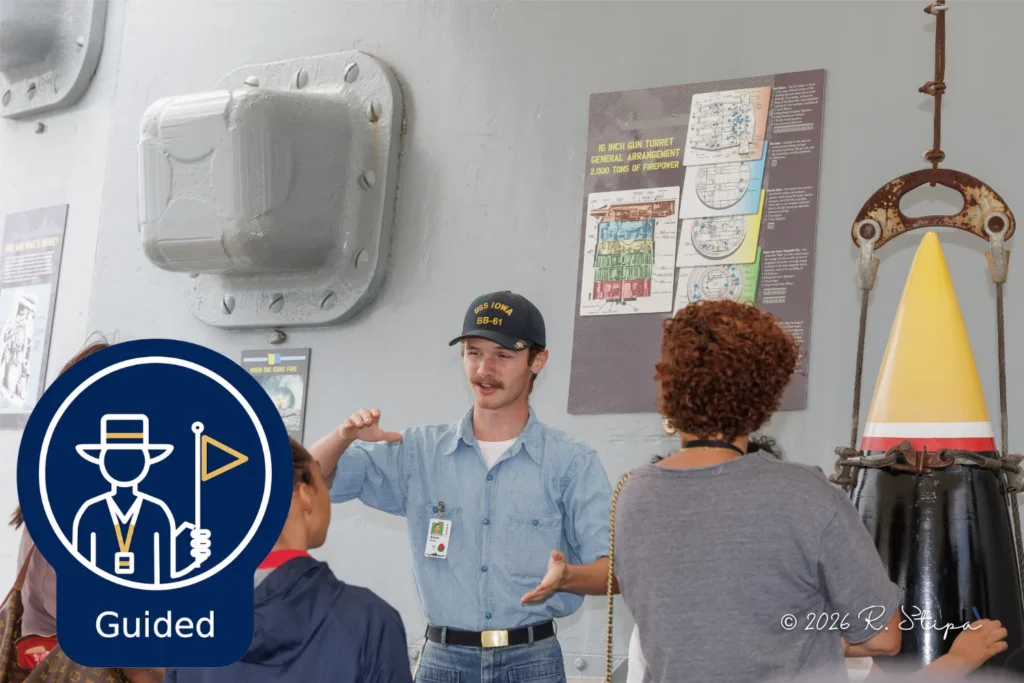
Overview Experience
The overview experience is a 90-minute crew-led tour that brings the ship's legacy to life through the stories of those who served, and those […]
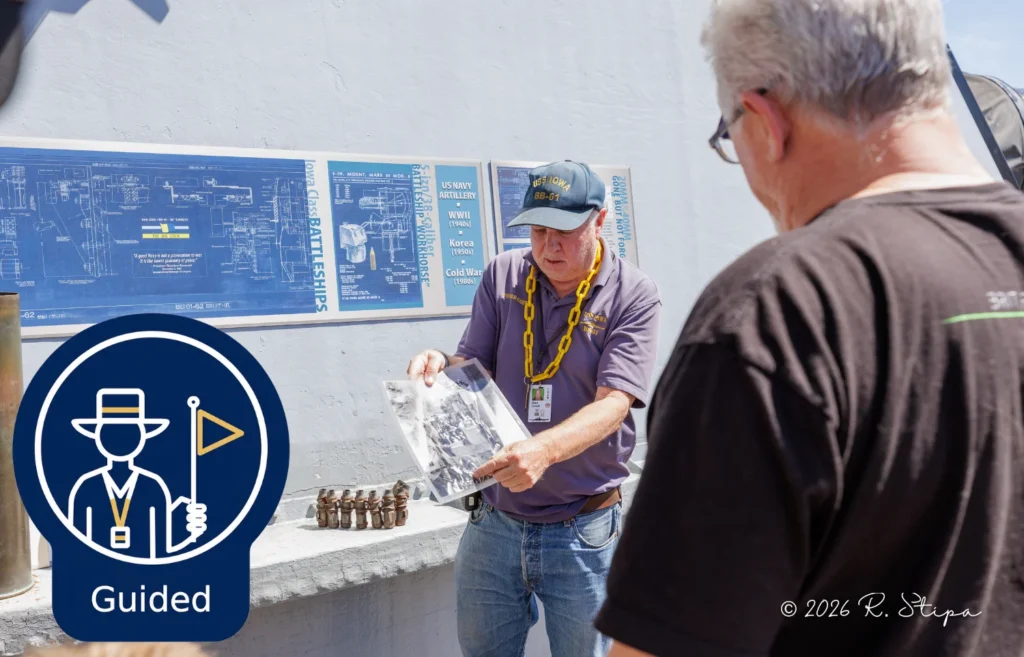
Gun Tour Experience
This exclusive, behind-the-scenes journey puts you inside the systems that made Battleship IOWA one of the most powerful warships ever built.
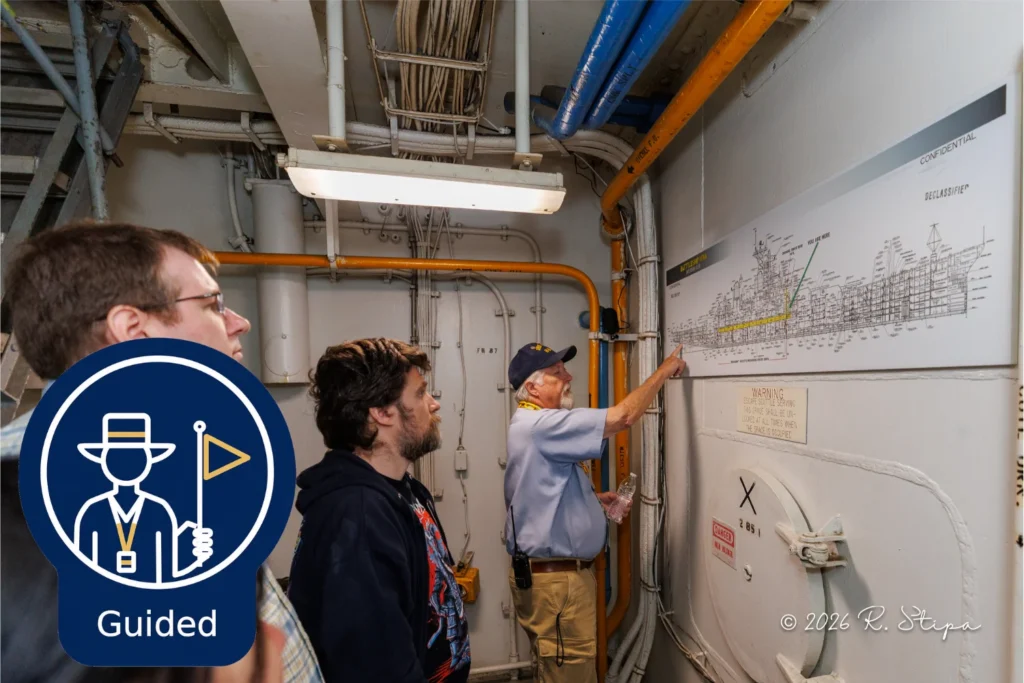
Engineering Tour Experience
The Engineering Tour takes you below into the hidden heart of Battleship IOWA, where eight boilers and four steam turbines once generated 212,000 shaft […]
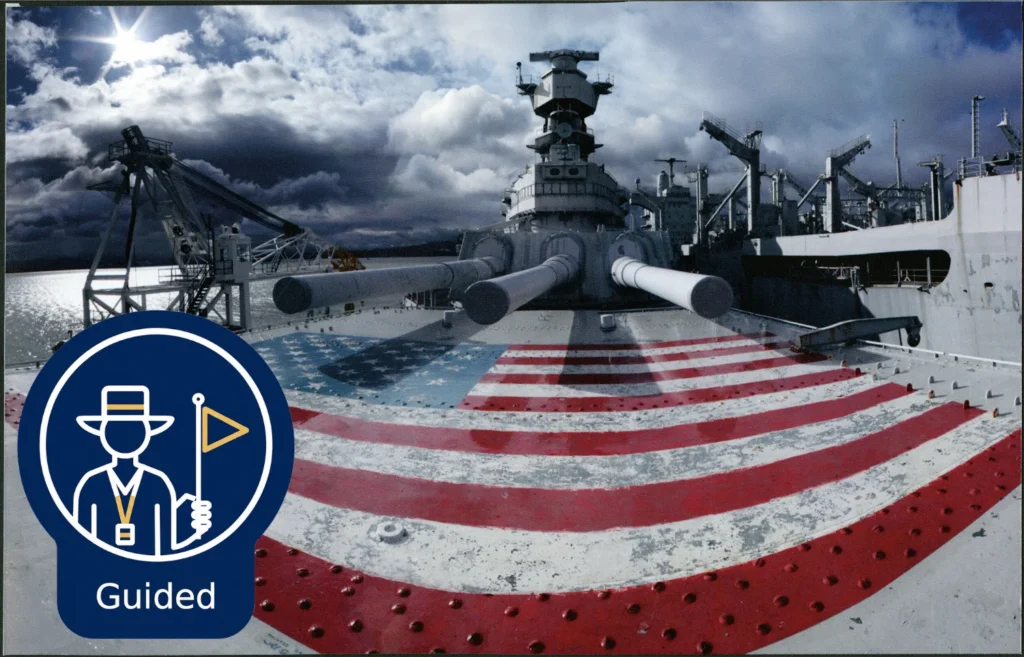
Escape the Fleet Adventure
In 2011, a small team raced against time to pull Battleship IOWA out of the Navy's reserve "ghost fleet" — or watch her be […]
Included with Admission
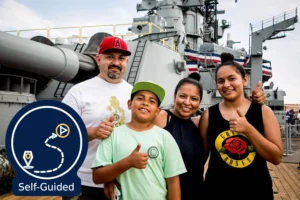
Life of a Sailor
Our general admission experience shows […]
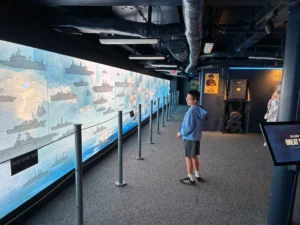
Great Ships
Explore the ships of America's […]
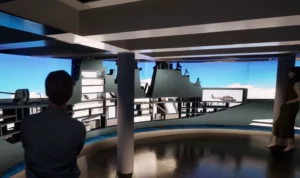
Ship Cutaway
See inside a Navy ship […]
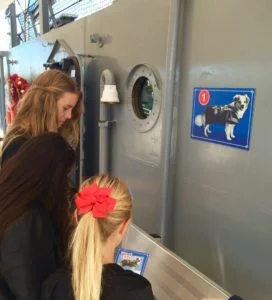
Vicky’s Scavenger Hunt
Find Vicky throughout your shipboard […]
Living Blueprint
Immerse yourself in a blueprint […]
Stewards of the Sea
Explore how the Navy protects […]
What’s My Rate?
Find the Navy career that […]
Every Sailor has a Story
Meet the people who serve.
HUP-2 Retriever Helicopter
Korean War-Era HUP-2 Retriever Helicopter.
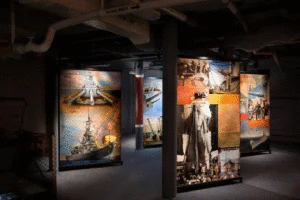
Sticks Art Gallery
Discover IOWA's story through art.
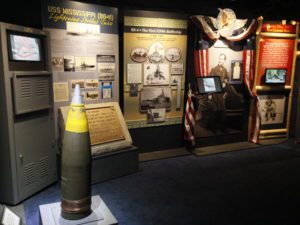
Gunnery Incidents
A dive into Navy gunnery […]
Translate This Guide
Use your browser’s built-in translation feature:
Chrome / Edge: Right-click the page and choose Translate to...
Safari: Use the Translate button in the address bar.
Mobile: Open your browser menu and choose Translate.
Limited time only!
Kids Board Free
In the all-new Life of a Sailor experience, kids become sailor recruits, building their skills, following the story of a famous sailor, and joining Vicky the Dog on a scavenger hunt through Battleship IOWA.
Kids board free with a paid adult.