Letters Home
Through writing “Victory Mail” (V-Mail) and role play, students learn how members of the military communicated with their family at home.
Grades: 4,5,6,7,8
Disciplines: Social Studies, Reading
Vocabulary
Distribute a single index card labeled with one of the following vocabulary words to each student. Have the students write their own definitions of the word they have been given. Collect the cards and sort them according to the word. Read and discuss the definitions generated by the students and then create a class definition of each. (Standard definitions from Webster’s online dictionary have been provided for reference.)
| Civilian | One not on active duty in the armed services or not on a police or firefighting force |
| Citizenship | Membership in a community |
| Civic Responsibility | Responsibilities related to citizenship, or community affair. |
| Home front | The sphere of civilian activity in war |
| Patriotism | Love for or devotion to one’s country |
| Victory | Success in a struggle against difficulties or an obstacle |
Victory Mail
Victory Mail, more commonly known as V-Mail, operated during World War II to expedite mail service for American armed forces overseas. Moving the rapidly expanding volume of wartime mail posed hefty problems for the Post Office, War, and Navy Departments. Officials sought to reduce the bulk and weight of letters, and found a model in the British Airgraph Service started in 1941 that microfilmed messages for dispatch.
V-Mail used standardized stationery and microfilm processing to produce lighter, smaller cargo. Space was made available for other war supplies and more letters could reach military personnel faster around the globe.
This new mode of messaging launched on June 15, 1942. V-Mail assisted with logistical issues while acknowledging the value of communication. In 41 months of operation, letter writers using the system helped provide a significant lifeline between the frontlines and home
“The Post Office, War, and Navy Departments realize fully that frequent and rapid communication with parents, associates and other loved ones strengthens fortitude, enlivens patriotism, makes loneliness endurable, and inspires to even greater devotion in the men and women who are carrying on our fight far from home and friends. We know that the good effect of expeditious mail service on those of us at home is immeasurable” Annual Report to the Postmaster General, 1942
Letter Writing in World War II
For members of the armed forces the importance of mail during World War II was second only to food. The emotional power of letters was heightened by the fear of loss and the need for communication during times of separation. Messages from a husband, father, or brother, killed in battle might provide the only surviving connection between him and his family. The imminence of danger and the uncertainty of war placed an added emphasis on letter writing. Emotions and feelings that were normally only expressed on special occasions were written regularly to ensure devotion and support.
Military personnel felt the most connected to home through reading about it in letters. Civilians were encouraged to write their service men and women about even the most basic activities. Daily routines, family news, and local gossip kept the armed forces linked to their communities.
Wartime romances adjusted to long distances and sweethearts and spouses separated by oceans used mail to stay in touch. Couples were married on furlough and babies were born while their fathers were away at the battlefront. Letters kept America’s troops informed about home life and detailed accounts allowed them to be in the war and have that critical link back to their families. Others wrote to kindle new relationships and fight off the loneliness and boredom of wartime separation.
Mail played a significant role in maintaining morale on the battlefront and at home, and officials supported that role by working to ensure mail communications during wartime. V-Mail service could ensure this communication with added security and speed. The Office of War Information and the Advertising Council worked with commercial businesses and the community to spread the word about this new service and its benefits.
V-Mail was promoted as patriotic with advertisements emphasizing contributions to the war effort, such as saving cargo space and providing messages to lift spirits. To allay the fears and misconceptions of would-be V-Mail writers, news reports explained how the letters were processed and sped to military personnel.
Using V-Mail
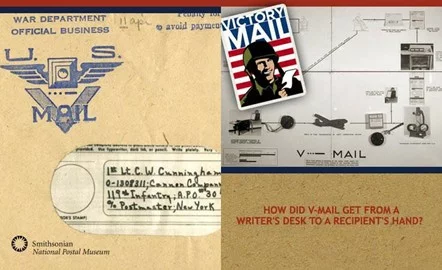
V-Mail letter sheets were designed to make the microfilming process easy. The distinguishing marks and uniform size of V-Mail stationery helped workers gather the folded letter sheets for their special processing. All sheets were set to standard dimensions, weight, grain, and layout.
The materials were produced by the Government Printing Office as well as printing and stationery firms that had been issued permits by the Post Office Department. Multiple suppliers were used to get the V- Mail forms to the people quickly.
The Post Office Department provided customers with special stationery for free. Correspondents could obtain two sheets per day from their local post office. Others opted to purchase the materials that were readily available in neighborhood stores.
V-Mail stationery functioned as a letter and envelope in one. Once the sender had completed her message, she put the recipient’s and return addresses at the top and then folded the sheet into a self- mailing piece. This set of addresses was essential to the final stages for delivery because only this side was reproduced from microfilm to photographic print.
The sender repeated addresses a second time on the opposite side of the sheet. This set, on the “envelope” side of the form, was used to carry the mail along its first stage of the journey from a mailbox to a processing center.
V-Mail was not developed to replace standard mail, but rather it was to be supplemental and its use was optional. Postal and military officials encouraged the use of V-Mail because it was specifically designed to meet both shipping and mail needs with the goals:
- To reduce the weight and bulk of mail to and from the armed forces
- To save transportation space for vital war
- To provide the most expeditious possible dispatch and handling of
Historical “Role Play” and Letter Writing
Have the students imagine themselves as a young person living onboard the USS Iowa in 1945. Then, using the V-Mail form (https://postalmuseum.si.edu/VictoryMail/images/vmail-FORM.pdf), students will write a letter to your family back home telling what it is like to serve aboard the USS Iowa in a time of war.
The V-Mail process could be explained as one of the many new technological developments in 1945.